April 22, 2026
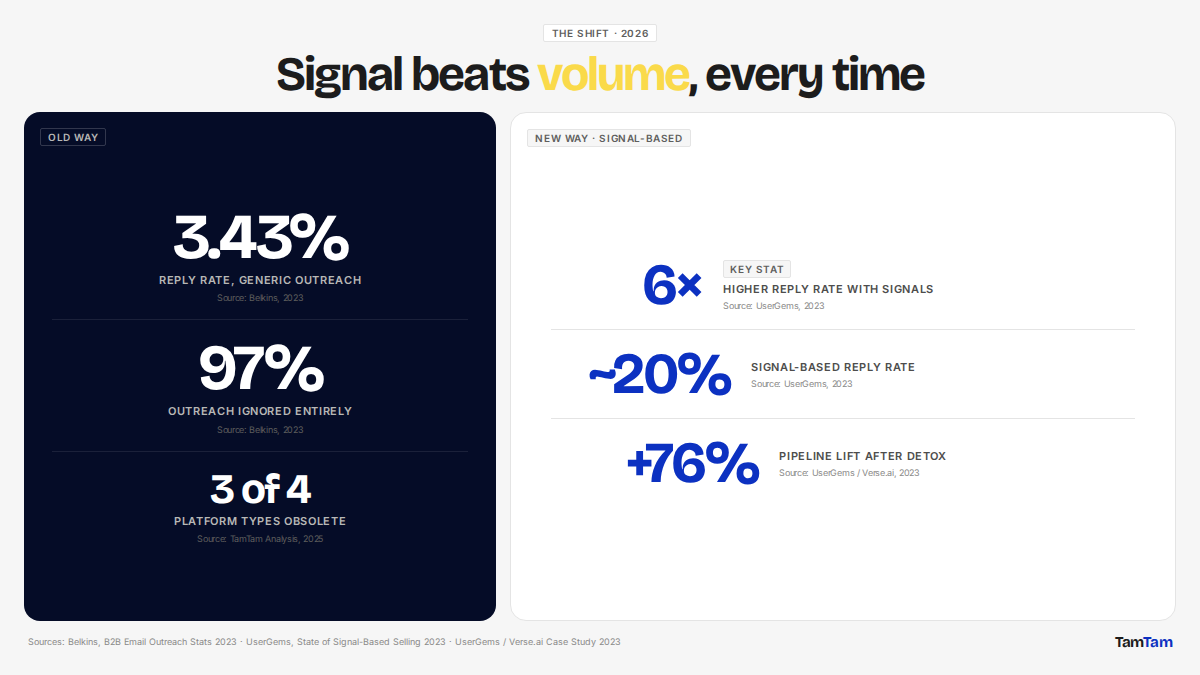
The hunt for the 'best' prospecting platform is a distraction from the real problem: your team's addiction to volume-based outreach. This flawed strategy yields a pathetic 3.43% reply rate, yet most platforms are designed to fuel it with vanity metrics. The only approach that works is Signal-Based Selling, which targets buyers showing active intent for reply rates 6x higher. It's time to stop comparing tools and start comparing the underlying philosophies to build a pipeline that actually works.
Let’s be honest. You’re here because your pipeline feels thin, your reps are burning out, and the pressure from the board is mounting. So you do what every sales leader does: you go looking for a new tool. A "magic platform" that promises to fix everything.
This is a trap.
The problem isn't the tool. It's the underlying belief that more activity equals more pipeline. This is a deeply human flaw called the "Action Bias" : our compulsion to do something, even if it's useless, just to feel in control. Your current sales tech is designed to feed this bias. It gives you beautiful dashboards showing thousands of emails sent, calls dialed, and tasks completed. It makes you feel productive. But a tool is only one input into pipeline generation; buy the wrong philosophy and the whole engine misfires.
But it’s an illusion. You’re just getting better and better at doing the wrong things, faster.
Generic, volume-based outreach now has an average reply rate of just 3.43%, according to a 2023 study by Belkins. That means for every 100 emails your expensive SDRs send, 97 are effectively screaming into a void. You’re paying people to fail 97% of the time, burning your brand and your Total Addressable Market (TAM) in the process.
Buying a new platform to optimize this broken process is like buying a faster engine for a car with no wheels. You'll make a lot of noise, burn a lot of fuel, and go absolutely nowhere.
Instead of a meaningless "Top 10" list of tools that all do the same thing, we’re going to dissect the four fundamental philosophies of prospecting platforms. Three of them are crutches for a dying strategy. One of them is the future.
Sales leaders pour millions into new platforms every year, and most of those investments fail to move the needle on pipeline. Why?
Because the platforms reinforce a flawed assumption: that the bottleneck is execution speed. So you buy faster tooling. More dialers. More automation. You hand your team a Ferrari with no destination and reward them for how fast they're driving.
The bottleneck isn't speed. It's relevance.
Buyers today receive 100+ outreach attempts per week. Most are template-based, mistimed, and irrelevant. Their default response is to ignore everything that doesn't immediately resonate with what they're working on right now. Your reps aren't being filtered out by spam detection. They're being filtered out by attention scarcity, by pattern-matching against the noise.
A new platform won't fix that. Only a different philosophy will. And there are exactly four philosophies competing in this market, three of which actively make the relevance problem worse.
This is the classic Sales Engagement Platform (SEP). It’s designed to do one thing exceptionally well: automate massive outreach sequences across email, phone, and social media. It’s a digital assembly line for sales touches.
Who it's best for: High-volume, low-ACV (Annual Contract Value) sales teams where deep personalization is mathematically impossible. Think transactional B2B sales where the goal is to churn through leads as quickly as possible, and rep attrition is just a cost of doing business.
Strengths:
Weaknesses:
Verdict: The Volume Cannon is a high-performance engine for driving your sales team straight off a cliff.
This category includes all the data and contact providers. Their job is to give you a massive, searchable list of companies and people : the raw material for your prospecting efforts. It's the "who."
Who it's best for: Any team that needs to build a foundational list of target accounts and contacts. It's a non-negotiable part of a modern tech stack, but it's just the starting point.
Strengths:
Weaknesses:
Verdict: Necessary, but utterly insufficient. Relying on it alone is like trying to win a war with just a map.
This is the modern approach. Instead of focusing on who to contact, Signal Intelligence platforms focus on when and why. They are built on the premise that timing isn't just one thing; it's the only thing that matters.
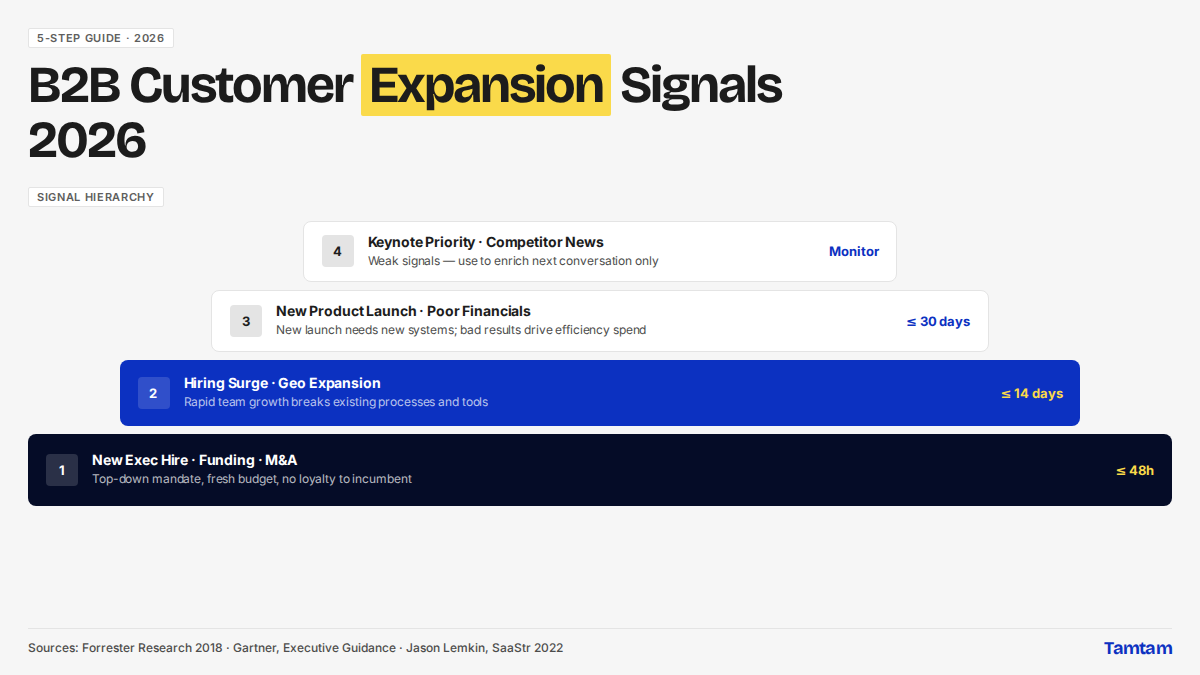
These platforms monitor millions of public data points for "buying signals" : events that indicate a company is ready to buy. Think of things like:
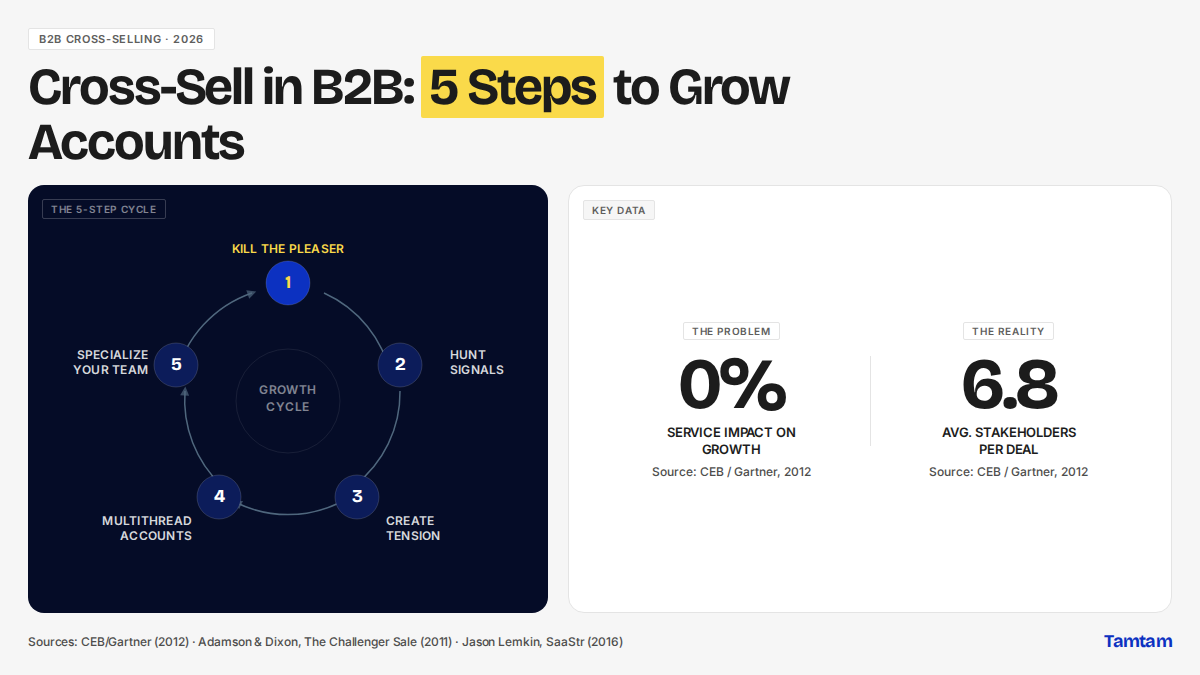
Beyond these obvious triggers, the highest-converting signals often sit deeper : a strategic priority surfaced in an earnings call, a transformation initiative buried in a 1,000-page filing, a change in tech stack revealed by a job posting requirement, a podcast appearance where an executive frames a new business challenge.
Who it's best for: Disciplined B2B revenue teams with a high ACV that understand relevance and timing beat brute force. These are teams that have the courage to trade the vanity of "10,000 emails sent" for the sanity of "5 qualified meetings booked."
Strengths:
Weaknesses:
Verdict: This is the only path forward. It’s the hard road that leads to a real pipeline, but it requires the guts to detox from the vanity metrics you’re addicted to. It’s the same signal-first logic behind modern B2B lead generation.
These are the massive platforms that try to be everything to everyone. They bundle a static database, a volume-based engagement engine, and some basic "signal" features into a single, monstrously expensive package.
Who it's best for: Large enterprises where the primary driver for a software purchase is vendor consolidation, IT compliance, and checking boxes on an RFP. The decision is often made by people who are far removed from the daily reality of the sales floor.
Strengths:
Weaknesses:
Verdict: This is a political choice, not a strategic one. It makes the CFO happy and your CRO miserable by guaranteeing expensive mediocrity.
| Approach / Philosophy | Core Function | Metric It Glorifies | The Psychological Trap | Typical Reply Rate | Best For (Team Maturity) |
|---|---|---|---|---|---|
| Volume Cannon | Automate mass outreach (emails, calls) | Activity (dials, emails) | The Action Bias | < 4% | Low-ACV, transactional |
| Static Database | Provide lists of accounts and contacts | List Size (TAM) | The Collector's Fallacy | N/A (it's data) | Foundational (all teams) |
| Signal Intelligence | Identify when and why to reach out | Signal-to-Meeting Rate | Requires delayed gratification | ~20% | High-ACV, disciplined |
| All-in-One Bloatware | Bundle everything, master nothing | Vendor Consolidation | The Illusion of Control | 4-6% (at best) | Bureaucratic enterprises |
Stop looking at feature lists. The choice you're making isn't about which tool has a better dialer. It's a strategic commitment to a GTM philosophy. Before you sign another PO, sit down with your leadership team and answer these three questions with brutal honesty.
1. What problem are you actually trying to solve? If your answer is "my reps aren't sending enough emails" or "we need to increase our call volume," you are asking the wrong damn question. You're trying to solve a productivity problem when you have an effectiveness problem.
The right question is, "How can we ensure every single outreach attempt from our team is as relevant and timely as humanly possible?" If you start there, you'll realize that a Volume Cannon isn't the answer. If your real problem is that your reps are wasting 97% of their time on outreach that is doomed to fail, the only solution is better intelligence. The only solution is signals.
2. How do you really measure success? Look at the dashboards you review in your weekly sales meetings. If the biggest numbers on the screen are "Emails Sent," "Dials Made," and "Tasks Completed," you are trapped. Your board and your managers get a dopamine hit from seeing big activity numbers because it creates the Illusion of Control. It feels like work is getting done.
To break free, you have to change your scorecard. You must have the courage to measure what actually matters. Start tracking metrics like "Signal-to-Meeting Conversion Rate" or "Percentage of Pipeline Sourced from Signals." When you change what you measure, you change what your team does. (Here are the outbound sales metrics worth tracking instead.)
3. Are you willing to "detox"? This is the hardest part. Shifting from a volume-based culture to a signal-based one is a shock to the system. Rep activity will look completely different. You’ll see fewer dials and more research. You'll see shorter bursts of hyper-focused outreach instead of an endless grind.
Can you, as a leader, handle that? Can you defend a rep who only sent 20 emails today because they were tailored to C-level executives who just received funding? Or will your anxiety kick in, forcing you to ask, "Why aren't they hitting their numbers?" If you can't stomach the detox, no tool will save you. You'll buy a Signal Intelligence platform and force your reps to use it like a Volume Cannon, getting the worst of both worlds.
Don't buy another tool to make your broken process run faster. The smartest, most courageous investment you can make in 2026 is to slow down, kill your addiction to activity, and arm your team with the intelligence to act with precision. The goal isn't to send more emails; it's to start conversations that actually lead to revenue.
Stop looking for a platform that gives you the illusion of control. Find one that gives you the power of timing. That is exactly the category Tamtam was built for: a signal intelligence layer that researches your whole market and surfaces the accounts worth a conversation right now.
Set up for you before our first call
Book a demo