May 5, 2026
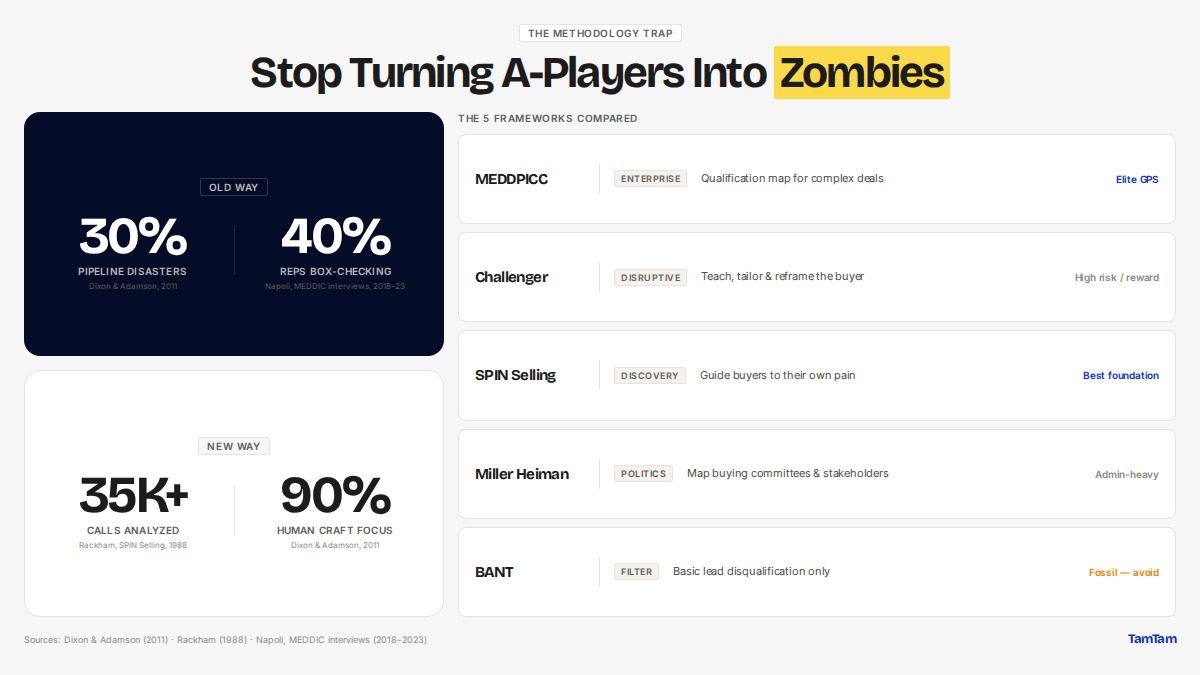
Most sales teams suffer from a compliance problem, not a methodology problem, forcing reps into rigid frameworks that kill performance. While popular methodologies like MEDDPICC, Challenger, and SPIN offer valuable maps for navigating deals, they often become traps when misapplied. The most effective approach is to use a framework as a strategic guide, not a conversational script. True success comes from automating robotic checklist work, allowing salespeople to focus on the human craft of selling.
Your sales team doesn't have a methodology problem, it has a compliance problem. MEDDPICC, Challenger, SPIN, and Miller Heiman are all useful maps, and every one of them turns toxic the second a leader wields it as a CRM compliance stick instead of a coaching tool. Pick the framework that matches your deal complexity, pour your energy into coaching the craft, and put BANT out to pasture. And never forget the part nobody puts on the slide: the best qualification on earth is wasted on an account that was never going to buy.
This isn't a listicle scraped from ten other blogs. It comes from years spent inside B2B sales orgs watching these frameworks get deployed, abused, and quietly abandoned. We have seen exactly what separates teams that close with MEDDPICC from teams that just fill out the fields, and this guide reflects that reality, not a vendor's feature sheet.
Let’s get this straight. A sales process is your series of stages : Prospecting, Discovery, Demo, Proposal, Closed-Won. It’s the "what happens next."
A sales methodology is the how. It’s the philosophy, the set of principles, the framework for how you navigate those stages. It’s the lens through which your reps view a deal.
And in a market where every buyer is skeptical and every budget is under a microscope, having a coherent how seems more important than ever. Sales leaders, terrified of missing their number, are clinging to rigid methodologies like a life raft. They want predictability. They want control.
But this desperate grasp for control often backfires. It creates the Methodology Trap.
The trap is when the framework stops being a guide and becomes a cage. It’s when coaching devolves into CRM compliance checks. It’s when your A-players, the ones who know how to read a room and have a real conversation, are forced to follow a script designed for a C-player. They spend more time updating Salesforce fields than they do strategizing. Their calls become interrogations. Their humanity gets stripped away, replaced by a checklist.
The goal of this guide isn't just to compare acronyms. It’s to help you pick a map without forcing your team into a straitjacket.
MEDDPICC is an acronym that stands for Metrics, Economic Buyer, Decision Criteria, Decision Process, Implicate Pain, Champion, and Competition. It’s the gold standard for qualifying complex enterprise deals, and it builds directly on the core MEDDIC sales process, adding Competition and Paper Process to the original six. For the full breakdown of why teams fake it (and how to stop), see the complete MEDDPICC guide.
Who it's best for: Teams selling high-ACV, complex solutions with sales cycles longer than a cicada’s lifespan. If you have to navigate procurement, legal, and a dozen stakeholders, this is your framework.
Strengths: MEDDPICC is an unparalleled internal tool. It’s a floodlight you shine on your pipeline to expose every weakness. Used correctly in a deal review, it forces a level of honesty that kills happy ears and prevents reps from wasting six months on a deal that was never going to close. It moves forecasting from wishful thinking to a calculated assessment. Did you identify the real economic buyer, or just the guy who was nice to you? Do you know their personal win for getting this deal done? If not, the deal is at risk, and MEDDPICC makes that painfully obvious.
Weaknesses / The Trap: The trap is using MEDDPICC as a conversational script. When reps walk into a meeting with a mental checklist ("Okay, gotta get the M, then the E, then the D..."), they sound like robots. The discovery call turns into an interrogation. The buyer feels like they’re being processed, not consulted. This is where you get "watermelon forecasting" : everything looks green in the CRM because every MEDDPICC field is filled out, but the deal is rotting from the inside because no real rapport or trust was ever built.
As Jack Napoli, one of the original creators of MEDDIC, has stated, it was designed as a qualification framework for managers, not an "interrogation tool for salespeople to beat up their customers with" [3].
Verdict: An elite-tier GPS for your internal strategy sessions; a disaster when used as a script for the road trip.
Born from the book of the same name, The Challenger Sale argues that the best reps don't just build relationships; they challenge customers [1]. They push them. They teach them something new about their own business and tailor a solution so compelling it creates urgency. For why most reps get this dead wrong, see the full Challenger Sale guide.
Who it's best for: Sales teams in disruptive or commoditized markets. If your product requires a fundamental shift in the buyer's thinking or if you’re selling against ten nearly identical competitors, you need to be a Challenger.
Strengths: The "Teach, Tailor, Take Control" model is incredibly powerful. It repositions the seller as an insightful consultant, not a product-pitching drone. By leading with a unique insight about the prospect's industry or business (the "Commercial Teaching" part), you earn the right to have a different kind of conversation. You’re not just responding to needs; you’re creating them. This is how you break the status quo and get buyers to act.
Weaknesses / The Trap: This methodology is wildly misinterpreted. "Challenging" the customer doesn't mean being an arrogant, argumentative jerk. But that’s exactly what happens when junior reps with a thin veneer of industry knowledge try to execute this play. A poorly delivered "Challenger" pitch is just a know-it-all condescending to a prospect. It requires deep business acumen, a genuine Point of View, and the social intelligence to know when to push and when to pull back. Without world-class coaching, you’re not building Challengers; you’re breeding assholes.
Verdict: A high-risk, high-reward strategy that can redefine your market position, or make everyone hate you.
Based on Neil Rackham's landmark research analyzing over 35,000 sales calls, SPIN Selling is a questioning framework designed to uncover and develop customer needs [2]. The acronym stands for Situation, Problem, Implication, and Need-Payoff questions. For the modern, research-first way to run it without sounding like an interrogator, see the full SPIN selling guide.
Who it's best for: More transactional sales or teams with junior reps who need a solid, repeatable structure for discovery. It’s phenomenal for uncovering pain the prospect didn't even know they had.
Strengths: SPIN is beautiful in its simplicity. It provides a logical flow for a conversation.
It's a masterclass in helping the buyer connect the dots themselves, which is infinitely more powerful than you telling them.
Weaknesses / The Trap: In today's world of hyper-educated buyers, SPIN can feel a bit dated. Many prospects show up to the first call having already diagnosed their own Situation and Problems. If a rep sticks too rigidly to the script, they can come across as naive, asking questions the buyer answered for themselves weeks ago. It’s also less effective for massive, non-linear enterprise deals where you’re juggling multiple stakeholders with competing problems. It’s a scalpel, not a Swiss Army knife.
Verdict: The absolute best foundational training for teaching reps how to ask effective questions, but it needs to be adapted for modern, complex sales.
Miller Heiman is the OG of enterprise sales strategy. At its core is the "Blue Sheet," a tool for deconstructing complex deals by identifying all the key players and their motivations. For the step-by-step way to run it without drowning in admin, see the full Miller Heiman guide.
Who it's best for: Large enterprise sales teams navigating massive, politically charged buying committees where the unofficial org chart matters more than the official one.
Strengths: This methodology is the gold standard for political navigation. It forces reps to move beyond a single point of contact and map the entire buying committee. It defines distinct buyer personas : Economic, User, Technical, and, most importantly, the Coach (your internal advocate), and pushes you to understand each one’s "Win-Results" (what’s in it for them personally and professionally). It’s an incredibly robust system for making sure you’ve covered all your bases in a nine-figure deal.
Weaknesses / The Trap: The Blue Sheet can become the entire job. It’s so detailed and academic that reps can spend more time filling out boxes and analyzing the political map than actually talking to the people on it. It creates a massive administrative burden that, without disciplined management, leads to reps just pencil-whipping the forms to keep their manager happy. The framework becomes a substitute for, rather than a guide to, actual sales activity.
Verdict: An essential framework for multi-threaded enterprise sales, but it can easily collapse under its own administrative weight.
BANT stands for Budget, Authority, Need, and Timeline. It was developed by IBM decades ago as a simple way for reps to qualify leads. Over the years, it has spawned children like CHAMP and NEAT, which are just minor variations on the same theme.
Who it's best for: Maybe, maybe, an SDR team that needs a very basic, first-pass filter for a high volume of inbound leads. And even that's a stretch.
Strengths: It's simple. It's easy to remember. That’s about it. It can, in very simple scenarios, help a brand new SDR quickly discard a lead from a student or a tiny company that has no chance of ever buying.
Weaknesses / The Trap: BANT is completely seller-centric and laughably outdated for any serious B2B sale. It operates on the assumption that a buyer arrives with a pre-allocated budget and a clear timeline, just waiting for a vendor to show up. That's not how the world works anymore.
The trap is thinking this is a qualification methodology. It's a disqualification checklist. Great deals are created, not found. A prospect might not have a budget yet because you haven't built a strong enough business case for them to go fight for one. They might not have a timeline because you haven't shown them the cost of inaction. BANT encourages reps to kill promising opportunities before they even have a chance to grow. If your AEs are using BANT to qualify deals, you are actively coaching them to lose.
Verdict: A fossil. If this is the core of your sales methodology today, you're driving a horse and buggy on the autobahn.
The five above dominate the conversation, but they aren't the whole map. A few others earn their place depending on your motion:
| Methodology | Core Philosophy (In one sentence) | Best For (Deal Type & Team) | Biggest Strength | The Trap (How it's abused) | When to Avoid It |
|---|---|---|---|---|---|
| MEDDPICC | Brutally honest internal qualification to see if a deal is real. | Complex, high-ACV enterprise deals. | Exposes every weakness in your pipeline before you waste resources. | Used as a conversational script, turning reps into interrogators. | Short, transactional sales cycles. |
| Challenger | Teach your prospect something new to challenge their status quo and create urgency. | Disruptive/commoditized markets. | Shifts the power dynamic and positions reps as insightful consultants. | Reps come across as arrogant know-it-alls without deep business acumen. | When your reps lack deep industry expertise or you sell a simple product. |
| SPIN Selling | Guide the buyer to discover their own pain and articulate the value of a solution. | Transactional sales; junior reps needing structure. | Masterful at building a business case from the ground up through questions. | Feels formulaic and outdated if buyers are already well-educated on their problems. | Hyper-complex, non-linear enterprise sales with multiple stakeholders. |
| Miller Heiman | Systematically map the political landscape of a buying committee. | Massive, politically complex enterprise deals. | Unbeatable for understanding organizational politics and stakeholder motivations. | Creates a huge administrative burden; reps manage the "Blue Sheet" instead of the customer. | High-velocity or SMB sales where the buying committee is one person. |
| BANT | Quickly disqualify leads that don't have budget, authority, need, or timeline. | High-volume, low-complexity lead filtering (SDRs only). | Simple and fast. | Kills promising deals before they start by being entirely seller-centric. | Pretty much any modern B2B closing role. Seriously. Stop using it. |
Stop looking for the "perfect" methodology. It doesn't exist. The right one for you depends entirely on your context. Here’s a simple framework to make the right call.
This is the most important variable. Are you selling a $5k/year SaaS tool with a 30-day sales cycle, or a $500k platform implementation that takes nine months?
Where do you sit in your customer's mind? Are you a well-known leader in a mature category, or are you a disruptive upstart trying to convince people there's a better way?
This is the one everyone ignores. A methodology is only as good as your team's ability, and willingness, to use it.
Are you, as a leader, prepared to invest heavily in coaching the art of sales? Or are you just looking for a new set of CRM fields to enforce compliance?
If you choose Challenger but you aren't committed to weekly role-plays, film reviews, and deep industry training, you will fail. If you choose MEDDPICC but your deal reviews are just about the numbers and not about the strategy, you will fail. These frameworks require intense, ongoing coaching.
Be brutally honest with yourself. If you don't have the culture or resources for that, pick the simplest framework that fits your deal cycle (like a lightweight version of SPIN) and focus 90% of your energy on coaching the fundamental skills: asking good questions, listening, and handling objections. A team of masters-of-the-basics will always beat a team of mediocre framework-followers.
The holy war over acronyms is a distraction. The question isn't whether MEDDIC is "better" than Challenger. It’s whether you’re building a team of artists or a team of paint-by-number robots. The real challenge is that the robotic work (the CRM updates, the compliance checklists, the endless research) is precisely what kills the artistry. To operationalize any methodology effectively, you have to solve that problem first. The best frameworks fade into the background, guiding reps' instincts rather than replacing them. But methodology only works on a deal that's worth working in the first place. The fastest way to break the methodology trap is to stop running great qualification on bad accounts. Tamtam rebuilds your lead list every morning around the buying triggers that closed your past deals, so the MEDDPICC, the Challenger insight, or the SPIN discovery lands on a buyer who actually has a reason to engage.
Set up for you before our first call
Book a demo