60 Seconds Summary
The classic B2B sales org splits work between SDRs who hunt for new pipeline, Account Executives who close deals, and Account Managers who farm existing customers for retention and expansion. However, this linear handoff model is obsolete, leading to abysmal quota attainment rates and internal friction. Elite teams are now ditching this broken system for cross-functional "revenue pods" that align incentives and create a better buyer experience.
Let’s be honest. For years, the B2B sales org chart has looked like a factory assembly line.
- Marketing generates a "lead" (often just an email address from a webinar).
- The Sales Development Rep (SDR) hammers that lead with calls and emails until they book a meeting.
- The Account Executive (AE) takes the meeting, runs the deal, and (hopefully) closes it.
- The Account Manager (AM) or Customer Success Manager (CSM) inherits the new customer and tries to keep them happy and paying.
It looks clean on a PowerPoint slide. It’s logical. It’s specialized.
It’s also completely, utterly broken.
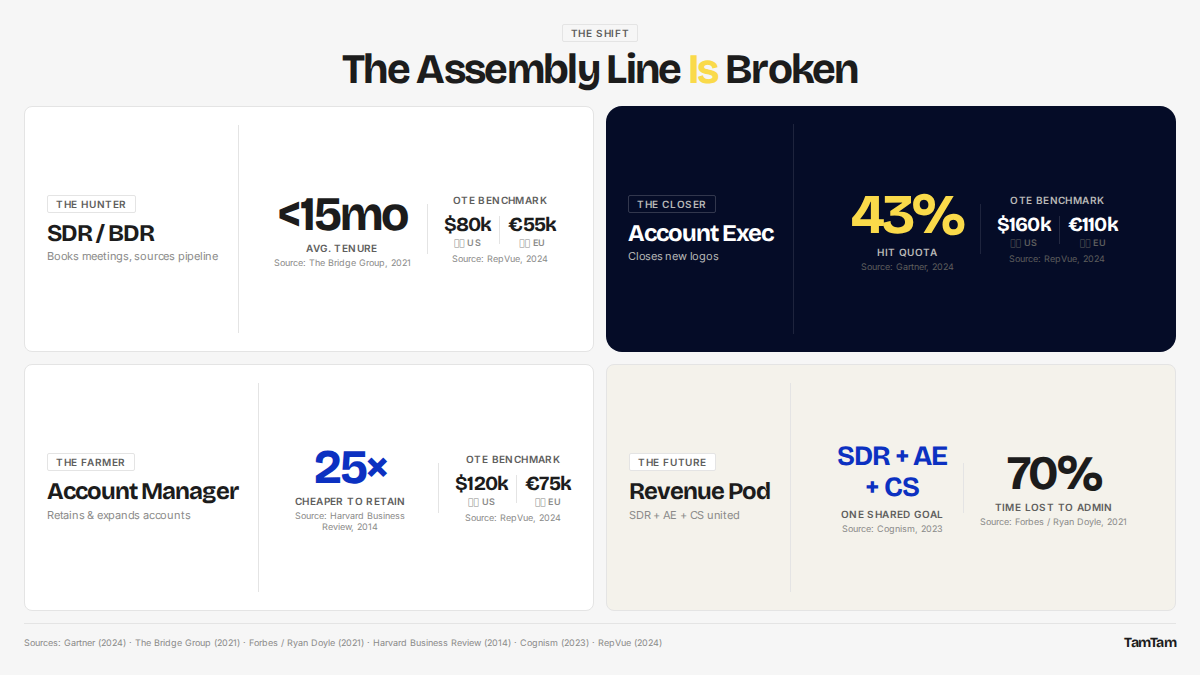
The proof? According to Gartner, average sales quota attainment has cratered to a miserable 43%. That means the system is designed for the majority (nearly six out of ten reps) to fail. It’s a machine that creates friction, burns people out, and delivers a disjointed, annoying experience for the buyer.
Each person on the assembly line has a different goal. The SDR is paid for meetings, not quality. The AE is paid for new logos, even bad-fit ones. The AM is left to clean up the mess. It's a circular firing squad disguised as a go-to-market strategy.
So before we break down the roles, understand the context: you’re looking at job descriptions for a factory that’s shutting down. The question isn't just "which role is right for me?" The real question is, "How do I get out of the assembly line and into a model that actually works?"
1. The Meat Grinder: Sales Development Rep (SDR/BDR)
The Sales Development Rep (or Business Development Rep, BDR, the title is mostly interchangeable) is the infantry of the sales world. Their job is singular: generate qualified meetings for the Account Executives. They are the hunters.
Who it's for: Grinders. People fresh out of college or career-switchers who want the fastest, most direct, and most brutal, entry into tech sales. If you have thick skin and an almost superhuman tolerance for rejection, this is your boot camp.
Strengths:
- Structured Training: You learn the basics of sales fast: how to talk to prospects, how to handle objections, how to use a CRM, and most importantly, how to be resilient.
- Clear Path: In theory, it’s the clearest path to the coveted AE role. Do your 12-18 months in the trenches and you get promoted.
- Measurable: For leadership, it’s a predictable machine. You know that X calls and Y emails will generate Z meetings. It’s a comforting, if often misleading, activity dashboard.
Weaknesses:
- Soul-Crushing Burnout: This is not an exaggeration. The job is a monotonous loop of cold calling, emailing, and getting rejected. Connect rates for cold calls are often below 5%. Imagine spending your entire day getting hung up on. One SDR on Reddit described it as "a daily exercise in demoralization." It’s no wonder the average tenure is often less than 15 months.
- Low-Status Work: You are the lowest person on the sales totem pole. You are a meeting-booking machine, and much of your time (up to 70% by some estimates) is spent on non-selling admin tasks like research and data entry.
- Existential Threat from AI: This is the big one. The repetitive research and outreach tasks that define the SDR role are exactly what AI is getting scarily good at. Why pay a human to copy-paste email templates when an algorithm can do it better and for cheaper? The "volume SDR" is a dead-end job.
Verdict: The SDR role is a hazing ritual that the industry is starting to realize is both cruel and inefficient.
2. The Star Player: Account Executive (AE)
The Account Executive is the closer. They are the hero who rides in, slays the dragon, and brings home the treasure (the signed contract). They own the deal from the first qualified meeting to the final signature.
Who it's for: Relationship builders, negotiators, and people who thrive on the pressure of a quota. If you love the thrill of the chase and the satisfaction of seeing your name at the top of the leaderboard, this is your stage.
Strengths:
- High Earning Potential: This is why people endure the SDR grinder. A successful AE at a top tech company can easily clear six figures, with top performers pushing well beyond that. The upside is significant.
- Ownership and Autonomy: You own your pipeline. You run your deals. The success or failure of your number rests squarely on your shoulders, which can be incredibly empowering.
- Strategic Work: Unlike the SDR's repetitive tasks, an AE's job is to navigate complex buying committees, diagnose deep business pain, and craft compelling solutions. It’s problem-solving at its core.
Weaknesses:
- Crushing Pressure: That 43% quota attainment number isn't a joke. You live and die by a number that is often set by a spreadsheet in a finance department that has no connection to market reality. Miss it for two quarters in a row, and you’re likely looking for a new job.
- Dependency Hell: Your success is almost entirely dependent on the quality of the leads you're given. If marketing is sending you garbage and your SDR is booking meetings with anyone who has a pulse, you’re destined to fail, no matter how good you are. It's like being a world-class chef who is only given rotten ingredients.
- Feast or Famine: Life as an AE is a rollercoaster. One quarter you’re a hero, the next you’re on a Performance Improvement Plan (PIP). The financial and emotional instability can be draining.
Verdict: The AE role is the prize, but it’s a prize won in a casino where the house has a massive edge.
3. The Diplomat: Account Manager (AM)
The Account Manager, sometimes called a Customer Success Manager (CSM), is the farmer. While the AE hunts for new logos, the AM is responsible for nurturing and growing the existing customer base. Their goal is retention and expansion (upsell/cross-sell).
Who it's for: Strategic, consultative, and empathetic people. If you prefer building deep, long-term relationships over the thrill of the one-time kill, the AM role is a natural fit.
Strengths:
- Stability: The AM role is generally more stable and less of a pressure cooker than the AE role. Your goals are tied to Net Revenue Retention (NRR), which is often more predictable than chasing new business.
- Deep Expertise: You become a true expert in your product and your customers' businesses. You’re not just selling a tool; you’re a strategic partner helping them achieve their goals.
- Relationship-Driven: The work is rewarding in a different way. You get to see the long-term impact of your work and build genuine partnerships with your clients.
Weaknesses:
- The Janitor: You often inherit the messes made by the sales team. Did the AE over-promise and sell to a bad-fit customer to hit their number? Guess who has to deal with the fallout, the angry support tickets, and the inevitable churn. It’s a shit sandwich, and you’re the one who has to eat it.
- Lower Compensation Ceiling: While base salaries are solid, the variable component of an AM's compensation is typically lower than an AE's. You're unlikely to have those massive, commission-fueled paychecks.
- Viewed as a "Cost Center": In many organizations, sales is "offense" and customer success is "defense." This can lead to being under-resourced and overlooked, despite the fact that retaining a customer is 5-25 times cheaper than acquiring a new one.
Verdict: The AM role is a saner, more stable career path, but you have to be prepared to clean up problems you didn't create.
4. The Future: The Revenue Pod
If the assembly line is broken, what’s the alternative? Enter the Revenue Pod.
A pod isn't just a new name for the sales team. It's a fundamental restructuring. Instead of a linear handoff, you create a small, cross-functional team (typically including an SDR, an AE, and an AM/CSM) that owns a specific territory, vertical, or list of target accounts together.
They share one number: revenue.
Who it's for: Collaborative, team-first operators who are sick of internal politics and blame games. People who want to focus on a single thing: delivering a seamless, valuable experience to the buyer.
Strengths:
- Aligned Incentives: The blame game disappears. The SDR is no longer incentivized to book garbage meetings, because it hurts the AE and, ultimately, the pod's number. The AE can't close bad-fit deals, because the AM's ability to retain and expand that account impacts the entire pod's compensation.
- A Better Buyer Experience: The buyer isn't handed off between three different people who barely know each other. They have a consistent, cohesive team guiding them from initial interest to long-term success.
- Deep Account Knowledge: The pod develops incredible expertise in their specific patch. The SDR's research benefits the AE's demo, which informs the AM's onboarding plan. It’s a virtuous cycle of knowledge sharing.
Weaknesses:
- Requires a Cultural Shift: This isn't a simple org chart tweak. It requires leadership to abandon traditional activity metrics (calls made, meetings booked) in favor of shared revenue outcomes. It’s a massive change for companies built on the assembly line model.
- Harder to Implement at Scale: It’s easier to manage 100 SDRs in a call center than it is to orchestrate 30 independent revenue pods. It requires more trust and autonomy.
The Proof: This isn't just a theory. Companies like Cognism famously transitioned to a pod model. They reported that this shift was instrumental in helping them scale their revenue, creating tighter team alignment and a more customer-centric approach.
Verdict: The pod model is the antidote to the broken factory floor. It’s a saner, more collaborative, and more effective way to sell.
5. The Supporting Cast: Sales Managers and RevOps
No sales org, old or new, runs without its support structure. Two key roles are the Sales Manager and the increasingly critical Revenue Operations (RevOps) team.
Sales Manager / Director:
This is the coach. Their job is no longer to just crack the whip on activity metrics. In a modern org, a good manager is a deal strategist, a mentor, and the person responsible for clearing roadblocks for their team. In a pod structure, they act more like a General Manager for a portfolio of pods, ensuring they have the resources and strategy to win their market.
RevOps & Sales Ops:
If the sales team is the engine, RevOps is the engineering crew. They build and maintain the entire go-to-market machine. This includes managing the CRM, selecting and implementing sales tools, defining territories, setting quotas, and analyzing performance data. They are the architects of the system, and their role is absolutely essential for making a pod model work. They provide the data and infrastructure that allows pods to operate intelligently.
6. The Money: OTE Benchmarks (US vs. EU)
Compensation is a huge factor, and it varies wildly by geography. The "On-Target Earnings" (OTE) is your total potential compensation, split between a base salary and variable commission.
-
United States: The US market is known for its "high-risk, high-reward" structure. OTEs are significantly higher, but so is the pressure.
- SDR: $70k - $90k OTE
- AE: $140k - $200k+ OTE (top performers at enterprise SaaS companies can earn far more)
- AM: $100k - $150k OTE
(Source: RepVue, 2024 data)
-
Europe (France/Germany/UK): European compensation is generally more conservative, with a higher base salary relative to the variable component. This often provides more stability and less of a hire-and-fire culture.
- SDR: €45k - €65k OTE
- AE: €80k - €150k OTE (can reach €180k+ in hot markets like Germany for senior roles)
- AM: €60k - €90k OTE
(Source: Glassdoor & local market data, 2024)
The takeaway? The US numbers look bigger on paper, but they come with the brutal reality of that 43% attainment figure. The European model often provides a more sustainable and less volatile career.
7. The Ladder: Sales Career Paths are Changing
The old ladder was simple: SDR → AE → Senior AE → Sales Manager.
That ladder is rickety and missing a few rungs. The new career paths are more like a jungle gym, with multiple ways to advance.
- The AI-Augmented "Super Rep": Instead of moving into management, many top performers are becoming hyper-efficient individual contributors. They master their tech stack, leverage AI for research and outreach, and operate like a one-person revenue pod.
- The Move to RevOps: Analytically-minded reps who love the process behind the sale are finding lucrative careers in RevOps, becoming the architects of the sales machine.
- The Specialist: As pods become more common, you’ll see more specialization. A rep might become the go-to expert for the healthcare vertical or the master of a specific competitive takedown, moving laterally to increase their impact.
- The Entrepreneurial Route: Many former reps leverage their sales and market knowledge to found their own companies or move into marketing, product, or founding roles.
The point is, "management" is no longer the only definition of success.
8. AE vs. AM vs. SDR Comparison Table
| Role | Primary Goal | Core KPIs | Average OTE (US vs. EU) | Biggest Frustration | Future-Proof? |
|---|
| SDR / BDR | Book Qualified Meetings | Meetings Set, SQLs | $80k vs. €55k | Mind-numbing rejection, burnout | Evolving (AI is taking over) |
| Account Exec (AE) | Close New Logos | ACV Closed, Win Rate | $160k vs. €110k | Bad leads from SDRs, insane quota pressure | Yes, but requires new skills |
| Account Manager (AM) | Retain & Expand | NRR, Churn Rate, Upsell Revenue | $120k vs. €75k | Cleaning up the AE's messes, being seen as a cost center | Yes, critically important |
| Revenue Pod | Grow Revenue in a Patch | Pod Revenue, Pipeline Velocity | N/A (Team-based) | Requires major cultural shift from leadership | Yes, this is the future |
9. How to Choose Your Role (Or Rebuild Your Team)
There’s no single right answer, just a series of trade-offs.
For Sales Leaders: Which structure should you build?
- Look at Your Deal Complexity: Are you selling a simple, transactional product that can be closed in two calls? The assembly line might (barely) work. Are you selling a complex, six-figure solution to a multi-stakeholder committee? The assembly line will kill you. The more complex the sale, the more you need a pod.
- Optimize for the Buyer, Not Your Dashboard: Do you want to optimize for internal activity metrics that make you feel productive (100 calls a day!) or for a seamless, consultative buyer journey that actually leads to revenue? The former leads to the factory floor. The latter leads to pods.
- Decide on Your Culture: Do you want a pack of lone wolves competing for scraps, or a collaborative team hunting together? Your org chart will define your culture, not the other way around.
For Sales Reps: Which path should you choose?
- Be Honest About Your Skills: Are you a relentless, rejection-proof hunter (SDR)? A persuasive, high-pressure closer (AE)? Or a strategic, long-term farmer (AM)? Playing to your natural strengths is the only way to survive.
- Weigh Risk vs. Reward: The US OTEs are tantalizingly high, but they come with a hire-and-fire culture and mathematically improbable quotas. European roles often offer more stability, a better work-life balance, and a saner path to hitting your number.
- Ask the Real Question: Stop asking which title to chase. Start asking, "How do I become an AI-augmented, strategically-minded rep?" The answer to that question is where your career security lies.
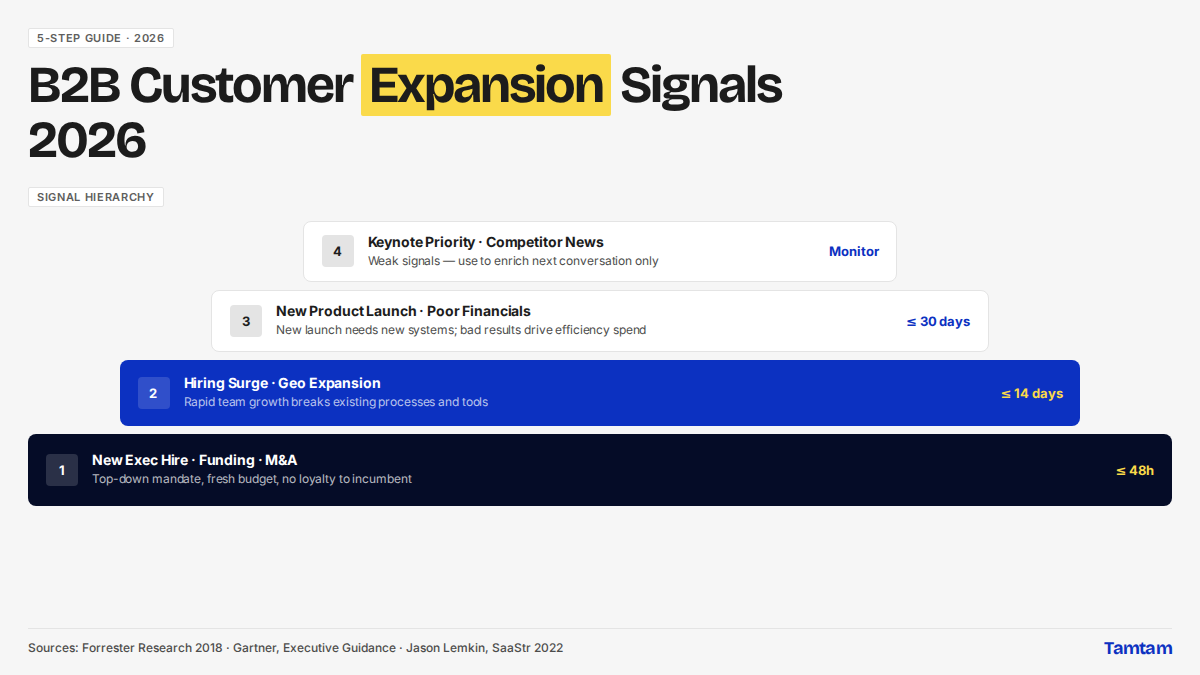
The honest recommendation is to stop thinking about which rung to grab on a broken ladder. The question isn't "SDR or AE?" but "How do I escape the assembly line?" The future of sales isn't about hyper-specialization in a silo; it's about being a strategic, tech-enabled business partner within a collaborative team. The smartest move you can make is to learn how to interpret buying signals, orchestrate AI-driven research, and work cross-functionally. Those skills are title-agnostic and future-proof. That's exactly the world Tamtam is built for. We analyze your past won deals to learn the buying triggers specific to your offering, then rebuild your reps' list every morning around the accounts showing those triggers right now. Verified contacts, the angle to use, delivered to your CRM. Whether you organize as pods or as a traditional team, the leverage point is the same : a list of accounts your reps actually have a reason to call.