May 18, 2026
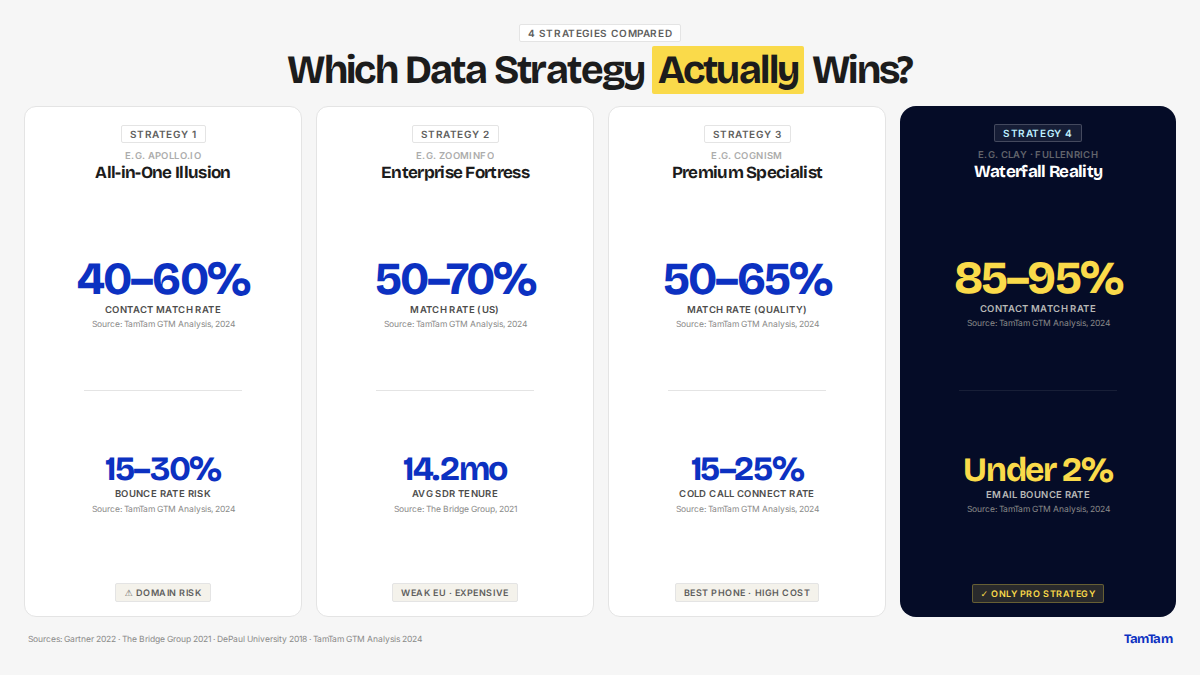
Relying on a single data vendor like ZoomInfo or Apollo is a strategic mistake due to rapid data decay, which leads to high bounce rates and burned-out reps. The real decision isn't about features but strategy: cheap scale, enterprise mapping, or premium accuracy. For serious GTM teams, the only intellectually honest approach is Waterfall Enrichment: sequentially checking multiple providers to maximize accuracy, achieve 85-95% match rates, and keep bounce rates under the critical 2% threshold. This multi-source system is the key to building a resilient and effective sales motion.
Let’s be honest. You’re here because something is broken.
Your SDRs are grinding, sending thousands of emails and making hundreds of calls. Your activity dashboards look great. But your pipeline is anemic. Your best reps are burning out, and you’re starting to get those dreaded "Undeliverable" notifications that make your stomach clench. It all traces back to one thing: the quality of your B2B data.
The problem isn’t your team. The problem is your data. And the "solution" you bought (that expensive, all-in-one data enrichment tool) is probably making it worse.
B2B data decays at a horrifying rate. Industry benchmarks from firms like Gartner show a staggering 30% of your contact database becomes obsolete every single year (1). People change jobs, companies get acquired, tech stacks evolve. Relying on a single, static database is like trying to navigate a new city with a map from 2018. It’s a direct path to getting hopelessly lost.
The market for data enrichment companies is full of vendors selling you a comforting lie: that their one, massive database is the magic bullet.
It's not.
The real decision isn’t about which vendor to pick. It’s about which strategy to adopt. Here are the four dominant playbooks, three of which are based on an illusion, and one that's based on reality.
This is the siren song of "cheap scale." It’s the promise of a massive database, sequencing tools, and contact data, all bundled into one impossibly low price. It feels like a steal.
Who it's best for: Early-stage startups, bootstrapped teams, or anyone on a shoestring budget who needs to get something moving, right now. It’s for teams who prioritize activity volume above all else.
Strengths:
Weaknesses:
Verdict: Apollo is the fast food of B2B data. It’s cheap, it’s fast, and it feels good in the moment, but a long-term diet of it will wreck your health.
This is the "nobody ever got fired for buying IBM" approach. ZoomInfo has built a data empire, an enormous fortress of contact and company information that promises total market visibility.
Who it's best for: Large, established, US-focused enterprises that need to map a massive Total Addressable Market (TAM) and want broad, company-level intent signals.
Strengths:
Weaknesses:
Verdict: ZoomInfo is a powerful tool for high-level market mapping, but a dangerously blunt and expensive instrument for frontline sales execution.
This strategy says, "forget scale, let's pay for quality." Cognism built its brand on providing human-verified mobile numbers ("Diamond Data") and a cast-iron commitment to GDPR compliance.
Who it's best for: Sales teams with a healthy budget, a strong focus on the EMEA market, or anyone whose sales process relies heavily on cold calling high-level decision-makers.
Strengths:
Weaknesses:
Verdict: Cognism provides the best phone data on the market, period. But it's a premium, specialized tool, not a universal solution.
This is the only strategy that acknowledges the fundamental, unshakeable truth: no single data provider is perfect.
A waterfall enrichment process doesn't bet on one horse. Instead, it creates a logical, sequential system. It’s simple:
You create a cascading series of lookups, using the best of each provider to fill the gaps left by the others.
Who it's best for: Mature, performance-driven GTM teams who are sick of excuses and refuse to accept bad data as a cost of doing business. This is for the builders, the systems thinkers, the winners.
Strengths:
Weaknesses:
Verdict: Waterfalling is the only professional approach to data enrichment today. It’s more work, but it’s the only strategy that actually, truly works.
| Strategy / Approach | Primary Vendor Example | Best For (Company Stage/Focus) | Psychological "Sell" | Critical Weakness | Typical Contact Match Rate | EU/GDPR Strength | Relative Cost |
|---|---|---|---|---|---|---|---|
| All-in-One Illusion | Apollo.io | Early-stage startups, small teams on a tight budget | Illusion of Scale & Action | High bounce rates (15-30%), domain damage | 40-60% | Weak | $ |
| Enterprise Fortress | ZoomInfo | Large, US-focused enterprises | Illusion of Control & Certainty | SDR burnout, poor EU coverage | 50-70% (US) | Poor | $$$$ |
| Premium Specialist | Cognism | EMEA-focused teams, high-ACV sales | Confidence & Compliance | High cost, smaller database | 50-65% (but high quality) | Excellent | $$$ |
| Waterfall Reality | Clay, FullEnrich | Mature, performance-driven GTM teams | Intellectual Honesty & Resilience | Upfront setup complexity | 85-95% | Varies (Provider Dependent) | $$ |
Stop asking which company is best. Start by asking these three questions about your own team.
1. What's Your Core Philosophy: Volume or Precision? This is the big one. Are you fundamentally a "growth at all costs" team that is willing to burn through domains and SDRs for the sake of hitting activity metrics? Be honest. If so, the cheap scale of the "All-in-One Illusion" might be your path. But if you're building a high-signal, reputation-focused GTM motion where every touchpoint matters, you have to move towards a precision-based strategy like the "Premium Specialist" or, ideally, the "Waterfall Reality."
2. What is Your Most Critical Channel? Is your entire outbound motion built on cold email? If so, getting a "good enough" email address that doesn't bounce is your primary goal. But if a cold call to a decision-maker's direct-dial mobile is a non-negotiable step in your sales process, then you absolutely must invest in premium phone data. This dictates whether you can get away with a broad provider or need to pay the premium for a specialist like Cognism.
3. What's Your Operational Maturity? Do you have the in-house expertise (or the willingness to learn) to build and manage a multi-provider stack? Or do you need the perceived simplicity of a single platform, even if you know you're paying a hidden tax in bad data and wasted effort? There's no shame in starting simple, but there's no excuse for staying there once you have the resources to build a system that respects the value of your team's time.
Look, a waterfall strategy on contact data is the only intellectually honest path forward. But contact data is just one piece of the lead-list problem. The real question is which accounts and which people deserve to be on the list in the first place.
That's where Tamtam operates. We sit one layer above the enrichment vendors. We analyze your past won deals to learn the buying triggers specific to your offering, then continuously research every account in your TAM against those triggers. For every account that matches, we identify the right contacts, run a multi-source waterfall to surface verified emails and mobile numbers, and deliver the lead with the context behind the opportunity straight to your CRM.
The enrichment is part of what we do, not the whole story. Tamtam is for B2B teams that target mid-market and enterprise, run outbound as a pipeline motion, and have stopped believing that a bigger contact database is the answer.
This isn't the right tool for every job. If your entire GTM is a numbers game (blasting hundreds of thousands of emails for a few bites), the cheap scale of an all-in-one platform makes more sense. If your C-suite just needs a high-level map of the entire Fortune 500 for territory carving, an enterprise database is built for that specific task. Tamtam is for the teams that have moved past "how do I get more contacts?" and are asking "why now, and which list should my reps actually work on Monday morning?".
Stop shopping for a data vendor like it's a magic bullet. Start architecting a data strategy. The simplicity of an all-in-one platform is a comforting lie, one you pay for with the sanity of your sales team and the reputation of your domain. For any team that is genuinely serious about performance, the answer isn't a single vendor. It's a system that combines a multi-source waterfall on contact data with the intelligence to know which accounts and people deserve to be on the list in the first place. It's not the easiest path, but it's the only one that respects the brutal reality of data decay and the humanity of the people you hire to sell.
Set up for you before our first call
Book a demo