May 15, 2026
Tired of C-suite meetings going nowhere? Ditch the traditional executive briefing template, a psychological crutch that makes you sound like every other vendor. The real goal isn't to present but to provoke. This guide gives you a 5-step plan to demolish your prospect's status quo by building a case so compelling they have to listen. Learn how to weaponize pre-meeting research, quantify the cost of inaction, and control the frame of the conversation from the first second.
Let’s be honest. You’re here because you Googled "executive briefing template."
You have a big meeting on the calendar with a CRO, a CEO, a CFO, someone whose title has a "C" in it and whose calendar is a fortress. And you're terrified of blowing it. So you look for a template, a magic document, a fill-in-the-blanks safety blanket that will make you feel prepared.
Here's the hard truth: That template is the very reason you're going to fail.
Most executive briefings are a colossal waste of everyone’s time. They’re designed to make the seller feel prepared, but they put the executive to sleep. They’re full of predictable questions, boring slides, and a desperate, needy energy.
C-suite leaders suffer from extreme "discovery fatigue." They have a thousand things to do, and listening to your pitch isn’t even on the list. It’s a rounding error. It’s fucking nothing.
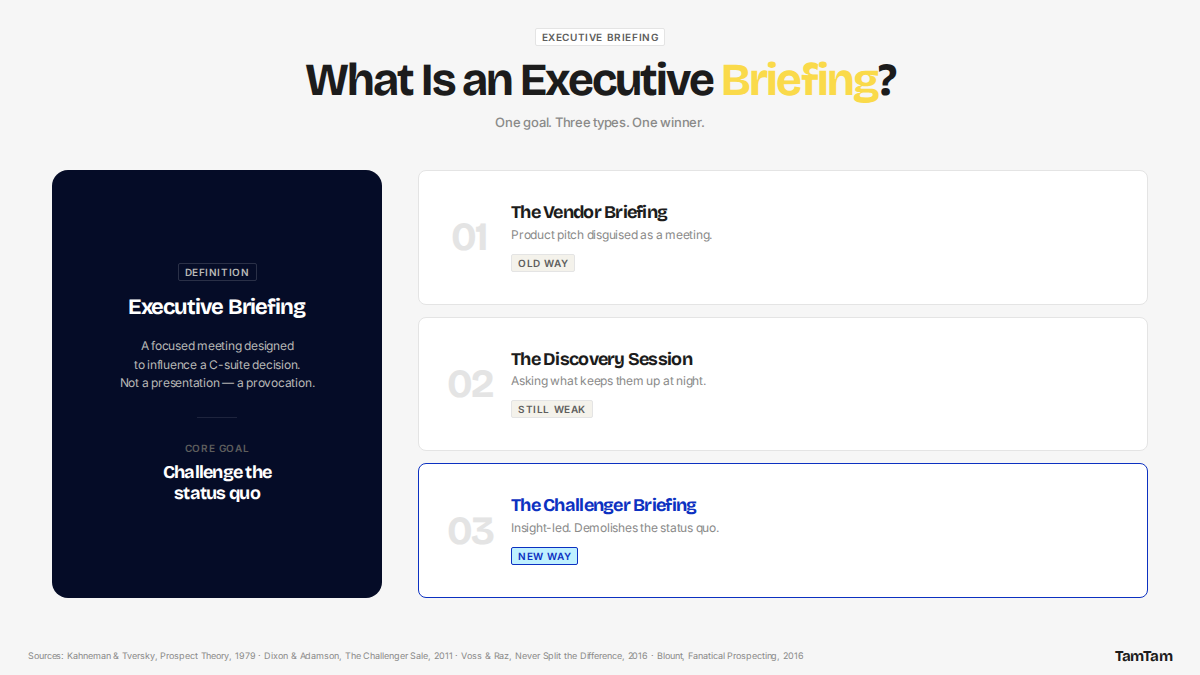
If your first move is to ask, "So, what keeps you up at night?" you’ve already lost. They aren't there for an interrogation. They expect a consultation. They expect you to bring a point of view.
The most effective executive briefing isn't a document you present. It's a private strategic plan designed to do one thing: challenge the executive's worldview and prove the high cost of their status quo.
It’s a demolition plan. Here’s how you build it. It only pays off when you aim it at a genuine ideal customer profile account, not a long shot.
Before you write a single word or open a single doc, the real work begins between your ears. Your biggest enemy in a C-suite meeting isn't the executive; it's your own Imposter Syndrome.
This feeling pushes you into a subservient "vendor frame." You use weak, permission-based language. You thank them profusely for their time. You act like they're doing you a favor by showing up. This immediately signals low status and hands them complete control of the meeting.
You have to flip the script.
Why this matters: Executives are surrounded by people who tell them what they want to hear. Your value isn't in agreeing with them; it's in challenging them with insights they can't get from their own team. To do that, you need to operate from a "Prize Frame."
The Prize Frame is the unshakeable belief that your insight is the prize, not their budget. You aren't there to beg for a piece of their pie. You are there as a peer-level advisor to diagnose a problem they likely can't see yet.
What to do:
Example:
See the difference? One is a plea. The other is a diagnosis.
Common Mistake to Avoid: Thinking that being polite means being passive. You can be respectful while still being direct and assertive. The goal is to be a peer, not a supplicant.
You cannot walk into a room and challenge a C-level executive without unshakeable evidence. This is non-negotiable. And that evidence doesn't come from asking the executive discovery questions.
That's a fatal error. The C-suite is not the place for discovery; it’s the place for validation.
Why this matters: Trying to do discovery in an executive meeting instantly erodes your credibility. It tells the executive you're unprepared and that you expect them to do the work of figuring out how you can help them. Your job is to connect the dots for them, not hand them a coloring book.
What to do: Your real work happens before the meeting, by becoming an intelligence operative inside their organization. You need to multi-thread and map out the ground-level pain by talking to the people who live it every day. This deep, multi-threaded work is 1:1 account-based marketing in action.
Example Mini-Story: You're meeting with a CRO. Your champion is a Director of Sales Ops. Don't just ask them for the meeting. Partner with them.
Say this: "John, I'm preparing a strategic overview for your CRO on the market risks I'm seeing. To make sure it's as relevant as possible, what are the top 2-3 operational drags your team is facing that the CRO might not have full visibility on? I want to make sure the case I build incorporates the ground truth from your team."
This transforms your champion from a scheduler into a co-conspirator. You're now working together to bring a powerful insight upstairs.
Common Mistake to Avoid: Relying solely on public information like 10-K reports and press releases. That’s table stakes. Your competitors have that too. Your unique advantage comes from gathering private intel from inside the company walls.
Now that you have your mindset right and your intel gathered, you can architect your plan. Forget a slide deck. This is your private battle plan, your "Status Quo Demolition Plan." It’s a document for you, not for them.
This framework is based on the "Commercial Teaching" methodology, famously articulated in The Challenger Sale. It's designed to systematically break down an executive's current beliefs and build a case for a new way of thinking.
Why this matters: This structure moves the conversation away from your product and squarely onto their problem. It establishes you as a thought leader who understands their world better than they do.
The 5-Part Structure of Your Plan:
Common Mistake to Avoid: Mentioning your product or company name at any point during this five-part sequence. The moment you say your name, their "vendor shield" goes up. Your goal is to get them to fully buy into the problem and the new way of solving it. Only then, once they've agreed with the diagnosis, do you introduce your solution as the best way to get there.
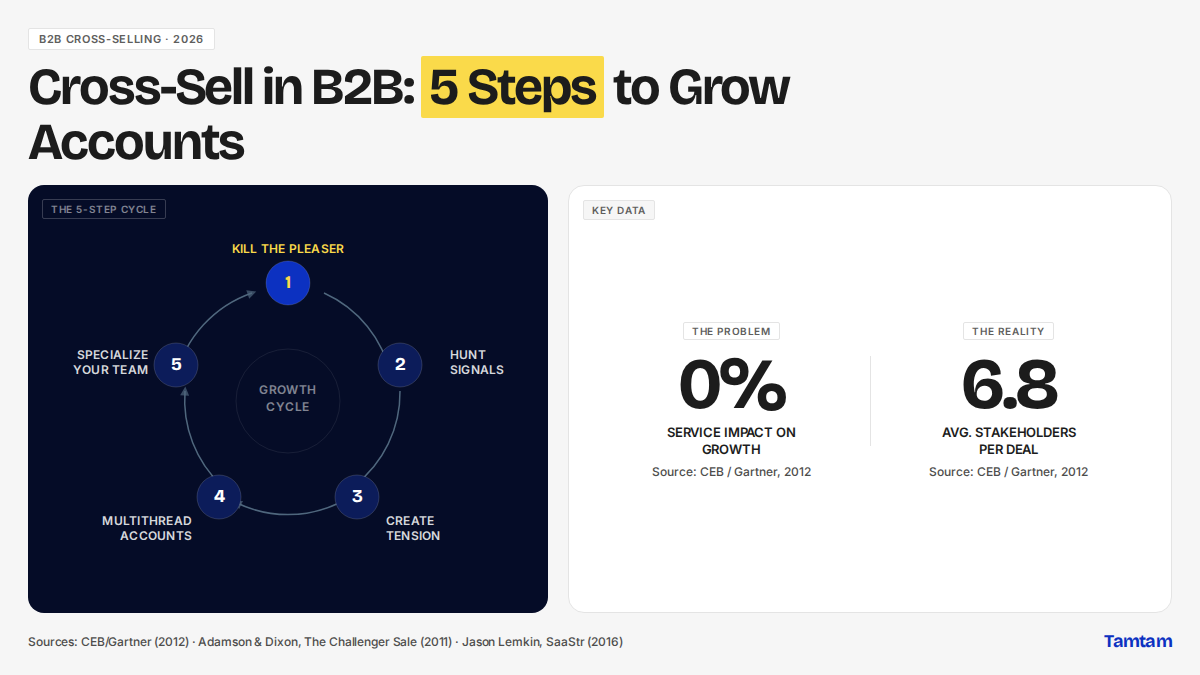
Your number one competitor in any complex deal isn't another company. It's "no decision." The gravitational pull of the status quo is immense. (We mapped those indirect competitors in detail.) To break that inertia, you have to prove that staying put is not a safe harbor but a sinking ship.
Why this matters: This leverages a powerful psychological principle called Loss Aversion, identified by psychologists Daniel Kahneman and Amos Tversky. It states that people are roughly twice as motivated to avoid a loss as they are to achieve an equivalent gain. Executives are numb to ROI promises. Every vendor promises a pot of gold at the end of the rainbow. Your job is to show them the fire they're standing in right now.
What to do: Calculate and present the explicit, ongoing cost of them doing nothing. This isn't about the future return on investment (ROI); it's about the present cost of inaction (COI).
Example:
The first is a vague promise. The second is a documented, ongoing, and escalating loss. It creates urgency. It turns "no decision" into an active, and expensive, choice.
Common Mistake to Avoid: Presenting your COI calculation as a guess. You must anchor it to the intel you gathered. "Based on the numbers your Director of Ops shared with me..." or "Using the industry benchmark data from Gartner..." This gives your calculation credibility and makes it their number, not yours.
You've built a powerful, disruptive argument. It's a bomb. Now you have to deliver it without getting kicked out of the room.
This isn't about being aggressive, arrogant, or confrontational. It's about being a confident truth-teller. The secret is to pair your sharp insight with what former FBI negotiator Chris Voss calls "Tactical Empathy."
Why this matters: Insight without empathy is just an insult. If you make the executive feel attacked or stupid, their defenses will go up, they'll shut down, and the meeting is over. You need to deliver the challenge in a way that makes them feel heard and respected, even as you dismantle their current worldview.
As one CRO famously told a sales rep: "Your job isn't to ask me what's keeping me up at night. It's to tell me what should be." This is the expectation you must meet.
What to do:
Example:
Let’s put it all together. You’re about to deliver your "Reframe." You know it’s a direct challenge to their current strategy.
Instead of just blurting it out, you cushion it with tactical empathy:
"Sarah, it's clear the system you've built for EU compliance is best-in-class and has been a huge factor in your success there. It makes complete sense why you'd want to replicate that model in new markets.
[Now, the accusation audit...]
You're probably thinking we're just another vendor here to tell you your baby is ugly. And it might seem that way, but I want to share some external data that suggests the market has shifted. It looks like the very system that made you so successful in Europe might now be putting the team in APAC at a competitive disadvantage."
This delivery is masterful. You’ve validated them, disarmed them, and prepared them to hear a difficult truth. You've positioned yourself as an ally bringing vital new information, not an adversary pointing out their flaws.
Common Mistake to Avoid: Being blunt for the sake of being blunt. The goal is to be a trusted advisor, not an antagonist. Confidence is quiet. Arrogance is loud. Be confident in your research and empathetic in your delivery.
The mindset shift is from "How do I survive this meeting?" to "How do I control this meeting?" The executive briefing template you searched for was a script for a minor role; this demolition plan makes you the director. But it all hinges on having a point of view so sharp they can't ignore you. That kind of insight requires a ton of upfront work : synthesizing annual reports, earnings calls, and ground-truth intel from inside the account. The gap between knowing this strategy and having the bandwidth to execute it is where most reps fail. This is precisely where Tamtam comes in. We analyze your past won deals to learn the buying triggers specific to your offering, then continuously research every key account in your TAM against those triggers. You walk into every executive meeting with the buyer's strategic priorities, the buying signal that justifies your timing, and the angle to use. The strategic narrative is yours to build : we make sure the intel is already there when you sit down.
Set up for you before our first call
Book a demo