May 12, 2026
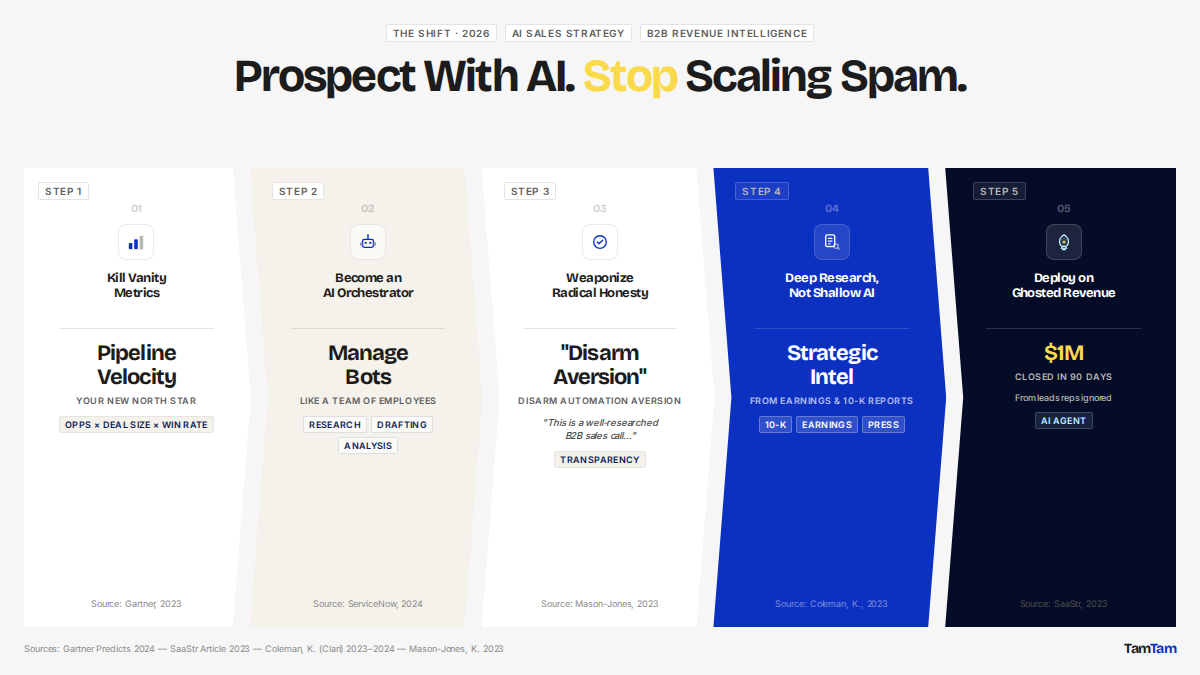
Most sales organizations use AI to scale spam, which is a failing strategy. This guide shows you how to use AI for surgical precision instead of brute force. You will learn to replace vanity metrics with Pipeline Velocity, manage AI agents like a team, and use radical honesty to disarm buyer skepticism. Ultimately, this approach leverages AI for deep strategic research to win deals, not just to generate more generic emails.
Let's get one thing straight. The way most sales teams are using AI right now is laughably, tragically wrong. They’ve been handed the most powerful tool in a generation, and they’re using it like a digital sledgehammer, trying to smash through inboxes with more volume.
This isn’t just failing; it’s actively burning your brand, your reputation, and your best accounts. Every irrelevant, auto-generated email your AI sends is another nail in your company's coffin.
The problem isn’t the AI. It’s the mediocre, volume-obsessed strategy behind it. Pointed at the right strategy, it becomes the engine of modern pipeline generation.
For decades, sales math was simple: more activity equals more revenue. More calls, more emails, more meetings. It was a game of brute force. AI can send 10,000 emails in the time it takes you to read this sentence. But if they're irrelevant, that's 10,000 potential buyers you've just trained to ignore you forever. According to Gartner, by 2025, 30% of outbound messages from large organizations will be synthetically generated. If your strategy sucks, you're just scaling suck.
The only path forward is to use AI as a scalpel, not a sledgehammer. It’s about focusing on relevance, timing, and human psychology with a precision that was impossible before. It’s about moving from brute force to surgical strikes. Here’s how you do it.
Your first move is tactical, symbolic, and absolutely necessary: delete the "activity" column from your sales dashboard. Right now.
Metrics like "emails sent," "dials made," and "sequences started" are the empty calories of sales. They give you a sugar high of feeling productive while making you strategically obese. These metrics incentivize your reps to do one thing: spam. They encourage corner-cutting, generic messaging, and burning through your total addressable market with zero regard for quality. It's a race to the bottom, and AI just gave everyone a rocket ship.
You need to replace all that noise with one metric that’s impossible to game: Pipeline Velocity.
This is your new North Star. It’s a clean, simple, bullshit-proof formula that measures how fast you are generating qualified pipeline. Here it is:
(Number of Qualified Opps × Average Deal Size × Win Rate) ÷ Sales Cycle Length (in days)
That's it. This one number tells you the health of your entire revenue engine. To improve it, your team has to focus on things that actually matter: creating more real opportunities, increasing deal size, improving win rates, and shortening the sales cycle. There is no room for "busy work" in that equation.
When Kyle Coleman was at Clari, he famously ran an experiment where he removed all activity metrics for his SDR team. No call quotas, no email quotas. The result? Performance didn't drop. In fact, morale went up. The good reps were already focused on quality outcomes, and removing the arbitrary targets freed them up to do more deep, strategic work instead of hitting a meaningless number to please a manager.
Your takeaway? You might be clinging to activity dashboards because they provide a false sense of control. Seeing "100 dials" or "500 emails sent" makes you feel like your team is working. But managing a spreadsheet isn't the same as managing a revenue engine. Have the courage to measure what matters, even if it means admitting the old way was wrong.
The job title "Sales Development Representative" is on its way out. The new role, and the one you need to hire for and train, is the "AI Orchestrator."
This isn't about pushing buttons on a new tool. It’s about managing a team of digital employees. Think of yourself as the Chief People Officer for your bots. Your job is to recruit the right AI agents for the right tasks (one for research, one for drafting, one for data analysis), write their "Standard Operating Procedures" (i.e., your prompt libraries and workflows), and run regular performance reviews on their output.
This is the most interesting and valuable job on the new revenue team : a hybrid of RevOps, data science, and sales psychology. You're not just executing tasks; you're designing the machine that executes the tasks. You're the architect of the revenue engine. This is the heart of building automated lead generation funnels that scale insight instead of spam.
This isn't science fiction. Look at recent job descriptions. ServiceNow posted a role for a "Generative AI Business Architect." SPS Commerce posted one for a Sales Enablement Manager that required experience with Python and SQL. They're not looking for button-pushers. They're looking for orchestrators who can integrate these systems. The consulting firm Lancengym even talks about creating "onboarding" and "performance review" processes for their AI agents.
The mistake is thinking you can just subscribe to an AI tool, "turn it on," and wait for the money to roll in. An unmanaged AI is a liability. It will hallucinate facts, drift off-brand, and alienate your best prospects with generic garbage. AI requires rigorous, daily, human-in-the-loop oversight. Your bots are your most junior employees, don't let them run unsupervised.
Your buyers are not idiots. They can smell an AI-generated email a mile away, and they are developing a deep-seated "automation aversion." It’s a visceral reaction to feeling like a number on a spreadsheet, a lead to be processed by a machine.
The worst thing you can do is try to trick them. Using AI to generate fake, folksy pleasantries is an insult to their intelligence. "Hope you're having a great week!" or "Saw you're a fan of the Golden State Warriors!" is the modern equivalent of a 1990s telemarketing script. It screams "I am a robot trying to fake being human."
The solution isn't better fakery. It's radical honesty.
Disarm them by acknowledging the reality of the situation. Pull back the curtain. This builds instant trust because it shows high emotional intelligence and respect. You’re treating them like a smart peer, not a mark.
Sales leader Katy Mason-Jones teaches a "disarming opener" for cold calls that works just as well in emails. It goes something like this:
"Hi [Name], for full transparency... this is a well-researched B2B sales call. The reason I'm reaching out specifically is because I saw [Relevant Strategic Initiative]. Do you have 30 seconds to hear why?"
This is genius because it bypasses the buyer's entire defense system. You've admitted what it is, so they don't have to waste mental energy figuring out your angle. It frames you as a professional, not a sleazy salesperson. And it immediately pivots to the only thing they care about: "What's in it for me?" Stop trying to trick people. Start treating them with respect.
There's a Grand Canyon-sized difference between personalization and relevance.
One of these gets you deleted. The other gets you a meeting with a CFO.
The laziest, most common use of prospecting AI is asking it to "personalize this email based on their public profile." This is a waste of incredible technology. The most powerful use is to command your AI agent to act as a tireless, brilliant research analyst.
Have it read a company's last three earnings call transcripts. Have it analyze their 10-K report and summarize their top three strategic initiatives. Have it monitor their press releases, job postings, and executive interviews. The AI's job is to surface the deep strategic context : the why. Your rep's job is to be the human advisor who connects that context to your solution.
Kyle Coleman advises reps to use this deep insight to open with a powerful presupposition. Instead of asking a dumb discovery question, you state a well-researched hypothesis that shows you've done your homework:
"Given your focus on IPO readiness, you've probably looked into automating your SOX compliance controls before, huh?"
This changes the entire dynamic of the conversation. You're not a vendor asking for time; you're a strategic peer discussing a known business problem. The AI is the research assistant that works 24/7; the human is the advisor who delivers the insight. You're mistaking trivia for insight if you're still talking about college mascots.
When you get a powerful new weapon, you don't test it for the first time on your most important target. You take it to the practice range.
The same applies to your AI prospecting engine. Don't point your brand-new, untested system at your Tier 1, net-new enterprise accounts. That's insane. The risk of damaging a key relationship with a clumsy, poorly-calibrated AI is too high.
The highest-ROI, lowest-risk place to start is with the leads your human reps are already ignoring. Every sales organization is sitting on a goldmine of "ghosted" revenue:
Your human reps, driven by ego and the hunt for big commissions, will almost never touch this stuff. But an AI agent doesn't have an ego. It will happily and systematically engage every single one.
The story from SaaStr is a perfect illustration. Their human sales team was, like most, focused on the top-tier inbound leads and ignoring thousands of others. They built an AI workflow to identify which "ghosted" leads were actually worth re-engaging based on real buying signals (a champion changing role, a new strategic initiative, a fresh funding round), then handed those signal-rich accounts back to humans for outreach. The result : over $1 million in new revenue in just 90 days from leads that had been considered worthless. The lesson isn't "replace your reps with bots". It's "use AI to find the leads that are now worth a human conversation". Go find the money you're already leaving on the table. (More on why most AI SDR deployments fail, and how the winners run them.)
AI isn't a magic button to fix a broken sales process. It's an amplifier. Point it at a bullshit, volume-based strategy, and you get amplified bullshit at a scale that will bankrupt you faster than you can imagine. But point it at a smart, signal-driven, and human-centric strategy, and you build an unstoppable revenue machine. The brutal irony is that following these steps creates a new bottleneck : finding the deep, meaningful signals for every single account becomes an impossible human task. That's exactly what Tamtam is built for. We analyze your past won deals to learn the buying triggers specific to your offering, then continuously research every account in your TAM against those triggers : 10-Ks, earnings calls, job postings, news. Verified contacts and the angle to use, delivered to your CRM every morning.
Set up for you before our first call
Book a demo