May 7, 2026
Stop chasing 'fair' sales territory maps that kill morale and cost you revenue. Traditional geographic or round-robin models are outdated. The most effective approach is a meritocracy that routes the best, highest-intent leads to your proven top closers. This ruthless shift can boost pipeline by over 10% from existing lead flow, but requires clean CRM data to succeed.
Let’s talk about that word: "fair."
In sales, "fair" is the most expensive word in the dictionary. It’s a political crutch used by managers who are more concerned with avoiding uncomfortable conversations than with blowing out their number.
The classic sales territory mapping exercise looks like a scene from a war movie: a manager hunched over a map, drawing lines with a Sharpie, trying to carve up the world into equal-sized slices of opportunity. A little bit of California for you, the entire Midwest for you, and a few key accounts in New York for the senior rep. Everyone gets a piece of the pie. Everyone feels good.
And the company gets systematically screwed.
Why? Because this entire approach is based on a lie. The lie that all reps are created equal. The lie that all leads are created equal. The lie that geography is still the most important variable in a world where you can close a seven-figure deal over Zoom.
Your top performer, the one who could sell ice to a penguin, gets the same number of inbound leads as the person who’s been “ramping” for nine months. A red-hot "Contact Sales" lead from a Fortune 500 company gets routed to the next person in the round-robin queue, who just might be your weakest rep.
That isn't fair. That's fucking malpractice.
In a tough economy, you can't afford to be "fair." You have to be ruthless. You have to route every single lead to the person with the highest probability of closing it. This guide is about how to do just that. We'll break down the traditional models, show you where they fall apart, and introduce the one model that actually aligns with reality: performance. Whatever model you pick, it only works if it routes reps toward your ideal customer profile, not just lines on a map.
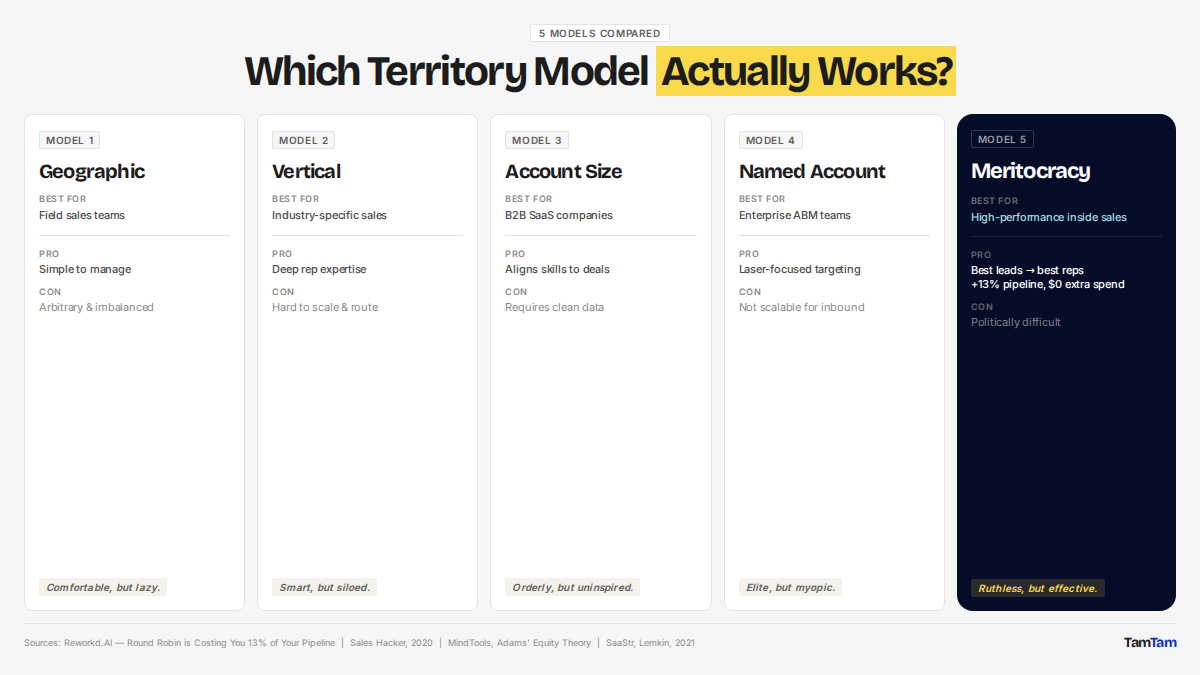
This is the one everyone knows. You take a map, you draw some lines around states, countries, or zip codes, and you assign a rep to each colored-in section. Done.
Instead of slicing the map horizontally, this model slices it vertically by industry. Jane gets FinTech, John gets Healthcare, and Sarah gets Manufacturing.
This is probably the most common model in B2B SaaS. You segment the market by company size, typically measured by employee count or annual revenue. Your team is then split into SMB, Mid-Market, and Enterprise reps.
Forget broad territories. Here, each rep gets a specific, hand-picked list of high-value target accounts. This is the foundation of any real Account-Based Marketing (ABM) strategy.
Now we get to the good stuff. This isn't really a single model; it's a philosophy that can be layered on top of the others. The core idea is simple: your best leads should go to your best reps. Period.
Instead of a static, "fair" distribution like round-robin, you use a dynamic, performance-weighted system.
The psychology behind this is called Equity Theory. It states that employees are motivated when they perceive fairness in the ratio of their inputs (effort, skill) to their outputs (rewards, opportunities). When your top rep sees a low-performer getting the same quality of leads, they feel their ratio is unjust. They become demotivated. The "Empty Inbox A-Player" is a real phenomenon : a top rep who slows down because they know they'll just have to wait for the round-robin to come back around.
According to research from Reworkd.AI, simply switching from a round-robin to a weighted distribution model can increase pipeline by 13% without spending a single extra dollar on marketing. Think about that. You're just allocating the same resources more intelligently.
The gold standard for this is the ServiceTitan "Premier League" model. As described by sales leaders there, reps are tiered based on their historical performance (close rate, pipeline generated, etc.). The top-tier reps get the highest proportion of the best leads (e.g., demo requests). If you perform well, you get promoted to a higher tier. If you slack off, you get relegated. It’s ruthless, transparent, and incredibly effective.
| Model Name | Core Logic | Best For | Main Pro | Main Con | Emotional Beat |
|---|---|---|---|---|---|
| Geographic | Zip code / State / Country | Field sales teams | Simple to manage | Arbitrary & imbalanced | Comfortable, but lazy. |
| Vertical | Industry (NAICS/SIC codes) | Complex, industry-specific sales | Builds deep rep expertise | Can be hard to scale/route | Smart, but siloed. |
| Account Size | Employee count / Revenue | Most B2B SaaS companies | Aligns skills to deal complexity | Requires clean data | Orderly, but uninspired. |
| Named Account | A specific list of target logos | Enterprise ABM teams | Laser-focused on top targets | Not scalable for inbound | Elite, but myopic. |
| Meritocracy | Historical close rate / Performance | High-performance inside sales | Maximizes revenue from every lead | Politically difficult | Ruthless, but effective. |
The secret is that you don't just pick one. The best systems are hybrids. You might segment by account size first, then apply a merit-based routing system within each segment. Or you might have named accounts for your enterprise team and a vertical model for your mid-market team.
To figure out your stack, ask three questions:
1. What's your sales motion? Are you field sales or inside sales? High-velocity transactional deals or long, complex enterprise cycles? The answer sets your foundation. Field sales will always need a geographic component. A true enterprise team will always need a named account list. Be honest about how you actually sell.
2. What's your primary bottleneck? Is it a lack of leads, or a failure to convert the leads you have? If you're starving for good leads, you can't afford to waste a single one on an average rep. As Jason Lemkin of SaaStr says, reps should have to "Earn It." High-intent leads are a privilege, not a right. This pushes you directly toward a merit-based model.
3. What's your leadership's stomach for conflict? This is the real question. Are you willing to have a tough conversation with a struggling rep about why they aren't getting the best leads? Or would you rather keep the peace on the sales floor, even if it costs you 10% of your revenue? Your answer here determines whether you have the guts to build a culture of performance or if you'll settle for a culture of "fairness" that protects mediocrity.
The honest recommendation is to evolve. You don't have to burn the maps overnight. Start small: take your "request a demo" form and route more of them to your top 2-3 closers. Measure the results for one quarter. When your CFO sees the lift, you'll have all the political capital you need to scale a performance-first culture. Stop protecting feelings and start protecting revenue. Ultimately, this isn't about the model; it's about a philosophical shift toward prioritizing accounts based on real buying triggers, not lines on a map. That's what Tamtam is built for : we analyze your past won deals to learn the buying triggers specific to your offering, then rebuild your reps' list every morning around the accounts showing those triggers right now. The best leads, routed to the right reps, refreshed daily.
Set up for you before our first call
Book a demo