May 6, 2026
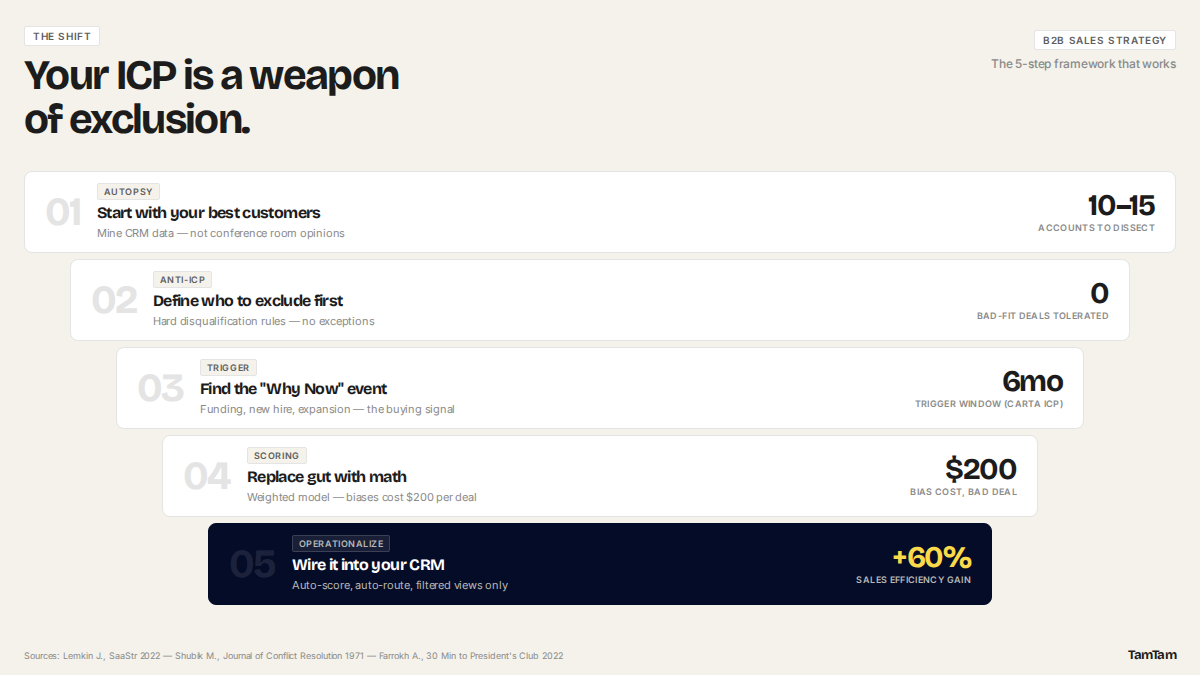
Most Ideal Customer Profile templates are useless corporate theater, allowing teams to feel strategic without making hard choices. A real ICP is a weapon of exclusion, defining who you won't sell to as much as who you will. This guide provides a five-step framework to build a functional ICP by analyzing your best customers, defining your "Anti-ICP" to repel resource drains, identifying buying triggers, building an objective scoring model, and operationalizing it directly in your CRM.
Your current Ideal Customer Profile template is a lie.
Let's be honest. It's a symptom of "strategic cowardice" : a fancy way to look focused without actually committing to a narrow market. It’s a beautifully designed PDF that lives in a Google Drive folder nobody ever opens. It’s a laundry list of demographics so broad ("mid-market tech companies in North America") that it includes everyone and, therefore, no one.
It lets your reps chase every shiny object that wanders into their inbox because you, as a leader, are too damn afraid to say "no" to potential revenue. Even bad revenue. Even revenue that costs you more in support tickets and churn than it ever brought in.
This guide isn't about filling in another template with fluffy adjectives. It’s about making the painful, profitable decision of who not to sell to. It’s about forging a weapon of exclusion that makes your sales team more lethal, your marketing more efficient, and your product roadmap clearer.
Ready to stop pretending? Let's build something that actually works.
The single biggest mistake companies make is building their ICP in a vacuum. A bunch of execs sit in a conference room, brainstorming on a whiteboard about who they think they should sell to. This is a recipe for disaster.
Your ICP isn't who you want it to be. It's who your happiest, most successful customers already are. The truth isn't on a whiteboard; it's buried in your CRM data.
Why this matters: Grounding your ICP in reality, not fantasy, removes the guesswork. The patterns hidden among your best customers are the literal DNA of your ideal fit. The patterns among your worst customers are the blueprint for what to run away from.
What to do:
Pull two lists. Go into your CRM and pull a list of your 10-15 best customers and your 10-15 worst customers.
Perform an autopsy. For both lists, dig into the hard data. No feelings, just facts. Look for patterns across:
A real-world example: The team at startup Tengo, as described by venture capitalist Christoph Janz, used one-month contracts to deliberately let bad-fit customers churn themselves out. This brutal-but-effective strategy quickly separated the wheat from the chaff. Instead of theorizing about their ICP, they let the market show them. The data from who stayed versus who left became the unshakeable foundation of their sales and marketing strategy. They turned their ICP from a theory into structured data.
Common mistake to avoid: Building an "aspirational" ICP. This is when you base your profile on the big logos you wish you could win, not the ones you actually do. It's the classic story of a startup that serves SMBs well deciding their ICP is "the Fortune 500." It leads to wasted effort, mismatched messaging, and a sales team banging their heads against a wall. Be honest about who you serve well today.
Most companies stop after defining who to target. The elite few understand that it’s more powerful to define who to ignore. This is your Anti-ICP, and it's your company's immune system. (Full playbook: how to define your Anti-ICP.)
An Anti-ICP is a list of explicit, non-negotiable disqualification criteria. It’s the velvet rope that keeps the wrong customers out, protecting your resources, your team’s morale, and your company's focus.
Why this matters: Sales reps are human. We’re wired with loss aversion, a cognitive bias that makes us feel the pain of a potential loss twice as strongly as the pleasure of an equivalent gain. This is why reps cling to dead-end deals that are clearly a bad fit. They hate to lose. Your Anti-ICP gives them the logical permission, and the strategic obligation, to walk away. It kills the "maybe if I just try one more time" mentality that rots pipelines.
What to do:
Use your "worst customers" list from Step 1. This is your source material.
Document the red flags. What are the common threads among these resource-draining, churn-happy accounts?
Make it explicit. Write these down as hard-and-fast rules. "We do not sell to companies with fewer than 50 employees." "We do not sell to companies in the public sector." "We disqualify any prospect who requires on-premise deployment."
This feels scary. It’s an act of strategic courage. Are you willing to explicitly write down who you will turn away, even if they have a check in their hand? If not, you don't have a strategy; you have a hopeful wish list.
Common mistake to avoid: Confusing a demanding customer with a bad-fit customer. As VC Jason Lemkin of SaaStr often argues, a demanding enterprise customer who fits your ICP is a gift. They are pushing your product to its limits and giving you a free, real-world guide to your future product roadmap. A bad-fit customer, on the other hand, isn't asking you to improve your product; they're asking you to build a different product just for them. Know the difference.
So you know the type of company to target. Great. The problem is, a company can fit your ICP on paper for five years without ever having a reason to buy from you.
A static ICP is a good start, but it’s incomplete. You need to find the trigger. The compelling event. The signal that turns a passive, happy-with-the-status-quo prospect into an active buyer with an urgent problem.
Why this matters: The trigger is what separates your total addressable market (TAM), a giant, mostly irrelevant number, from your active, in-market audience right now. Focusing on triggers is the difference between building a massive, dead prospecting list and a small, high-converting one. It’s about timing.
What to do:
A real-world example: Armand Farrokh, now CEO at Pave, tells the story of his time at Carta. Their ICP wasn't just "startups." That's way too broad. Their hyper-specific ICP was "mid-size private companies that raised an institutional round of funding in the last 6 months."
Why? Because the funding round was the trigger. A new financing round creates a cascade of urgent problems: new investors on the cap table, new employee stock options to issue, and a new 409A valuation required by law. The funding announcement was a blaring siren that screamed, "This company now has a painful, expensive problem that we are uniquely positioned to solve." That’s the power of a trigger.
Common mistake to avoid: Relying solely on static firmographics like company size and industry. You’ll end up with a list of 10,000 accounts that, on paper, look like a good fit but have absolutely no reason to talk to you today. Your reps will spend months cold calling into a void, burning leads and morale. Find the "why now."
You’ve defined your ICP, your Anti-ICP, and your triggers. Now you need to turn that intelligence into a weapon for your sales team. A simple checklist isn't enough, because human psychology will get in the way.
You need a mathematical scoring model that forces objectivity.
Why this matters: Remember loss aversion? There’s another nasty cognitive bias called the "endowment effect," where we overvalue things simply because we own them. For a sales rep, a lead in their pipeline is something they "own," and they will irrationally fight to keep it, even if it’s a terrible fit. A scoring model removes the "gut feeling" and the emotional attachment. It makes qualification and disqualification a simple matter of math.
Sales expert Jill Konrath famously illustrates this with the "$20 bill auction." She auctions off a $20 bill, but with a twist: the second-highest bidder also has to pay their bid, but gets nothing. Bidding quickly escalates past $20 as the top two bidders get locked in a battle, not to win the $20, but to avoid the loss. People have paid over $200 for a $20 bill in this auction. This is the irrationality your reps are up against every day. A scoring model is the only cure.
What to do:
The goal is a total score that instantly tells a rep where to focus. 20+ points? Prioritize immediately. 5-19 points? Nurture. Less than 5? Disqualify and move on.
Common mistake to avoid: Using a simple 1-5 scale for every attribute. This is lazy and ineffective. It treats all criteria as equally important, which is never true. A company using the wrong tech platform isn't just a "1 out of 5" on that attribute; it's a complete dealbreaker. Your scoring needs to reflect that reality with heavily weighted positive and negative values.
An ICP that lives in a PowerPoint deck is worthless. Let me repeat that. It is a complete and utter waste of everyone's time.
If your ICP isn't built directly into the tools your team uses every single day, it doesn't exist. The final, most critical step is to make your ICP an inescapable part of your go-to-market systems.
Why this matters: This is how you make your strategy binding. By encoding the ICP into your CRM and sales tools, you remove the rep's ability to deviate and chase bad-fit leads out of habit or desperation. Adherence becomes automatic, not a matter of willpower. It's the system that ensures the strategy gets executed.
What to do:
This final step is what makes it all real. It takes the enormous mental pressure of "what should I work on next?" off the rep's shoulders. Instead of starting their day with a vague, overwhelming list of 5,000 possible accounts, they start with a pre-qualified, high-probability list of 25. This is how you unlock focus and efficiency.
This template is the foundation. Each guide below goes deep on one part of turning it into a working target list.
Define the profile
Size and rank the market
Build and work the account list
Look, having a smart ICP framework is great. But it's just a thought exercise until you make it real. The final, brutal truth is that even the best reps can't manually track all the buying triggers for every potential account. It's a firehose of information that drowns good intentions. The real unlock is turning your ICP from a static document into a list that rebuilds itself every morning, around the buying triggers your past won deals taught you to recognize. That's the difference between a strategy on a slide and a system your reps actually use. It's the problem Tamtam is built to solve.
Set up for you before our first call
Book a demo