May 11, 2026
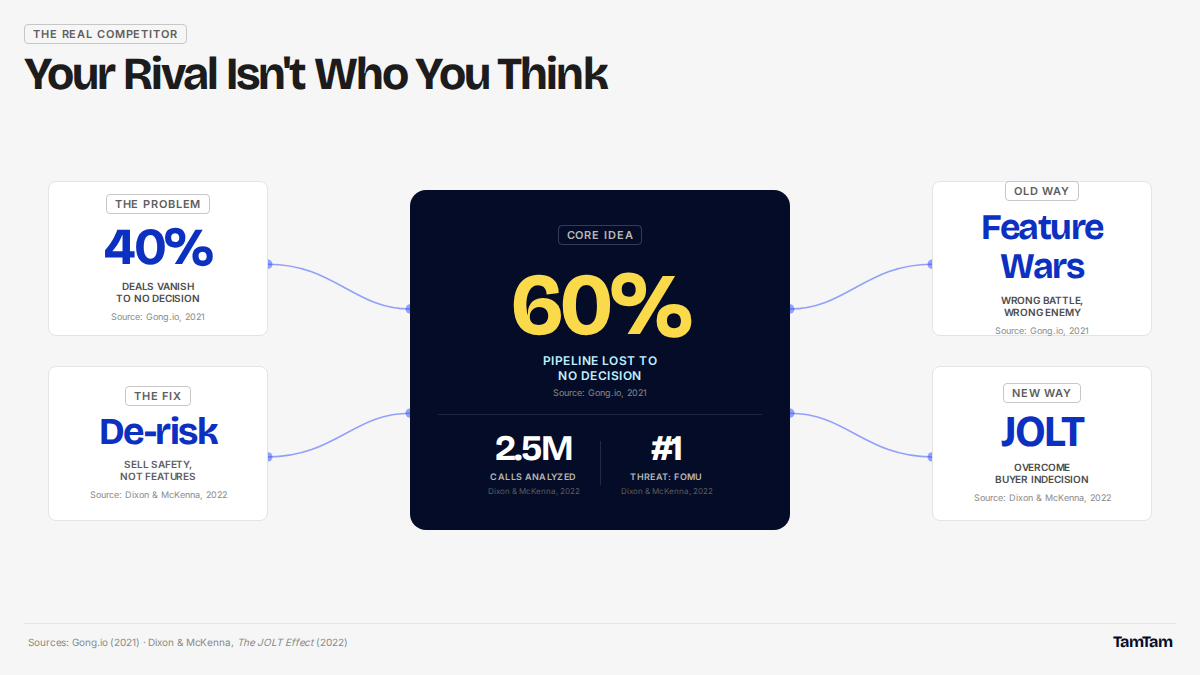
Most deals aren't lost to direct competitors but to buyer indecision driven by the Fear of Messing Up (FOMU). Teams often waste valuable time on feature-to-feature battlecards, which act as a security blanket but fail to address the real problem. The key to winning is to shift from selling features to selling safety, de-risking the purchase for your champion to overcome inertia and build internal consensus.
Your sales manager asks, "Who are we up against on the Acme deal?"
You check your notes. "It's between us and Vendor X."
And so the game begins. You pull up the battlecard, memorize your three key differentiators, and prepare for a feature-by-feature cage match. You spend hours strategizing how to beat Vendor X.
Then, a month later, the deal is dead. Not because they chose Vendor X, but because they chose... nothing. "Timing wasn't right." "Budget got re-prioritized." "Sticking with our current process for now."
Sound familiar?
This is the central delusion of modern B2B sales: we're addicted to fighting the wrong war. We obsess over direct competitors : the other companies selling a similar solution to the same problem. They look like us, talk like us, and show up in the same Gartner quadrant.
But the data screams that they aren't the real enemy. According to Gong, somewhere between 40% and 60% of qualified pipeline is lost to "no decision." Think about that. For every deal you lose to your named rival, you probably lose two or three to the void.
That void is your indirect competitor. It's any alternative that prevents a customer from buying your product, even if it looks nothing like it. It's the tangle of internal politics, hidden costs, and human psychology that makes "doing nothing" the easiest and most common decision.
Fighting your direct competitor is a comfortable lie. It feels productive. It has clear rules and a scoreboard. Fighting your indirect competitor is messy, complicated, and requires you to be more of a psychologist than a product expert. But it's the only battle that actually matters. It's also why account planning has to start from a sharp ideal customer profile: bad-fit accounts are the ones most likely to stall in "no decision."
When a deal dies, "no decision" is the cause of death listed on the certificate. But it's never the real reason. The real killers are four specific indirect competitors that feed on fear and inertia. A great rep knows how to identify which one they're facing and neutralize it before it kills their deal.
This is the undisputed, undefeated market leader in every B2B category. The status quo is the current way your prospect handles the problem you solve. It’s the familiar process, the devil they know.
Ah, the hero complex. This is the siren song of every engineering department and scrappy manager who looks at your polished software and thinks, "Psh, I could get a couple of interns to build that in a weekend."
This is the most misunderstood competitor. When a buyer says, "We don't have the budget," they're not saying the company is broke. They're saying your project isn't important enough to get the budget over something else.
This is the final boss. The invisible enemy. It’s the root cause that gives power to the other three. Buyer indecision is the paralysis that sets in when humans are faced with a high-stakes, complex decision. It's fueled by a singular, powerful emotion: the Fear of Messing Up (FOMU).
In their book The JOLT Effect, Matt Dixon and Ted McKenna analyzed 2.5 million sales calls and found that the biggest driver of lost deals wasn't the status quo; it was the buyer's inability to make a choice at all.
So, if theory is great but revenue is better, how do the best reps use this? They intuitively map these threats in their account plans. Forget complex Porter's Five Forces models designed for MBA classes. This is about a mental model you can sketch on a napkin.
It starts by shifting your own definition of what you sell.
The best reps then mentally map the battlefield across four quadrants, giving each one the weight it deserves:
Notice how the direct competitor is just one box out of four. That's the correct proportion of attention it deserves.
This mental model plays out in the real world all the time.
Example 1: Slack (in the early days)
Slack didn't win by having better emojis than HipChat. They won by waging an all-out war against email. Their entire marketing and sales motion was built on exposing the deep, painful costs of the status quo.
Example 2: Notion
Notion's genius is that it's not just a Confluence-killer. It's a Google Docs-killer, a Trello-killer, and a "my brain is a sieve"-killer all in one. It attacks the status quo and the DIY mess head-on.
This way of seeing the battlefield can't be just another mandatory CRM field that reps pencil-whip. It's a fundamental shift in how discovery is conducted and how pipeline reviews are run.
In Discovery:
The goal of discovery isn't to qualify based on BANT; it's to uncover these four threats. What separates mediocre discovery from great discovery are the questions. They shift from product needs to psychological barriers. For example:
In Pipeline Reviews:
The entire conversation changes. Useless questions like, "Who are we up against?" get replaced with questions that actually diagnose the health of the deal.
The new questions become:
This changes the entire conversation from features to fear. From product to psychology.
| Competitor Type | What it Sounds Like (The Buyer's Excuse) | The Real Driver (The Underlying Psychology) | The Winning Strategy (How to Beat It) | Key Signal to Look For |
|---|---|---|---|---|
| Status Quo | "We're fine with our current process." | Inertia & Fear of the Unknown | Quantify the hidden costs of inaction. Make staying the same feel riskier than changing. | Complacency. Lack of a clear "burning platform" or event driving the change. |
| DIY Solution | "We have engineers, we can build this." | Hubris & Illusion of Control | Build a ruthless TCO/ROI model that includes maintenance, support, and opportunity cost. | A strong internal engineering culture or a history of building internal tools. |
| Budget Competitor | "We don't have the budget this quarter." | Misaligned Priorities | Multi-thread to the economic buyer. Tie your solution to a top-line corporate initiative. | Your champion can't clearly articulate how your project helps the CEO's goals. |
| Buyer Indecision (FOMU) | "..." (Radio silence, stalled momentum) | Fear of Messing Up (FOMU) | The "Safety Sale": De-risk the purchase with pilots, guarantees, peer case studies, and clear implementation plans. | A champion who loves your product but can't get internal consensus. The deal "goes dark." |
The job isn't to pick one competitor to fight. It's to realize you're fighting a multi-front war and you need to deploy the right strategy for each enemy.
First, diagnose the primary threat. Listen carefully during discovery. Is the dominant theme, "We're comfortable" (Status Quo)? Or is it, "We're smart, we can build it" (DIY)? Is it, "We're busy with bigger things" (Budget)? Or are you just getting happy ears followed by total silence (FOMU)? The language they use will tell you which enemy is in the lead.
Second, map the fear. Once the main threat is identified, identify the person who embodies it. Who is the VP of "If it ain't broke"? Who is the Director of "We can build that"? Who is the CFO of "Show me the numbers"? And most importantly, who is the champion whose career is on the line if this fails? The fear is always personal. Find the person, find the fear.
Finally, the counter-move isn't a clever line, it's a tailored strategy. A one-size-fits-all pitch is useless here.
Burn your feature-comparison battlecards. They’re a security blanket for reps who prefer the comfort of a product debate over the messy reality of human psychology. The real pros are risk-mitigation experts first, and product-pitchers second. They obsessively map the full competitive landscape, from direct rivals to the buyer's own internal monologue, because it's the only way to see the whole board. That's also why the lead list matters so much : when reps work accounts already showing a clear buying trigger, the FOMU shrinks. Tamtam rebuilds that list every morning, around the buying triggers your past won deals taught us to recognize, so reps walk into every conversation with a real reason for the buyer to act now.
Set up for you before our first call
Book a demo