May 20, 2026
Your supposedly clean B2B email list is a ticking time bomb. Due to new Google and Yahoo rules, a bounce rate over 2% can get your domain blacklisted, and most B2B data decays faster than you think. Relying on a data provider's built-in verifier is a rookie mistake driven by a conflict of interest. The only way to protect your domain is to separate finding from verifying and use a just-in-time workflow to validate every email at the moment of outreach.
Let’s get one thing straight. The way you’ve been thinking about email lists is now obsolete. Sourcing the data is only half the job; verifying it is what keeps your domain alive, and it's the step most data enrichment workflows quietly skip. As of February 2024, new rules from Google and Yahoo are in full effect, and they have teeth (1). If you send bulk emails (over 5,000 per day), your complaint rate must stay under 0.3%, and your bounce rate must stay low. While they don't give a hard number for bounces, the industry consensus is clear: anything consistently over 2% puts your domain on a fast track to the spam folder, or worse, a complete block.
This isn't a slap on the wrist. It's a kill switch.
For years, a high bounce rate was just an annoying vanity metric. You wasted some credits, your SDRs grumbled, and you moved on. Now, it's a direct threat to your entire outbound operation. A trashed domain reputation can take months to repair, if it can be repaired at all.
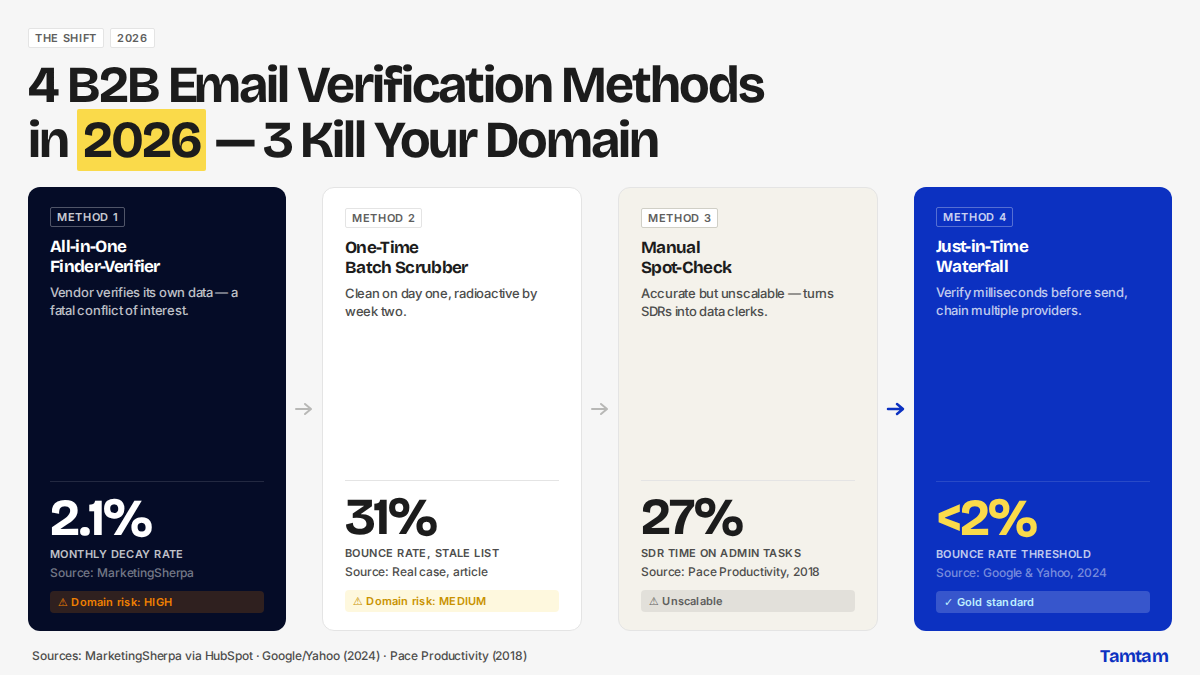
The problem is, B2B data decays at a horrifying rate. People change jobs, companies get acquired, email servers get reconfigured. According to MarketingSherpa, B2B contact data decays at a rate of 2.1% per month (2).
Do the math. A list that was 99% accurate on January 1st is already a domain risk by February 1st. That "clean list" you bought last quarter? It's radioactive.
This new reality forces a hard look at the old ways of verifying emails. Most of them are no longer just inefficient; they're actively dangerous. Let's break down the four common methods and see why three of them are recipes for disaster.
This is the most common approach. You buy a big-name data provider like Apollo, ZoomInfo, or Lusha. You search for contacts, see a little green "verified" checkmark, and assume you're good to go. It’s easy, it’s integrated, and it’s a trap.
We recently spoke with a RevOps leader who fell into what we call the "$8,000 Tool Trap." His team was using a major all-in-one platform, paying a premium for "verified" contacts. Their bounce rate was hovering between 8% and 12%, and their domain health was in the toilet. The platform's support team was useless. The "verified" checkmark was, for all intents and purposes, a marketing feature, not a technical guarantee.
The next logical step for a frustrated team is to take matters into their own hands. You export a big CSV of contacts from your CRM or data provider and upload it to a dedicated "email cleaning" service like NeverBounce or ZeroBounce. You pay a fee, it scrubs the list, and you get back a "clean" CSV.
A sales manager posted a now-infamous horror story on a social network about the "31% Bounce Rate Nuke." His team had batch-scrubbed a list of 10,000 contacts. It was clean, perfect. But the campaign got delayed by three weeks. Confident in his "verified" list, he launched the sequence anyway. The result? A 31% bounce rate, an instant domain block, and a conversation with his CEO that probably wasn't very fun.
This is the artisanal, old-school approach. Before adding a key prospect to a sequence, an SDR manually pastes their email into a free online verifier or, even worse, sends a "test" email from a burner account.
This isn't a tool; it's a philosophy. It acknowledges the fundamental truth that B2B data is never static. Instead of treating verification as a one-time event ("cleaning a list"), it treats it as an automated, integrated step in the outreach process.
Verification happens via an API call in one of two ways:
Okay, so "Just-in-Time" is the philosophy. But there's a standard version and then there's the pro version. The standard approach hooks your system up to one good verifier. Solid.
The pro version uses a waterfall. This isn't some complex tech nightmare. It's a dead-simple, brutally effective logic. Instead of relying on a single verification service, you chain several of them together. Your system asks Provider #1: "Is this email valid?" If #1 says "no" or "maybe," it doesn't just quit. It instantly asks Provider #2. Then #3. It stops the second it gets a confident "valid" response.
Why go to this trouble? Because it solves the painful tradeoff between match rate and accuracy. No single data provider is the best at everything. Provider A might have amazing data for US tech startups but suck at European manufacturing. Provider B might be the opposite. A waterfall approach lets you leverage the strengths of all of them, in sequence. The result is you find and validate more of the right emails without letting garbage into your system. You maximize the number of contacts you can reach (high match rate) while keeping your bounce rate near zero (high accuracy). It's the best of both worlds, automated.
This is the "aha!" moment. You stop worrying about whether your list is clean and start building a workflow that ensures you never send a bad email. It's a permanent solution, not a temporary fix.
| Verification Method | Accuracy (at moment of send) | Domain Risk | Workflow Complexity | Best For (Team Profile) | The Honest Truth |
|---|---|---|---|---|---|
| All-in-One Finder-Verifier | Low | High | Very Low | Teams prioritizing convenience over performance. | You're trusting a vendor with a clear conflict of interest. |
| One-Time Batch Scrubber | High (for 24h) | Medium | Low | One-off, massive campaigns used immediately. | Creates a false sense of security and encourages bad habits. |
| Manual Spot-Check | Very High | Low | Extremely High | Freelancers with a handful of VIP targets. | Utterly unscalable and a massive waste of SDR time. |
| "Just-in-Time" Workflow | Very High | Very Low | Medium | Professional revenue teams serious about deliverability. | The gold standard is a 'waterfall' approach using multiple verifiers. |
Forget about choosing a tool for a moment. Choose a workflow. Your decision boils down to a single, critical question: When do you need to know if an email is valid?
If you think you need to know when you build your list, you're still stuck in the old model. This flawed premise leads you directly to the Convenience Trap of Method 1 or the Illusion of Validity of Method 2. You’re focused on the static asset, the "list," which, as we’ve established, is a fantasy.
If you understand that you only need to know milliseconds before you hit 'send', then you have embraced the reality of data decay. This realization leads you exclusively to the "Just-in-Time" workflow of Method 4. The tool you choose is simply the one that enables this workflow most effectively within your existing tech stack, ideally with a waterfall model to maximize your reach without risking your reputation.
The goal is no longer to have a "clean list." That's a fool's errand. The goal is to have a clean process that ensures you never send to a bad address in the first place. This means you stop treating contacts as a static asset to be hoarded and start treating your domain reputation as your single most valuable asset in outbound. This requires a new way of working, where your sales intelligence is as dynamic as the market itself. It’s why platforms like Tamtam build this multi-source, waterfall verification logic directly into the list-building process. Instead of just delivering static lists that are obsolete on arrival, this approach ensures every contact is validated against the best available data the moment it's identified, connecting you not just to a verified person, but to a real, timely opportunity.
Set up for you before our first call
Book a demo