October 2, 2026
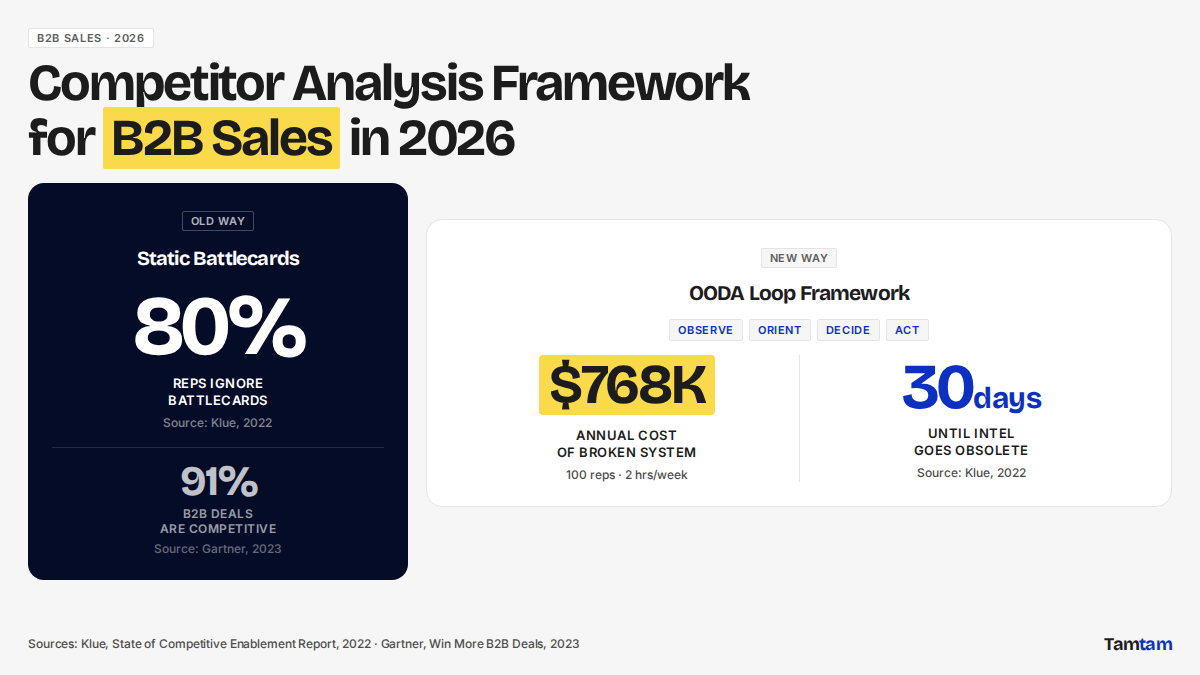
Traditional sales battlecards are a costly failure, with 80% of reps ignoring them as they become obsolete within a month. Instead of static feature lists, effective teams need a new mental operating system based on the OODA Loop (Observe, Orient, Decide, Act). This framework equips reps with psychological tactics like the Pratfall Effect and the "Reverse Compliment" to build trust and control the narrative. The goal is to transform reps from script-readers into autonomous operatives who can dismantle competitors and win high-stakes deals.
Let’s be honest. Your reps ignore your competitive battlecards for a good reason: they're mostly useless. Klue reports that a pathetic 20% of reps actually use the intel they're given, and that intel is likely stale anyway. It goes obsolete in about a month.
In a world where Gartner finds 91% of B2B deals are competitive, you're sending your team into a knife fight armed with a laminated history book.
You think you're helping them. You've got your marketing team spending hours putting together these beautiful, comprehensive PDFs listing every feature, every talking point, every "landmine" question. And for what? So your reps can pull them up mid-call, frantically scroll through 12 pages of bullet points, and sound like a robot reading a Wikipedia entry?
It’s not working. And it’s not the reps’ fault. The problem isn’t that the battlecard needs another update. The problem is the battlecard itself. It’s a relic from an era of static, predictable sales cycles. Today, you’re not in a structured debate. You’re in a dogfight.
It’s time to stop trying to manage risk and start training killers. Here's how to build a framework that actually works.
| Dimension | The Old Way: Static Battlecards | The New Way: OODA Framework |
|---|---|---|
| Primary Goal | Equip reps with pre-approved answers. | Equip reps with a mental model to think. |
| Core Asset | A static PDF or wiki page. | A dynamic decision-making loop. |
| Rep's Role | Script-reader, feature encyclopedia. | Autonomous intelligence operative. |
| Source of Truth | Marketing team (30 days ago). | The live reality of the sales call. |
| View of Competitor | An enemy to be attacked with "landmines." | A data point to be used for positioning. |
| Result | Brittle reps who sound like robots. | Agile reps who control the narrative. |
Before you can build something new, you have to burn the old thing to the ground. That starts with acknowledging that your current approach is not only ineffective but actively costing you a fortune.
Why this matters: You can’t fix a problem you refuse to see. Most sales leaders see battlecards as a cheap insurance policy. They're actually an expensive liability. The symmetric, feature-vs-feature warfare they encourage is a race to the bottom that turns your unique solution into a commodity.
What to do: First, accept the grim reality. Your battlecards are part of the 80% that get ignored. They are digital dust.
Second, calculate the real cost. Don't just count the marketing hours spent creating them. Calculate the opportunity cost of lost deals and the direct cost of reps wasting time. Let's do some back-of-the-napkin math. Say you have 100 sales reps. If they spend just two hours a week fumbling with outdated info or trying to do their own last-minute competitive research, that’s 200 hours a week.
Let’s assume a 48-week work year and a fully-loaded hourly cost of $80 for a sales rep.
100 reps x 2 hours/week x 48 weeks x $80/hour = $768,000 per year.
That’s over three-quarters of a million dollars in squandered sales time. That's the price you pay for clinging to a broken system. Put that number on a slide. Show it to your CEO. Make the pain undeniable.
Common Mistake to Avoid: The most common mistake is thinking the solution is a "better" battlecard. "We just need to update it more often!" "Let's put it in a new app!" "We need more detail!" This is like trying to fix a sinking ship by rearranging the deck chairs. The static document format is the problem, not the font you use.
Stop giving your reps a fish. Teach them how to hunt. Instead of a static document, you need to install a dynamic mental model in their heads. The best one for the job is the OODA Loop.
Developed by military strategist and U.S. Air Force Colonel John Boyd, the OODA Loop is a four-step process for making decisions in high-stakes, fluid environments. It stands for Observe, Orient, Decide, Act.
Why this matters: Sales calls aren't scripted plays. They're chaotic, unpredictable encounters. A battlecard tries to pre-calculate every move, which is impossible. The OODA Loop teaches a rep how to think and adapt in real time, cycling through decisions faster than the buyer or the competitor.
What to do: Train your team to see every interaction through this loop:
Boyd found that during the Korean War, American F-86 pilots consistently beat pilots in the supposedly superior Soviet MiG-15. Why? The F-86 had a better field of vision and faster hydraulic controls, allowing its pilots to cycle through the OODA Loop more quickly. They could observe, orient, decide, and act while the MiG pilot was still trying to figure out what the hell was going on. The pilot with the faster loop wins. Always.
Your sales reps are in the same situation. The one who can take a buyer's question (Observe), place it in the context of their pain and the competitive landscape (Orient), choose the perfect response (Decide), and deliver it confidently (Act) will control the entire conversation.
Common Mistake to Avoid: Focusing only on the "Act" phase. Most sales training is about what to say. The OODA Loop teaches you that the "Orient" phase is where the magic happens. Reps who rely on battlecards have outsourced their orientation phase to a marketing team from three weeks ago. They are guaranteed to lose.
Your product has flaws. Yes, it does. Stop training your reps to pretend it doesn't. Radical honesty isn't just ethical; it's a weapon. When you strategically admit a weakness, you build a level of trust that your competitors, with their slick and flawless presentations, can never achieve.
Why this matters: Buyers are not idiots. They have highly sensitive bullshit detectors, honed by years of being sold to. An unbroken stream of "we're the best at everything" perfection triggers those alarms. Admitting a small, strategic flaw makes everything else you say 10 times more believable. This is grounded in psychology, specifically the Pratfall Effect and the Blemishing Effect, which show that people are more appealing and trustworthy after they make a mistake or show a minor flaw.
What to do: Train your reps to distinguish between a "signal flaw" and a "damage flaw."
Here's an example script, the "Data Warehouse Pratfall Protocol":
The typical rep: "Our solution offers frictionless, seamless data migration. You'll be up and running in no time!" (Buyer's internal monologue: "Yeah, right.")
The Pratfall-trained rep: "I'm not going to lie to you, the first two weeks of migration can be a pain. We're moving a decade of your company's most critical data, and it requires focus from your team. Competitor X will tell you it can be done in a day with one click. And it can. But our process is more rigorous because it ensures zero data corruption and sets up the architecture to handle the complex queries you told me are critical for your business. It's a harder first two weeks for a much, much better next five years."
Who would you buy from?
Common Mistake to Avoid: Fearing that admitting any weakness will kill the deal. The opposite is true, provided you're admitting a signal flaw. It disarms the buyer, proves you're a straight shooter, and reframes your strengths as even more powerful.
Now for the tactical application. When the competitor's name comes up, the worst thing your rep can do is attack. It makes them look defensive, desperate, and insecure. The second worst thing is to pretend they don't exist.
The pro move is the "Reverse Compliment." You acknowledge a competitor's strength and then, in the same breath, reframe it as a liability for this specific buyer's context.
Why this matters: This technique allows you to control the narrative without looking like a jerk. You're not mud-slinging. You're being a helpful, strategic consultant who understands the market landscape. It shows you're confident enough to praise a competitor, which, paradoxically, makes you look stronger.
What to do: Master this script, based on a real-world example from Brian LaManna at Gong. When a prospect brings up a competitor, you say:
"Oh yeah, [Competitor Name]? They are a fantastic tool if your primary goal is [simple task they are known for]. They do that one thing incredibly well.
But based on what you told me about [the buyer's complex, strategic outcome], that's just not what they're built for. That’s where we live."
Let's break it down:
Game over.
Common Mistake to Avoid: Actually believing the compliment is the point. It's not. It's a strategic maneuver. It's the jiu-jitsu move that uses the competitor's own weight against them to frame them out of the deal.
Here’s the final mindset shift. After all this, you need to realize that your biggest competitor usually isn't Competitor X or Competitor Y. It's the status quo. It's buyer inertia. It's the overwhelming organizational gravity that pulls people toward doing nothing.
Why this matters: If you spend the entire sales cycle obsessed with beating another vendor, you can win the battle and still lose the war. You can be the "winner" of the bake-off, only for the buyer to come back and say, "You know what, we've decided to table this initiative until next year." The real goal isn't to be chosen over Competitor X; it's to make the pain of staying the same greater than the pain of change.
What to do: Reframe the presence of a competitor as a positive buying signal. A competitor getting involved means the buyer is serious. They have a budget. They have intent. The competitor isn't an enemy to be vanquished; they are a catalyst that forces the buyer to confront their own pain.
As the team at the 30 Minutes to President's Club podcast puts it, "status quo is actually probably our biggest competitor in every single deal." Your job is to leverage the evaluation process to build such a massive value gap between your solution and the buyer's current reality that choosing anyone else, including the "do nothing" option, feels like an active step backward.
Use the competitor's presence to ask better questions: "What's driving you to evaluate solutions like ours and Competitor X's right now? What happens if you don't make a change in the next six months?" Elevate the conversation above a feature-for-feature slap fight and back to the strategic business problem.
Common Mistake to Avoid: Getting dragged into the bake-off. The moment you're debating the minutiae of Feature A versus Feature B, you're playing the competitor's game on their terms. Your game is to constantly elevate the conversation back to the strategic outcome that makes both the competitor's limited solution and the status quo completely unacceptable.
The old world of sales tried to mitigate risk with scripts and encyclopedias. That world is dead. This framework gives your reps the brains and spine to win any dogfight they enter. But the ultimate edge isn't just knowing how to fight; it's knowing which fights are worth having in the first place. That shift from tactical skill to strategic intelligence, from winning arguments to finding the accounts where the pain is real and the timing is right, is the entire game. It's the core problem we're obsessed with at Tamtam.
Set up for you before our first call
Book a demo