September 30, 2026
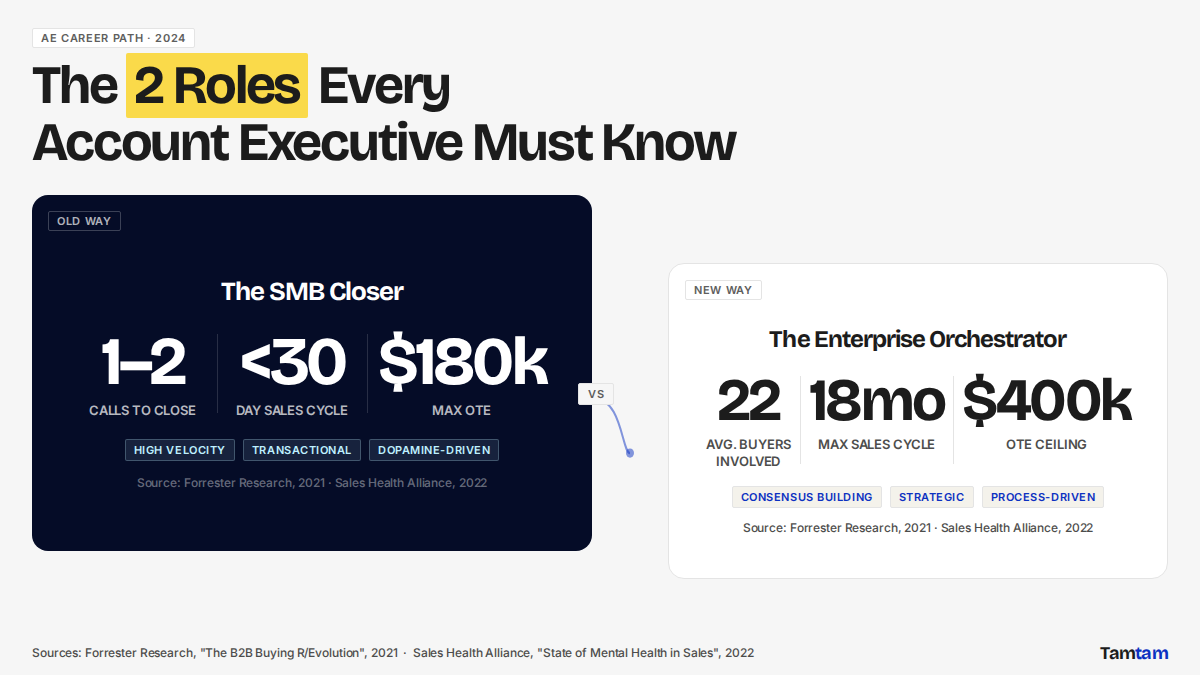
The Account Executive title masks two distinct career paths: the SMB "Closer" focused on high-velocity, transactional wins, and the Enterprise "Orchestrator" who manages slow, complex deals. These roles demand different skills and psychological temperaments, making the traditional career ladder a trap. Promoting a top Closer to an Enterprise role without retraining often leads to failure, as it requires abandoning a successful ego-driven identity for a more patient, strategic one. This guide unpacks both roles to help you navigate the AE career path successfully.
The job title "Account Executive" is a lie.
It implies one career path, a linear progression from small deals to big ones. Junior AE, Mid-Market AE, Enterprise AE. It sounds so simple. So logical.
It’s also a complete fantasy.
The truth is, there are two fundamentally different jobs hiding under that one title. They require different brains, different temperaments, and different definitions of success. They are two different species that evolved in different environments. Confusing one for the other is the single fastest way to kill your career.
The SMB "Closer" lives in a world of speed and volume. Their game is about momentum, efficiency, and the art of the one or two-call close. This is the classic salesperson you see in movies. Sharp, persuasive, and always moving on to the next one.
Who it's best for: High-energy individuals who thrive on quick wins, immediate feedback, and a competitive, fast-paced environment. They get a genuine buzz from the art of persuasion.
The Psychology: This role is dopamine-driven. The Closer gets a chemical high from the daily win, the quick signature, the fast commission check. Their ego and identity are welded to being a "deal-maker." The pipeline is a conveyor belt, and their job is to keep it moving at all costs. Stagnation feels like death.
The Daily Reality: It’s a blur of activity. We’re talking 30 to 50 calls a day, back-to-back demos, and mastering the art of overcoming the same three objections over and over again. You simplify the value prop, create a little urgency, and get the credit card details. It's a numbers game, and they're built to play it.
Strengths:
Weaknesses:
Verdict: The Closer is a master of the transactional sale. In the right environment, they are an unstoppable force of revenue generation.
The Enterprise "Orchestrator," sometimes called the "CEO of the Deal," lives in a world of complexity and patience. Their game is slow, strategic, and has more in common with diplomacy and project management than traditional selling.
Who it's best for: Patient, strategic thinkers who enjoy solving complex business problems, managing massive projects, and building deep, long-term relationships. They see sales as a form of high-stakes consulting.
The Psychology: This role is process-driven. The Orchestrator gets satisfaction from untangling a complex political knot, aligning a dozen stakeholders on a single vision, and navigating a project plan to completion over many months. Their ego is tied to being a "strategic partner," not just a vendor. A quick, easy win almost feels suspicious.
The Daily Reality: Forget back-to-back demos. Their days are spent managing spreadsheets, building financial models to justify a seven-figure price tag, and orchestrating internal resources. They spend more time talking to their own legal, security, and product teams than they do pitching customers. They map complex political hierarchies within the target account, identifying champions, blockers, and influencers.
Strengths:
Weaknesses:
Verdict: The Orchestrator is a master of the complex, transformational sale. They don't just sell software; they shepherd massive change-management projects.
The industry looks at these two roles and says, "Start as a Closer, get good, and we'll promote you to Orchestrator."
This is like training a world-class sprinter for years and then, as a reward, putting them in a marathon and expecting them to win. It's not just a bad idea. It's cruel.
Psychologists have a term for when you build your entire identity around a single role or belief: "identity foreclosure." A top SMB Closer's identity is "the person who gets deals done, fast." Their sense of self-worth is tied to their Salesforce dashboard.
When they get promoted to an Enterprise role, they do what they’ve always done. They try to create urgency with a prospect who has a 12-month procurement cycle. They talk past a security objection from a CISO who holds the keys to the kingdom.
And it backfires. Spectacularly.
Their proven tactics, the very things that made them a star, are now signs of amateurism. The brain perceives this threat to their competence as a threat to their survival. This triggers a massive wave of cognitive dissonance, anxiety, and burnout. It's a complete fucking mind-scramble. They question everything they thought they knew about their own talent.
Imagine Dave, a top SMB rep who closed 20 deals last quarter. He lands his first big enterprise meeting. He offers a juicy end-of-month discount to the Chief Information Security Officer. Dave thinks he's making a power move. But the CISO doesn't care about saving 15%. She cares about SOC-2 compliance, data residency, and a vendor security assessment that takes three months. Dave didn't just fail to create urgency; he vaporized his own credibility. The deal is dead, and he doesn't even know why.
The world Dave stepped into is terrifyingly complex. He thinks he's selling to a person. He's not. He's selling to a committee.
According to Forrester, the average B2B buying decision now involves 22 people. That’s 13 internal stakeholders and 9 external influencers. It's an absolute mess of competing priorities, hidden agendas, and political landmines.
The AE's job is no longer persuasion. It’s consensus engineering. You aren't there to convince the buyer. You are there to help the buyer navigate their own internal dysfunction. This is the reality that triggers the psychological crisis for the unprepared Closer. Their superpower was influencing a single mind. Now they have to influence a small city.
This isn't just a career problem. It's a health crisis. Research from the Sales Health Alliance shows that 70% of sales professionals are struggling with their mental health.
A huge part of this comes from the pressure of unattainable quotas and, more subtly, the psychological dissonance of being in the wrong role. The system is designed to promote people based on a skillset that guarantees their failure and misery at the next level. We take our best sprinters, tell them they're now marathon runners, fire a starting pistol, and then act surprised when they collapse two miles in.
The good news is, you can avoid this trap. But it requires a level of self-awareness that most "crush it" sales cultures don't exactly encourage.
The first step is to stop thinking about this as a promotion and start thinking about it as a career change. Then ask yourself some hard questions:
If your answers point toward volume, persuasion, and quick wins, that's not a failure. It means you're a Closer. Own it. Become the best damn Closer in the world. A great SMB AE is a force of nature. Don't let ego push you into a role that will make you miserable.
If you do decide the Orchestrator path is for you, you need new heroes. Your goal is no longer to be the smooth-talking salesperson. Your goal is to be the most trusted advisor in the room.
Here's what that actually looks like:
This is the new game. It's less about having all the answers and more about orchestrating the resources to find them. It's less about a perfect pitch and more about radical honesty.
| Criteria | SMB Account Executive ("The Closer") | Enterprise Account Executive ("The Orchestrator") |
|---|---|---|
| Primary Goal | Transactional Volume | Strategic Partnership |
| Average Deal Size | < $25k ARR | $100k to $1M+ ARR |
| Sales Cycle | < 30-60 Days | 6 to 18+ Months |
| Key Metric | # of New Logos, Velocity | Annual Contract Value (ACV), Deal Profitability |
| Buyer | Single Decision-Maker (e.g., Manager, Founder) | 22-person Buying Committee (Execs, IT, Legal, Procurement) |
| Core Skillset | Persuasion, Objection Handling, Pitching | Project Management, Financial Modeling, Consensus Building |
| Psychological Driver | Dopamine from the "Win" | Satisfaction from Solving a Complex Puzzle |
| Typical OTE | $100k to $180k | $250k to $400k+ |
Forget your title. Forget the ladder. Answer these three questions with brutal honesty.
The point isn't that one role is "better." A world-class Closer is an artist. A world-class Orchestrator is a grandmaster. The problem is the industry pretends they're playing the same game. They aren't. They are two different psychological sports. The most important decision you'll make in your sales career is figuring out which game you were built to play. Modern selling, especially upmarket, requires you to stop thinking like a salesperson and start acting like an intelligence officer: mapping the players, understanding the signals, and orchestrating the entire campaign long before you ever ask for the signature. For those built to be Orchestrators, this means your most valuable asset isn't your pitch, but the quality of your pre-deal research, a process where platforms like Tamtam are becoming the new foundation for building a winning strategy.
Set up for you before our first call
Book a demo