June 23, 2026
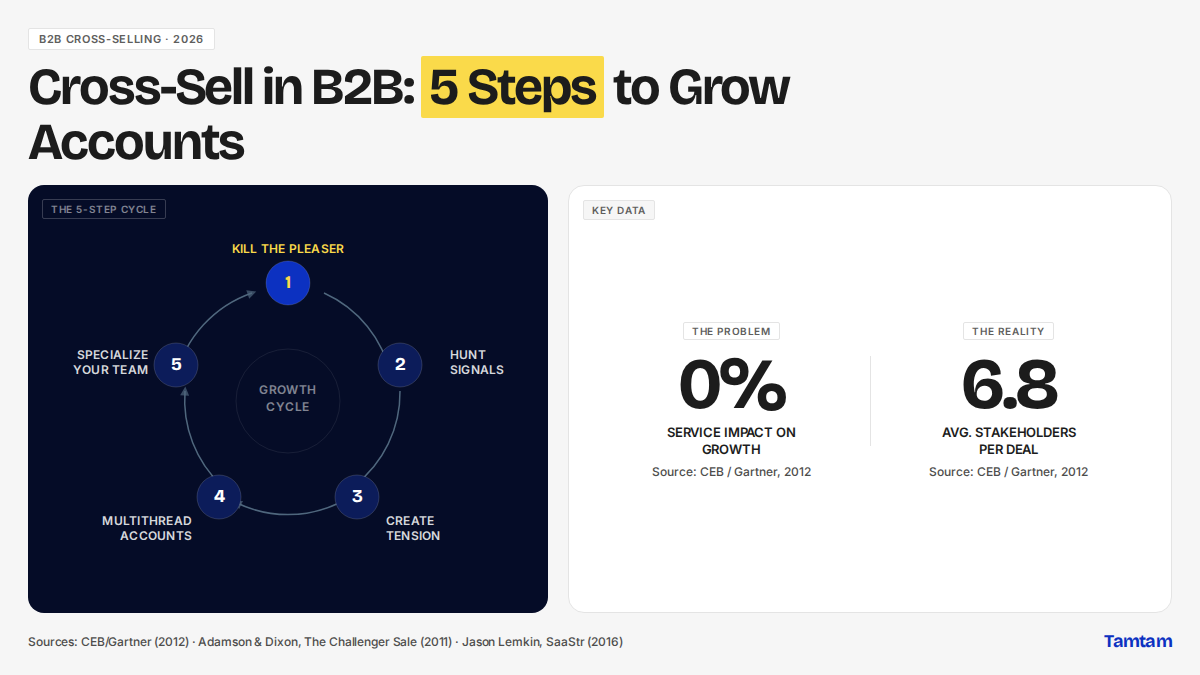
The belief that amazing service earns you the right to cross-sell is a common but costly myth in B2B sales. Data shows that true account growth comes from challenging customers with new perspectives, not just pleasing them. This guide provides a five-step playbook for this "challenger" approach, covering everything from shifting your mindset and hunting for buying signals to crafting pitches that create constructive tension and structuring your team for repeatable success.
Your crippling need to be liked by your customers is killing your revenue.
You think that by being available 24/7, answering emails at 9 PM, and acting as a glorified support rep, you'll be rewarded with more budget. You believe that if you just serve them harder, they'll eventually see your value and throw expansion deals your way.
Here’s the cold, hard truth: there is zero statistical connection between providing great service and driving account growth.
Research from Gartner's predecessor, CEB, analyzed thousands of B2B customer interactions and found that while good service prevents churn, it has no meaningful impact on expansion revenue. What does drive growth? Challenging your customer with a new perspective on their business, what they call "Customer Improvement."
You don't earn the right to cross-sell by being nice. You earn it by being valuable. And being valuable often means being uncomfortable. It's time to unlearn the biggest myth in account management and adopt a playbook that actually works. Cross-selling is one of the core motions of customer expansion.
The first step is a mindset shift. It’s the hardest one, because it forces you to rewire years of conditioning that tells you "the customer is always right."
Why this matters: The "pleaser" mindset makes you a reactive vendor, not a proactive partner. Pleasers wait for requests. Challengers bring insights. Pleasers solve today's small problems. Challengers reframe tomorrow's big opportunities. One gets you a "thank you" email. The other gets you a six-figure expansion contract.
What to do: Internalize this distinction:
Your job as an account manager isn't just to keep the customer happy. It's to make them more successful, even if that means pointing out a flaw in their current process.
A story of two reps: Meet Sarah. She's a Customer Success Manager with a 100% CSAT score. Her clients love her. She's always available, always helpful, always cheerful. During her last Quarterly Business Review (QBR), she vaguely mentioned their new analytics suite. The client contact, a mid-level manager, smiled and said, "Thanks, we'll keep it in mind!" Sarah logged it as a successful check-in.
Two weeks later, the client signed a massive deal with Sarah's competitor. Why? Because a sales rep from that company went over the manager's head, got a meeting with the CFO, and presented a data-backed case showing how the client's current reporting process was costing them 8% in operational waste per quarter.
Sarah pleased the user. The competitor challenged the business. Guess who got paid?
Common mistake to avoid: Believing you have to "earn the right" to cross-sell through months of flawless service. You don't. You earn the right the moment you have an insight that can materially improve your customer's business. Your value is your perspective, not your responsiveness.
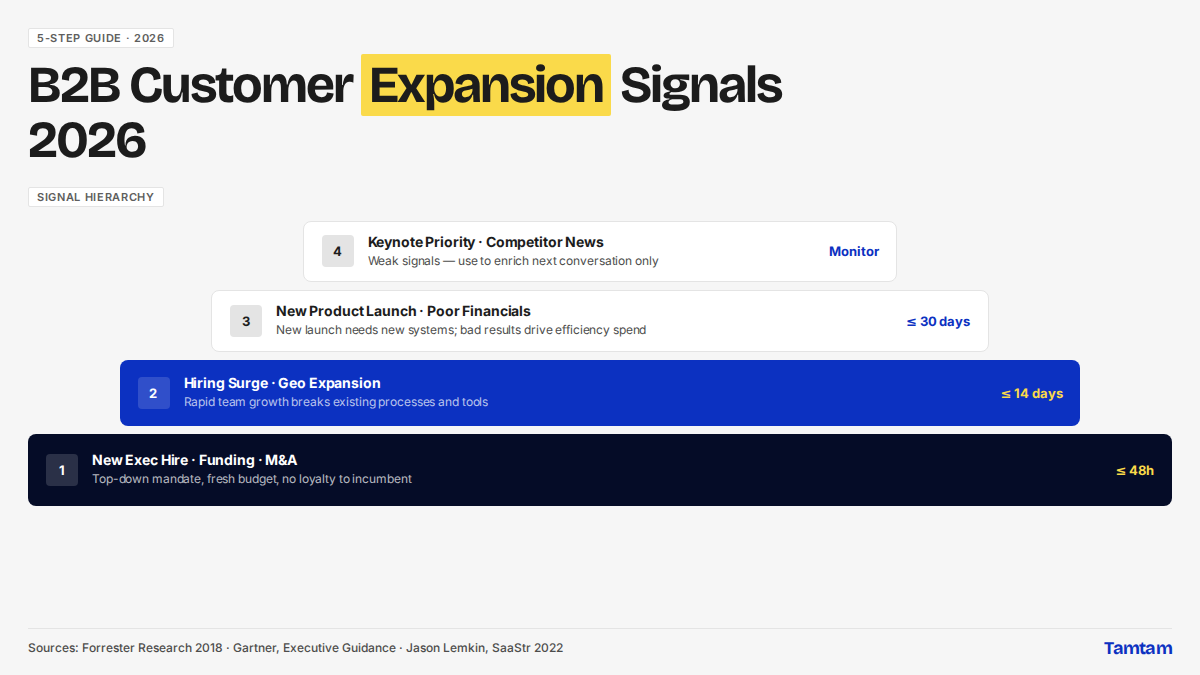
Pleasers wait for the QBR to ask, "So... any new projects coming up?" Challengers know that by the time a customer mentions a new project, it's probably too late. The real opportunities are hidden in the data, in the digital breadcrumbs your customers leave every single day.
Why this matters: Waiting for a scheduled meeting puts you in a reactive stance. You're relying on your customer to self-diagnose their own problems and connect them to your solutions. That's not their job, it's yours. Proactively hunting for signals lets you approach them with a hypothesis at the exact moment of need, making your pitch feel like telepathy, not a sales call.
What to do: Become a detective. Your two richest sources of intel are your product usage data and your support ticket logs.
Your customer’s actions inside your product speak louder than any words in a meeting. Look for these four high-intent expansion signals:
| Signal | What It Looks Like | What It Really Means (Your Pitch Angle) |
|---|---|---|
| Hitting Usage Limits | Constantly nearing their API call limit, running out of storage, or adding the max number of users. | "Your business is growing. Your current tier was built for the company you were, not the one you're becoming. Let's talk about a structure that supports your new scale." |
| Power User Behavior | One specific team is using an advanced feature 10x more than anyone else. | "I noticed the marketing team is living in the A/B testing module. This usually means they've proven its value and are ready to roll it out company-wide. What's the plan for that?" |
| Adjacency Adoption | Users from one department (e.g., Sales) start exploring features built for another (e.g., Marketing). | "I saw a few of your sales reps experimenting with the content analytics dashboard. Are they trying to create their own assets because Marketing's current process is too slow?" |
| Team Growth | You see a steady flow of new user invitations being sent out. | "Your team has grown by 30% in six months. How are you ensuring every new hire is onboarded correctly and not creating compliance risks with our platform?" |
Most companies see support tickets as a cost center. That's insane. Support tickets are a focus group you get paid for. They are a direct line into your customer's frustrations and unmet needs.
Your customer doesn't file a ticket saying, "I have a budget for your enterprise package." They file a ticket saying, "Why can't I export more than 1,000 rows?" or "How do I set up single sign-on?"
Every ticket that brushes up against the limitations of their current plan isn't a problem. It's a qualified lead. Create a system where support flags these "limitation-based" tickets and routes them directly to the account manager.
Common mistake to avoid: Treating support tickets as fires to be put out. Reframe them as signals to be captured. Stop relying on what customers say and start paying attention to what their behavior proves.
Once you've found a signal, you can't just drop it in an email and hope for the best. "Hey, noticed you're out of storage. Wanna buy more?" is lazy and will get you ignored. Your pitch is shit.
You need to use that signal to create constructive tension. This is the core of "Commercial Teaching," a concept from The Challenger Sale. You use data to reframe the customer's understanding of their own business, creating a gap between where they are and where they want to be. Your product is the bridge.
Why this matters: A pitch based on fear makes buyers defensive. They cling to the status quo because of loss aversion. A pitch based on constructive tension makes them curious. It challenges their assumptions and makes sticking with the status quo feel riskier than making a change.
What to do: Follow this four-part framework for your pitch:
See the difference? You didn't sell a feature (Enterprise Permissions). You sold a new reality (launching products faster).
Common mistake to avoid: Confusing tension with FUD (Fear, Uncertainty, and Doubt). "If you don't upgrade, you'll get hacked!" is fear. "Your current permission model is exposing you to compliance risks that could jeopardize your enterprise contracts. There's a safer way to operate." That's tension. One is an attack; the other is a diagnosis.
So you've found the perfect signal and crafted a brilliant, tension-filled pitch. It's completely useless if you deliver it to an end-user with no authority and no budget.
The number one killer of expansion deals is single-threading: relying on one point of contact within an account. That person could be your biggest fan, but they are also your single point of failure. They could leave the company, get re-orged, or simply not have the political capital to get your deal done.
Why this matters: Big B2B purchase decisions are made by committee. A CEB study found that the average is 6.8 stakeholders. If you're only talking to one of them, your odds of closing are, to put it mildly, not great. Multithreading de-risks your deal and gets your message in front of the people who actually control the budget.
What to do: Map the organization. Your champion is your entry point, not your final destination. Use them to understand the political landscape. Who else cares about this problem? Who owns the budget? Who would be the ultimate beneficiary of this change?
A brutally effective tactic from the 30 Minutes to President's Club podcast:
Now, craft your outreach. Don't go in cold. Use your champion as context.
"Hi [Executive Name],
I was speaking with Sarah in operations about the challenges they're facing with manual data entry as the team scales. It made me think about your wider company goal of improving operational efficiency this year.
My perspective is that those two things are deeply connected. I have an idea about how to solve Sarah's problem in a way that directly contributes to your strategic objective.
Worth a 15-minute chat next week?"
This message works because it’s relevant, shows you've done your homework, and connects a tactical problem to a strategic priority.
Common mistake to avoid: Being afraid to "go over your champion's head." You're not going over them; you're building a coalition around them. A good champion will welcome the support. If they get defensive, it's a red flag that they don't have the influence to get the deal done anyway.
The final piece of the puzzle isn't a tactic; it's a strategy. If you want to make challenging and cross-selling a repeatable, scalable engine of growth, you have to structure your team for it.
You cannot ask the same person to be a nurturing, empathetic, relationship-building CSM one minute, and a sharp, challenging, commercially-driven Account Manager the next. The psychological profiles are fundamentally opposed.
Why this matters: When you combine the roles, one will always win out. Usually, it's the nurturing side. A CSM with a heavy expansion quota is incentivized to not rock the boat. They won't risk their relationship (and their retention bonus) by introducing constructive tension. The result: happy customers who never, ever grow.
What to do: Separate the roles. As investor Jason Lemkin has argued for years, you need to split the functions:
The CSM and AM must work together as a team. The CSM identifies the signals and makes the warm introduction. The AM takes that intel and builds the commercial case, navigating the organization to get the deal done.
This split isn't just theory; it's being forced by technology. AI tools are now automating many of the basic "pleasing" tasks like sending onboarding emails, flagging health scores, and answering simple questions. This frees up humans to do what they do best: thinking critically, building strategic narratives, and challenging the status quo.
Common mistake to avoid: Giving your CSMs an expansion quota. A small one might be okay for obvious, customer-initiated upgrades. But any significant cross-sell motion needs a dedicated, commercially-focused owner. Don't ask your nurturers to be hunters. You'll just get a team that's bad at both.
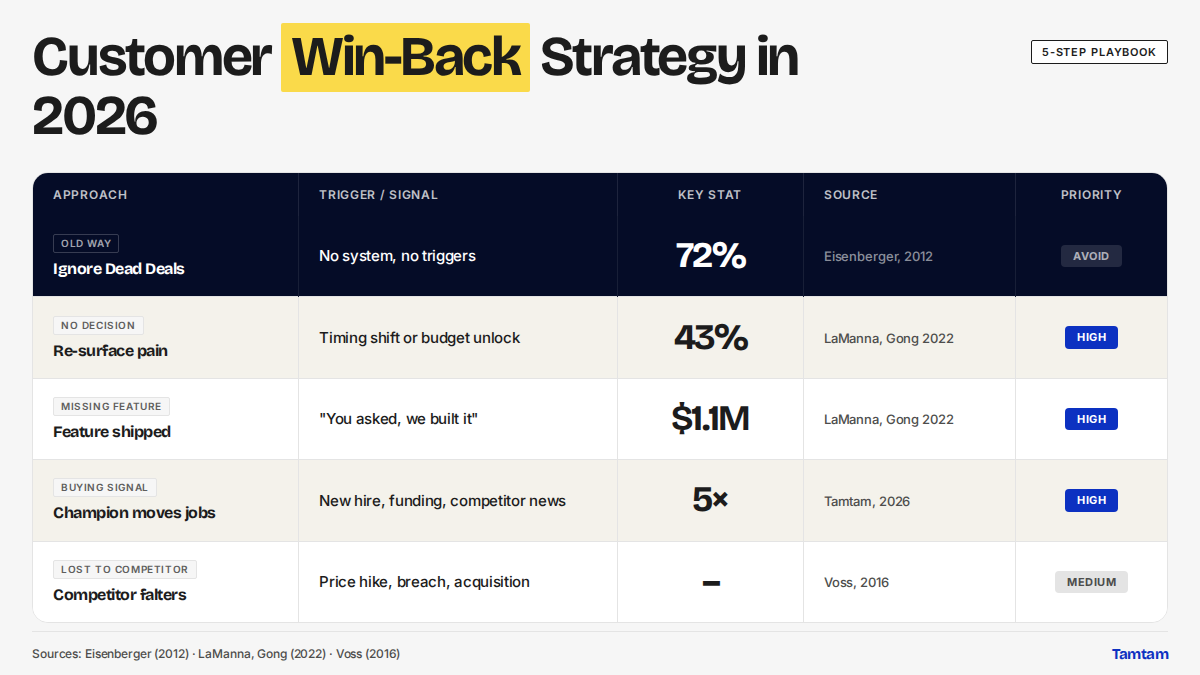
Stop acting like a vendor hoping for a tip and start acting like a strategic partner who uses intelligence to find and solve problems your customer doesn't even know they have. That’s not being a pest; it's being indispensable. The revenue is a byproduct of the insight you deliver, not the service you provide. All of this signal-hunting and analysis is hard work, and that’s the point. It’s what separates elite account teams from everyone else. The problem is, relying on individual heroics doesn't scale. The best teams build a machine to find these opportunities systematically. A platform like Tamtam is built on this exact philosophy: turning the messy art of spotting buying triggers into a repeatable science, arming your team with the specific insight needed to start that challenging conversation.
Set up for you before our first call
Book a demo