June 23, 2026
Customer health dashboards often lie by measuring complacency instead of opportunity. Real expansion revenue stems from "healthy chaos", disruptive events like new executive hires, funding rounds, and M&A that create an urgent need for new solutions. This playbook outlines a 5-step process to ditch vanity metrics and focus on the trigger events that signal a customer is truly ready to buy more. Acting on these signals quickly is crucial, as the first vendor to engage wins the deal 74% of the time.
You think your "healthiest" customers are ripe for an upsell. You know the ones: perfect product usage, green health scores across the board, and zero support tickets for six months straight.
You're dead wrong.
Those aren't your best expansion opportunities. They’re your most complacent accounts, the ones deeply addicted to the status quo. They’re happy, they’re stable, and they have absolutely no reason to change a thing, which includes giving you more money.
The real money, the kind of seven-figure expansion deals that make a quarter, isn't found in peace and quiet. It's found in chaos. It's found in the disruptive, messy, real-world events that your entire customer success industry is trained to ignore or, worse, fear.
This guide will show you how to stop managing accounts and start hunting for chaos. It's the timing layer behind a land-and-expand motion.
First things first: that color-coded dashboard you worship every Monday morning is an enemy of growth. Stop treating your customer health score as a predictor of expansion. Recognize it for what it is: a lagging indicator of past stability.
And stability is the enemy of change. No change, no new budget.
Traditional health scores are fatally flawed. They’re built on survivorship bias and misinterpret key signals. They overweight subjective feelings (like a CSM’s gut feeling) and reward inaction.
Think about it. A customer with zero support tickets isn't necessarily "healthy." More likely, they're stagnant. They aren't pushing your product’s limits, exploring new use cases, or even thinking about you at all. They’re coasting. And coasting customers don't sign bigger checks.
This is best explained by the story of Abraham Wald and the WWII bombers. During the war, the US military wanted to add armor to its planes, but they couldn't armor the whole thing or it would be too heavy. So they analyzed the bombers that returned from missions and meticulously mapped out where they had been hit by enemy fire. The initial plan was to reinforce those areas, the wings, the fuselage, the tail.
Wald, a statistician, pointed out their mistake. They were only looking at the planes that made it back. The armor shouldn't go where the bullet holes were. It should go where the bullet holes weren't: the cockpit and the engines. The planes hit in those spots never returned, so their data was missing.
Your "perfect" customer with the green score and no support tickets is the missing bomber. They're quiet, and you assume they’re fine. But in reality, they're quietly becoming irrelevant, getting disrupted by a competitor, or getting ready to churn because your product no longer solves their evolving problems.
Common Mistake to Avoid: Praising your team for accounts with flat, stable usage and zero support tickets. You're rewarding hibernation, not deep, strategic engagement. You're putting armor on the wings while the engine is about to explode.
If stable accounts are a dead end, where do you find growth? You hunt for chaos. You shift your entire focus from internal product usage data to external, real-world trigger events. It's the same discipline as buying signals for new accounts, turned inward on your customer base.
These events are signals of disruption. They shatter the status quo inside a company and create an immediate, urgent need for new solutions. A new executive has a mandate for change and a budget to make it happen. A new funding round comes with immense board pressure to scale right now. An acquisition forces a messy tech stack consolidation.
This isn't just "interest" like a whitepaper download. This is a circumstantial imperative to spend money. Your job is to find these moments.
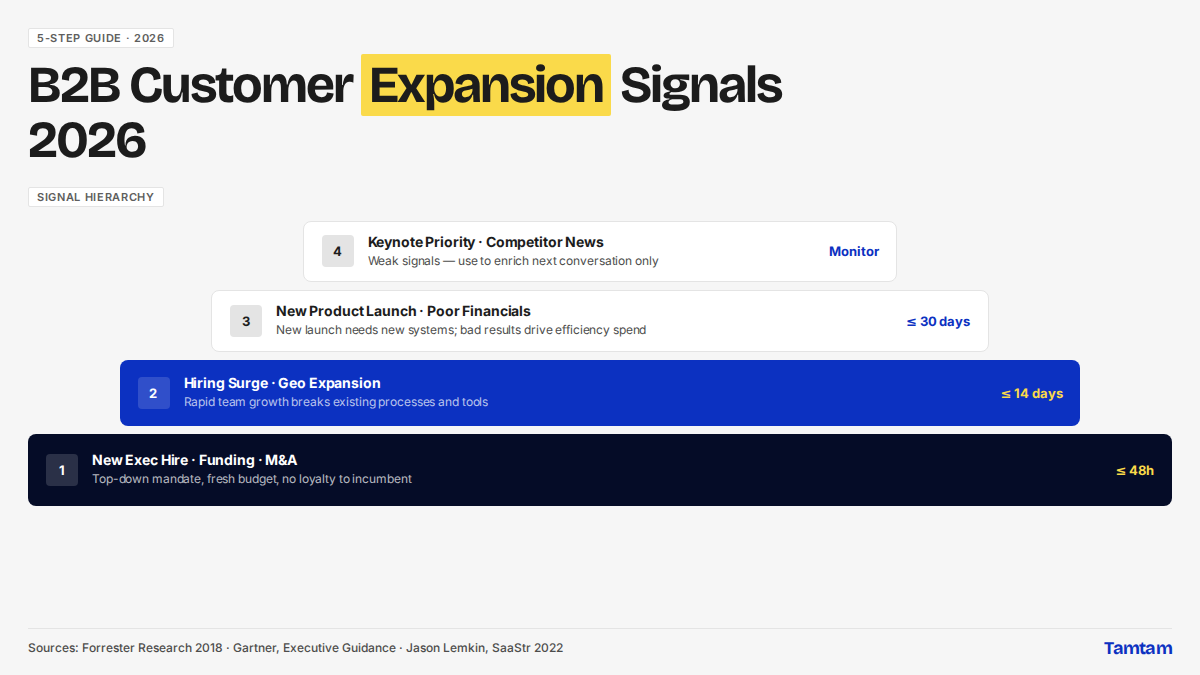
Not all signals are created equal. A blog comment is a whisper; a new CRO is a goddamn air horn. You must prioritize your response based on the urgency and impact of the trigger.
| Tier | Trigger Event | Your Response Time | Why It Matters |
|---|---|---|---|
| 1 | New Executive Hire (C/VP-Level), Major Funding Round, M&A | Within 48 Hours | These events unlock massive new budgets and signal an immediate, top-down mandate for change. The old playbook is out the window. |
| 2 | Departmental Hiring Surge, New Office/Geo Expansion | Within 14 Days | A department rapidly hiring for a specific role (e.g., 10 new SDRs) indicates a process is about to break. They need tools to support that growth. |
| 3 | New Product/Market Launch, Report of Poor Financials | Within 30 Days | A new launch creates needs for new systems. Bad financials create pressure to find efficiencies, which your product might offer. |
| 4 | Keynote Mention of a Strategic Priority, Competitor News | Monitor & Engage | These are weaker signals, but they give you context. Use them to tailor your next check-in call with relevant insights, not a generic "how's it going?" |
Common Mistake to Avoid: Treating every signal with the same level of urgency. Your team will burn out chasing low-impact events while high-impact ones go cold. Tier 1 triggers should set off alarms and demand an immediate, personalized response plan. Tier 4 triggers should just inform your next conversation.
Of all the triggers in your arsenal, one stands above the rest: a new executive hire in a key account. This is the single most potent expansion signal you will ever find, and your ability to act on it with speed and precision will define your success.
According to Gartner, new senior executives spend a huge portion of their discretionary budget within their first 100 days. They were hired to make an impact, fast. They have zero political loyalty to the incumbent vendor their predecessor chose. They have a fresh perspective and a mandate from the board to fix problems.
This is your window of opportunity. The first vendor to reach a new leader with a relevant, timely solution wins the resulting deal an incredible 74% of the time, often bypassing a formal RFP process entirely.
You cannot afford to wait.
Let's make this real. Your customer, Acme Corp, just raised a $50M Series C. Two weeks later, they announce a new VP of Sales. This is a Tier 1 event. Your clock starts now.
A lazy competitor sends this message: "Congrats on the new role and the funding! Would love to connect and see how we can help." Delete. Useless.
You, the chaos hunter, do your homework. You know the funding means pressure to double revenue. You know a new VP of Sales means they will overhaul the existing sales process. You send this:
Subject: Saw the raise, new role, and the 15 open SDR roles
Hi [New VP Name],
Board is probably demanding you double the pipeline by Q3. Hiring 15 SDRs is a start, but your predecessor's tech stack will break trying to onboard them all at once.
Our platform cuts SDR ramp time from 4 weeks to 1. Let's talk before the hiring surge grinds your process to a halt."
See the difference? You aren't congratulating them. You're attacking the chaos. You’re showing them you understand their specific pressure and have the specific solution. You just jumped to the front of their list.
Common Mistake to Avoid: Waiting for the new executive to "settle in." By the time they're settled, their plans are made, their budget is spent, and their new tech stack is chosen. You have to be part of the change, not a vendor they discover three months after the fact.
You can't hunt for chaos with a team that's designed to maintain peace. Spotting these signals is useless if your organization isn't structured to act on them. This means you have to stop siloing expansion into a passive "customer success" function.
Your Customer Success Managers (CSMs) are on the front lines. They have the relationships. But are they incentivized to rock the boat? Usually not. Their compensation is tied to retention and happiness, which encourages them to keep things stable.
You need to give them skin in the game. As Jason Lemkin of SaaStr argues, CSMs responsible for renewals and upsells should have at least 20% of their compensation tied to that expansion revenue. Suddenly, a new executive hire isn't a relationship risk; it's a huge opportunity to hit their number.
For simple, transactional upsells (e.g., adding 10 seats), a CSM can handle it. But for a complex, multi-threaded expansion deal into a new business unit with new budget holders, you need a hunter. You need an Account Executive.
Eleanor Dorfman's "Land and Expand" model at Retool is a masterclass in this. An AE lands a small deal in one department. They prove the value. Then, they use that success story as a wedge to run a brand new sales cycle to expand across the entire organization.
This isn't a casual cross-sell managed by a CSM over email. It's a strategic, disruptive hunt led by a salesperson who knows how to navigate enterprise complexity, challenge the status quo, and close big, new business.
Common Mistake to Avoid: Assuming the CSM, whose primary goal is a peaceful renewal, has the skill set or the incentive to run a complex, six-figure expansion deal. It's like asking a farmer to hunt a bear. They might be brave, but they have the wrong tools and the wrong training.
You're bought in. You're ready to hunt for chaos. But now you're looking at your book of 500 accounts and thinking, "How the hell am I supposed to track every single one for job changes, funding news, and M&A announcements?"
The answer is, you're not. Manually tracking this stuff is a guaranteed path to burnout, misery, and missed opportunities. The solution isn't to get better at scrolling a social network; it's to build a system that acts as your team's nervous system, automatically sensing the jolts of chaos across your entire customer base. This is the new strategic high ground. Instead of drowning in noise, your team gets clean alerts that surface not just who to talk to, but the precise why now. It's how top-tier teams find and close expansion deals before their competitors even know an opportunity exists, and it's the entire design philosophy behind a platform like Tamtam.
Set up for you before our first call
Book a demo