June 23, 2026
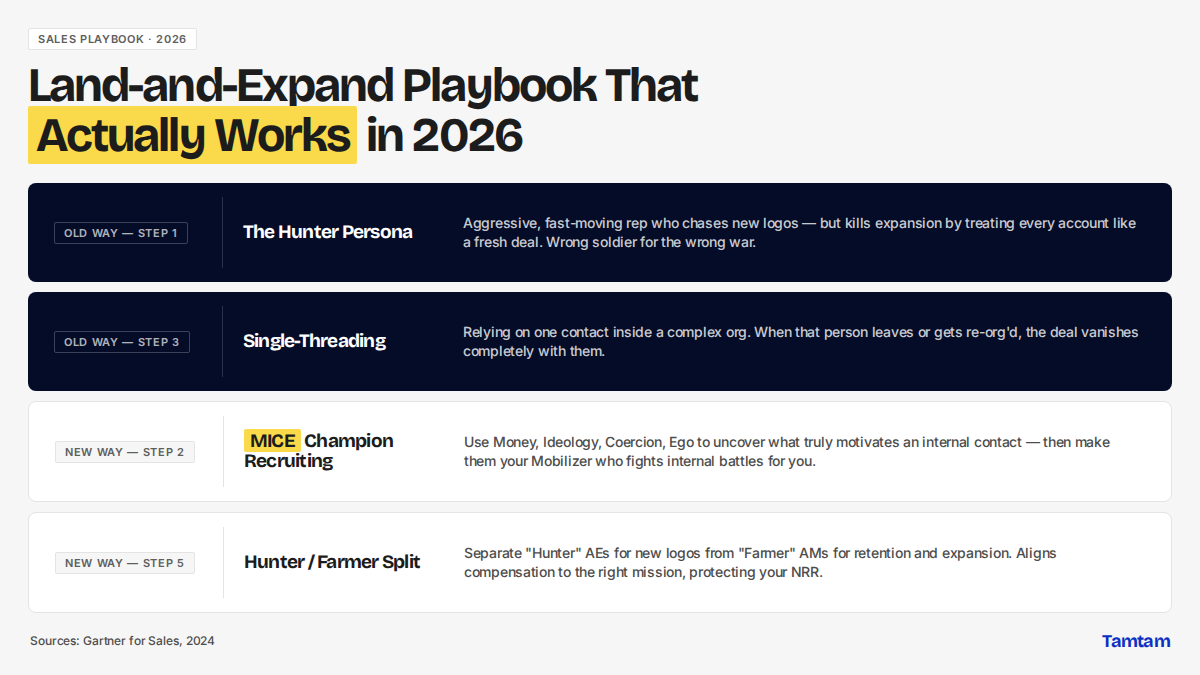
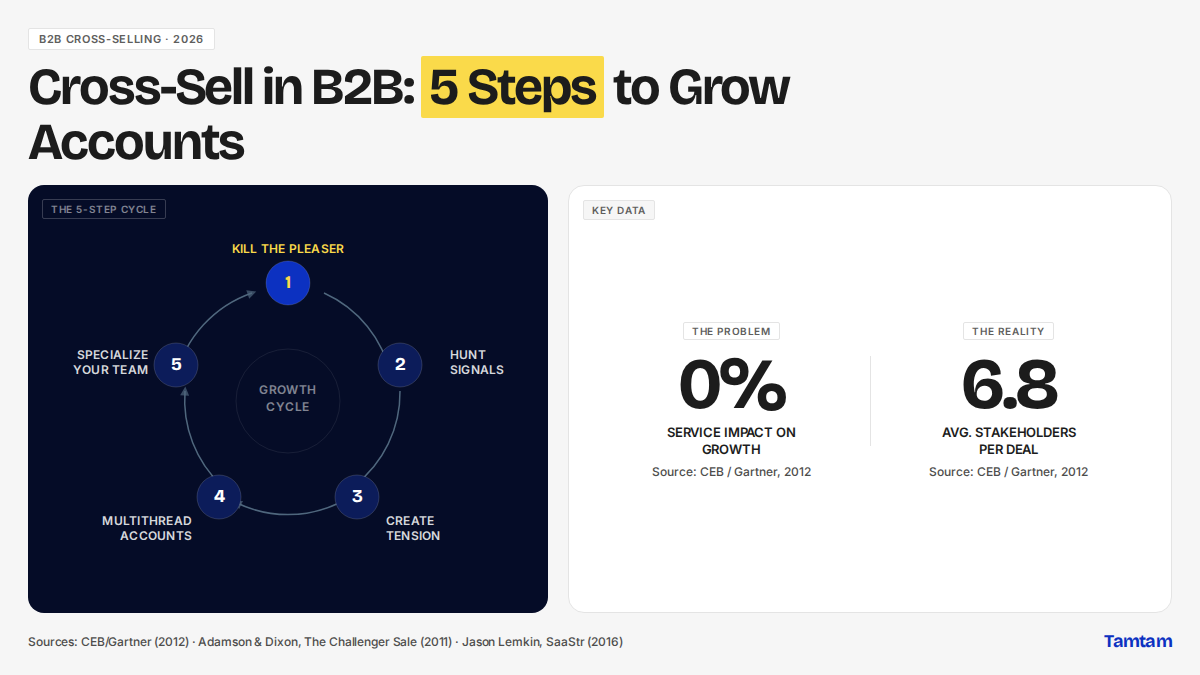
Your land-and-expand strategy is failing because it treats expansion like a bigger sale, not a political insurgency. Success requires ditching the aggressive 'Hunter' persona for a patient 'Insurgent' mindset focused on recruiting internal champions using frameworks like MICE and multi-threading relentlessly. For revenue leaders, this means abandoning the outdated 'womb-to-tomb' sales model that sabotages Net Revenue Retention and specializing roles to drive real growth.
We, as an industry, are pathologically obsessed with the myth of the "Hunter." The lone-wolf Account Executive who parachutes into enemy territory, charms their way to a decision-maker, and comes back with a signed contract before lunch. We celebrate their aggression, their speed, their relentless focus on the close.
And for landing that first deal, the beachhead, that persona works.
But here’s the problem: the exact traits that make a great Hunter make them utterly useless at expansion. They kick down the front door when they should be looking for the unlocked window in the back. They see a single target when they should be mapping a complex network of political alliances.
Expansion isn't a bigger sale. It's a political insurgency, the hardest motion in customer expansion. And you've been sending the wrong soldiers to fight it.
The Hunter's job is over the moment the ink is dry. The Insurgent's job has just begun.
An Insurgent doesn't care about a quick win. They care about a total takeover. They move slowly, quietly. They learn the language, the culture, the power structures of the organization they've infiltrated. They don't sell; they recruit. They don't pitch; they plot. They understand that turning a $50,000 pilot into a $2 million enterprise deal is not a transaction. It is an orchestrated, internal coup against the status quo, and you are the outside handler.
Why this matters: If you keep a Hunter's mindset, you'll treat every expansion opportunity like a new logo deal. You'll push for the demo, try to force a timeline, and get frustrated when things move slowly. You’ll annoy your contacts, burn your internal credibility, and watch your tiny foothold evaporate.
What to do:
Common Mistake: Believing expansion is just "upselling." Upselling is getting someone to buy the fries with their burger. Expansion is convincing the entire restaurant chain to change their whole damn menu because your burger is just that good. It's a fundamentally different game.
Once you’re inside, your first job is to find a local asset who can help you navigate the terrain and build influence. Too many reps cling to the first friendly face they find, their initial buyer, their "buddy." But a friendly "Talker" who likes your product is not the same as a "Mobilizer" who has the political capital and personal motivation to risk their reputation championing it.
So, how do you find a true Mobilizer? You stop thinking like a salesperson and start thinking like an intelligence officer.
The CIA uses a simple framework for understanding and leveraging human motivation called MICE. It’s a tool for recruiting assets, and that’s exactly what your champion is: your most valuable asset. MICE stands for:
Why this matters: Pitching ROI to an Ego-driven director is like speaking a foreign language. They don't care about the numbers; they care about how this makes them look. Understanding your potential champion's core driver allows you to frame your solution not in terms of what it does, but in terms of what it does for them, personally.
What to do:
Example in action: A few years ago, an AE sold a $30k departmental deal into a massive tech company. Her contact was a mid-level Director of IT. He was smart, competent, but constantly overlooked. His boss, the VP, was an old-school guy who shot down every new idea. The AE realized this director wasn't motivated by money or ideology. He was driven by pure Ego. He desperately wanted to prove his asshole boss wrong.
So, the AE's strategy shifted. It wasn't about the software anymore. It was about making this director look like a goddamn genius. They worked together for six months, building a bulletproof business case, running a flawless pilot, and gathering testimonials from the team. They framed the enterprise rollout as the director's initiative. When it was time to present to the C-suite, the VP had no choice but to support it. The director got his win, a promotion, and the AE turned her $30k pilot into a $1.2 million enterprise contract. She didn't sell software; she sold victory.
A single-threaded deal isn't a deal. It's a lottery ticket with terrible odds.
You found your champion. You understand their motivation. You feel great. The deal is in the bag. And then they update their network profile with "Open to Work." Game over.
Your champion is your entry point, not your entire strategy. Relying on one person inside a complex organization is professional negligence. The data on this is brutal and non-negotiable. Gartner research shows that deals with multiple high-quality stakeholder interactions have a 2.8 times higher likelihood of closing. That's not a small difference. That's the difference between hitting your number and updating your resume.
Multi-threading means systematically identifying and building relationships with every single person who has a stake in the deal: the economic buyer, the technical buyer, the end-users, legal, procurement, and the champion's influential peers.
Why this matters:
The "Slack Status" Deal Death: Every seasoned sales leader has this horror story. An AE has an $85k deal marked as "Commit" for the end of the quarter. They talk to their champion, Bob, every day. Bob loves them. Bob loves the product. Bob says the contract is on the CFO's desk. It's a sure thing.
On the last day of the quarter, the AE can't reach Bob. His calendar is cleared. His Slack status is dark. The AE sends a panicked email and gets an automated reply from HR. Bob's last day was yesterday. The deal didn't just stall; it vanished. It never existed anywhere but in Bob's inbox. No one else even knew what it was.
That’s what single-threading gets you. A ghost in your pipeline.
Common Mistake: The "Fear of Escalating." Reps are terrified of going over their champion's head. They think, "If I talk to Bob's boss, Bob will get mad and stop helping me." This fear is the single biggest barrier to effective multi-threading.
You have to reframe this. You're not "going around" your champion; you're "building a coalition to support" your champion. You should be transparent. "Bob, to make sure your initiative gets the executive support it deserves, I think it's critical we loop in your VP, Sarah. My goal is to make you look good by showing her how prepared we are. How do you think we should approach that?"
Okay, so you’ve committed to multi-threading. You’ve used your champion to get introductions to the CFO, the VP of Engineering, and a key director in another department. You’re having conversations. Fantastic.
Now, don't screw it up by being lazy.
The most common failure at this stage is what I call "single-threading with multiple people." This is when you connect with everyone on the buying committee but give them all the exact same generic pitch, the same demo, the same ROI deck.
This is monumentally stupid. The CFO and the VP of Engineering do not care about the same things. They speak different languages. They have different fears, different goals, different key metrics. Sending them the same material isn't just ineffective; it's disrespectful. It shows you haven't done your homework.
Your job is to be the propaganda minister for your internal insurgency. You must create tailored ammunition that your champion can use to win the hearts and minds of each individual stakeholder.
Why this matters: A one-size-fits-all business case is a one-size-fits-none business case. To get enterprise-level buy-in, you need to prove enterprise-level value across multiple domains.
What to do:
Common Mistake: Inviting the entire buying committee to a single, hour-long demo. It’s a recipe for disaster. The CFO will be bored in five minutes, the engineer will get annoyed by the "fluffy" business talk, and you'll end up answering basic questions from ten different perspectives, satisfying no one. Divide and conquer.
This last step is for the sales leaders. You can coach your reps on all the insurgent tactics in the world, but if your organizational structure is working against you, you're just pushing a boulder uphill.
If you are a company over $10 million in ARR and you still have a "womb-to-tomb" or "full-cycle" sales model where one AE is responsible for landing a new logo and then managing and expanding it forever, you are systematically killing your expansion revenue.
Let's be brutally honest about how salespeople are wired. They are coin-operated. Their behavior is a direct reflection of your compensation plan.
Consider a typical plan. An AE gets a 10% commission on a new logo deal. They get a 2% commission on an expansion deal. If they have one hour of free time, where are they going to spend it? Prospecting for the juicy 10% deal or nurturing the 2% expansion? The math isn't complicated. You are structurally incentivizing them to neglect your existing customer base.
Why this matters: Your company's valuation is more closely tied to your Net Revenue Retention (NRR) than almost any other metric. A model that incentivizes ignoring existing customers is a model that will slowly strangle your growth and sink your valuation.
The Inevitable Outcome: A SaaS company was stuck with a flat NRR of 98%. Their AEs were crushing their new logo quotas, but customer churn and down-sells were erasing all the gains. The VPs were pulling their hair out, blaming the product, blaming marketing, blaming customer success.
The real problem was the sales model. They finally split the roles. They created a team of "Hunters" (AEs) focused exclusively on new logos and a team of "Farmers" (Account Managers) focused exclusively on retention and expansion. They gave the Farmers a comp plan based heavily on NRR.
The result? Within two quarters, NRR jumped from 98% to 115%. Expansion revenue more than doubled. The AEs were happier because they could focus on what they do best: hunting. The new Account Managers were happier because they had a clear mission and a comp plan that rewarded them for it.
What to do:
This isn't about finding better people. It's about building a better system. A system that acknowledges the fundamental difference between conquering new territory and governing existing territory.
The land-and-expand playbook isn’t a series of sales tactics; it’s a complete operational and psychological shift. It's about realizing that the skills required to take the beachhead are the opposite of what's needed to win the war. The real challenge is finding the right internal allies and understanding the political landscape you've just entered. Success depends on knowing who to talk to, what they care about, and why they would risk their own capital to help you. That level of insight doesn’t come from a static contact list; it's pieced together from the signals people and companies send out every single day. The platforms that can interpret those signals, like Tamtam, are becoming the foundation for this modern, insurgent-led approach to expansion.
Set up for you before our first call
Book a demo