June 23, 2026
Your obsession with new logos is a trap. The single most important predictor of your company's value is Net Revenue Retention (NRR). Elite NRR isn't a happy accident; it's manufactured by teams who have built aggressive, signal-driven machines to systematically hunt for expansion revenue. This guide breaks down the math, org structure, and tactical plays needed to stop plugging a leaky bucket and build a true growth flywheel.
Picture your sales floor.
When a new deal closes, what happens? The bell rings, the Slack channel goes nuts, and the rep who closed it gets treated like a hero for the day. It’s a huge shot of dopamine for the whole company.
Now, what happens when an Account Manager expands a current customer for an extra $50K in ARR? Usually, you get a quiet congrats in a team meeting and a line item in a spreadsheet.
This is the cultural rot at the heart of most B2B companies. We are addicted to the thrill of the hunt. We celebrate new logos with the energy of a championship win, while treating expansion revenue like a predictable annuity payment. We've built our compensation plans, our kick-off themes, and our entire sales identity around conquering new territory.
And this addiction is making us strategically blind.
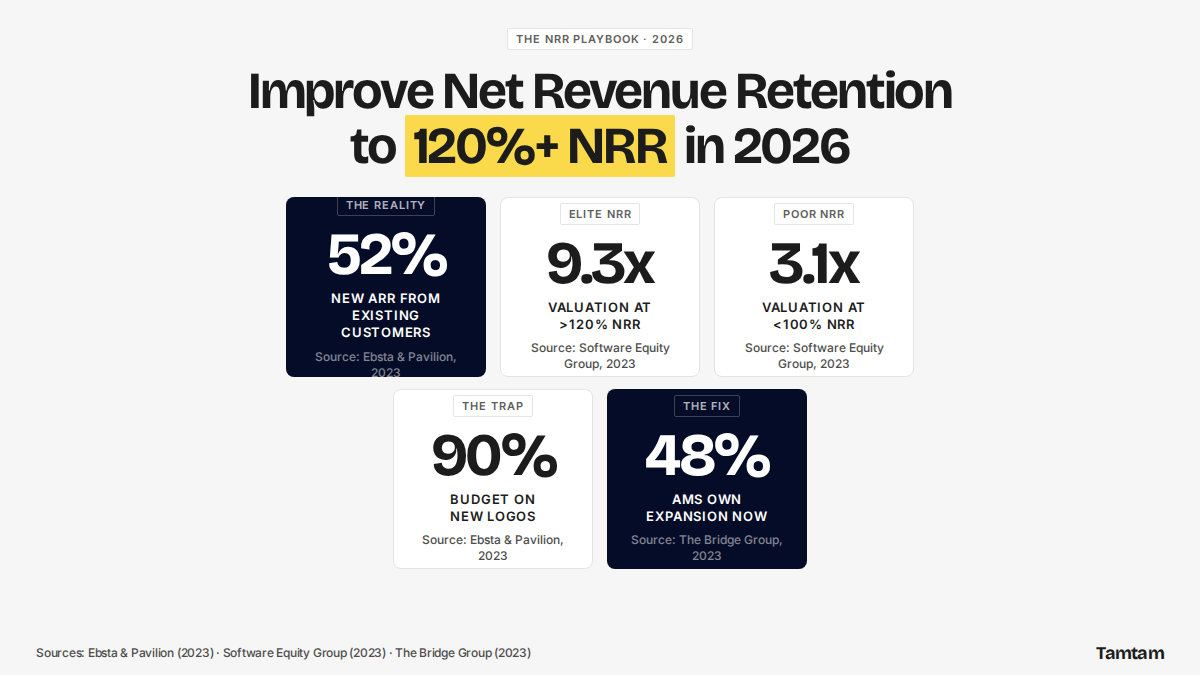
While you're pouring millions into acquiring new customers, you're ignoring a gold mine that's already been drilled, mapped, and secured. According to a joint report from Ebsta and Pavilion, 52% of new ARR for SaaS companies now comes from expansion.
Let that sink in. More than half of the growth at a typical software company isn't coming from the celebrated "hunters." It's coming from the often-overlooked "farmers." Yet, where does 90% of the budget, headcount, and attention go? You already know the answer.
This isn't just inefficient. It's a slow-motion form of corporate suicide. You’re spending a fortune to fill a bucket with a massive hole in the bottom, celebrating every new drop of water you add while ignoring the gushing leak. It's time to fix the damn bucket. NRR is the scoreboard for customer expansion.
If your addiction to new logos is the disease, Net Revenue Retention (NRR) is the cure.
Let’s get the definition out of the way so we can get to the good stuff. NRR measures how much your revenue from existing customers grew or shrank over a period, taking into account both expansion (upsells, cross-sells) and churn (downgrades, cancellations).
Here's the simple formula:
(Starting MRR + Expansion MRR - Churn MRR) / Starting MRR
An NRR over 100% means your existing customers are generating more revenue than they're churning. An NRR below 100% means you're shrinking.
This isn't just another vanity metric for your board deck. In the cold, hard world of SaaS valuations, NRR is the single cleanest predictor of what your company is worth. According to the 2023 SaaS M&A Snapshot from Software Equity Group, the numbers are absolutely brutal:
That’s a 3x difference in your company’s valuation, dictated by this one metric. Three times. The market doesn't reward your bell-ringing ceremonies. It rewards compounding efficiency.
Think about what 120% NRR actually means. It means that if you fired your entire sales and marketing team tomorrow and didn’t sign a single new customer for a year, your company would still grow by 20%.
That’s a business that can survive a recession. That’s a business that prints money. That’s a business investors trip over themselves to fund. Anything less is a house of cards, constantly dependent on the next expensive, hard-won logo just to stay afloat. NRR isn't a "health metric." It's a weapon.
So, you’ve seen the light. You're ready to make NRR your religion. Great. Now for the bad news: your org chart is probably set up to fail.
About five years ago, the SaaS world ran a massive, terrible experiment. The idea sounded good on paper: let’s make Customer Success Managers (CSMs) responsible for renewals and upsells. We’ll give them a small quota, call them a "trusted advisor," and watch the expansion revenue roll in.
It was a complete and utter disaster.
As venture capitalist Jason Lemkin bluntly put it, we bastardized the role of the CSM, turning them into "glorified, lower-paid account executives" forced to conduct an "upsell Zoom." Instead of building trust and ensuring customers got value, CSMs were now seen as salespeople in disguise. Trust evaporated. Renewals got rocky. And the upsells never really materialized, because the CSMs weren't trained or compensated like true commercial owners.
The smartest companies are now admitting this experiment failed and are aggressively course-correcting.
Data from The Bridge Group's 2023 report shows a sharp 10-point swing back toward having dedicated Account Managers (AMs) own the expansion motion. Here’s the breakdown of who owns expansion today:
The verdict is in. You cannot win the expansion game by forcing a non-commercial role to carry a commercial quota. You need dedicated killers. You need Account Managers who wake up every morning thinking about one thing: how to find and close expansion opportunities within their book of business. They are hunters, just like your new business reps, but their territory is your customer base. Anything else is just wishful thinking.
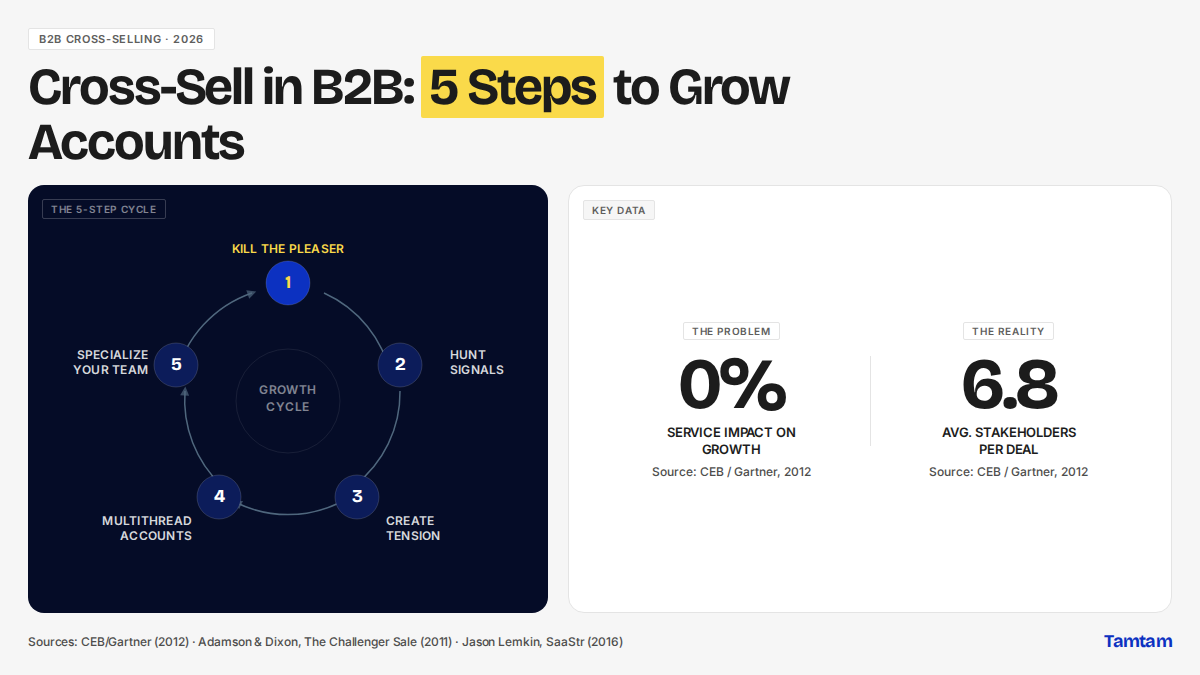
Elite NRR isn't a happy accident that you discover during a quarterly business review (QBR). It’s manufactured. It’s the result of a proactive, systematic machine built to hunt for expansion opportunities long before the customer even knows they exist.
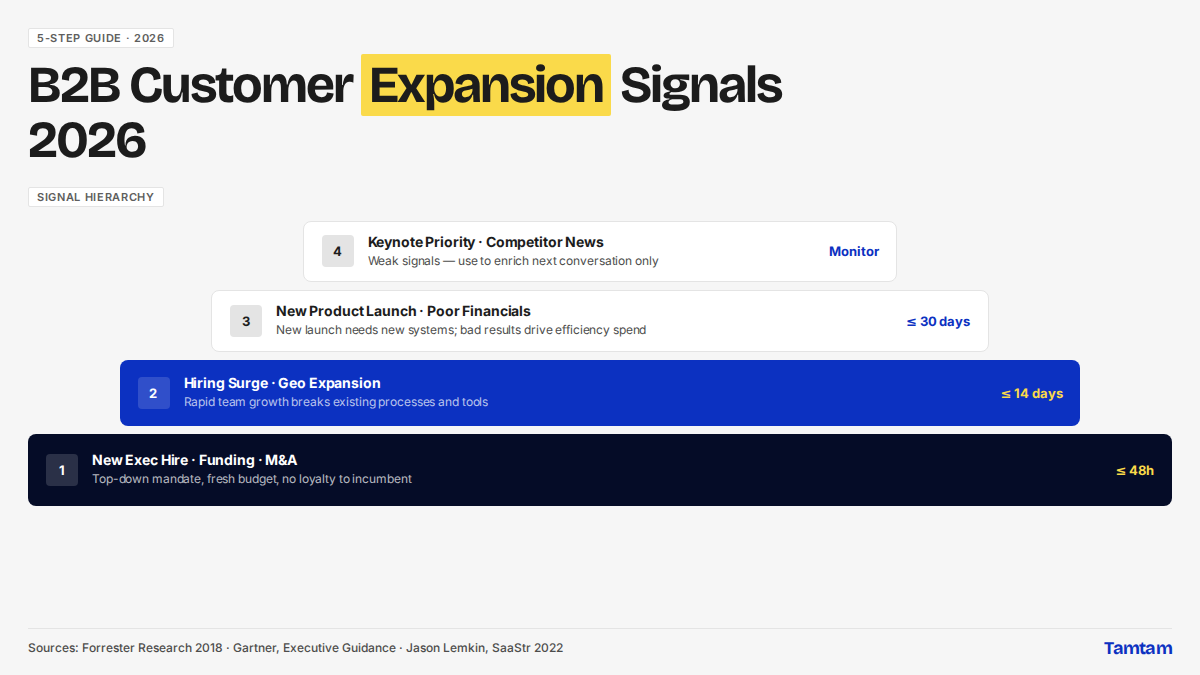
Waiting for a customer to raise their hand and say, "I'd like to buy more, please," is a losing strategy. The winners are using internal signals, like product usage data and conversation intelligence, to run trigger-based plays.
Here are two brilliant, tactical plays you can steal.
This playbook, detailed by former Unbounce leader Courtany Williams, brilliantly solves the CSM-as-salesperson problem. Instead of forcing one person to wear two hats, they split the QBR into two distinct parts.
This creates a perfect separation of church and state. The CSM preserves their trusted status, while a dedicated commercial owner runs a real sales cycle. It’s a simple, elegant solution to the org chart problem.
This is a killer move for expanding into new departments or business units within a large account. As sales leader Maddy Jackson explains, going straight to the new stakeholder you want to sell to often fails. They don’t know you, and they see you as just another vendor.
Instead, you use your existing executive champion.
You go to your champion and say: "Hey [Champion's Name], based on the success we're seeing in your division, we believe we can drive similar results for the marketing team. I've identified [Stakeholder's Name] as the person who owns that. Would you be open to making a quick introduction so I can explore if there's a fit?"
But here’s the genius part. You don't just ask for an intro upwards or sideways. You ask your executive sponsor for an introduction downwards to their peer's direct report. This does two things:
These aren't passive, reactive tactics. They are offensive plays designed to proactively create pipeline where none existed before. This is how you manufacture expansion.
Right now, you’re probably thinking one of two things. Let’s tackle them head-on.
You're right. Kind of.
It is mathematically harder to achieve 120%+ NRR in the SMB segment because gross churn is naturally higher. But saying it's "impossible" is a lazy excuse for not trying.
You probably won’t get there by just selling more seats of your existing product. The path to breaking 100% NRR in SMB is almost always through product strategy. Look at a company like Bill.com. They serve SMBs, a notoriously churn-heavy segment. Yet, they consistently post NRR figures well over 100%, sometimes hitting 131%.
How? They didn't just sell more of their core accounts payable product. They built a second, massive product line: accounts receivable. By cross-selling a genuinely valuable new solution to their installed base, they created a powerful expansion engine. The other path is to slowly and deliberately move upmarket, capturing slightly larger "SMB-plus" customers who have lower churn profiles.
The lesson: if you sell to SMBs, your NRR challenge is a strategic one, not just a sales one.
This is a legitimate resource constraint. But you're confusing headcount with mindset.
Even if you can't afford a separate AM team today, you can still adopt an AM playbook. It's about process and focus, not the title on someone's business card.
A single AE who owns the entire customer lifecycle can still win by carving out dedicated time for expansion hunting. This means time-blocking their calendar every week for "AM activities." During that block, they aren't prospecting for new logos. They are digging through product usage data, listening to Gong calls from their customers, and looking for the internal signals that precede an expansion opportunity.
It's not about having more people. It's about having a dedicated process for mining your existing customer base with the same rigor you apply to finding new ones. Stop treating expansion as something that just happens. Start hunting for it.
The real shift isn't organizational. It's philosophical. It's moving from a culture that only celebrates the thrill of the new logo hunt to one that celebrates the genius of the harvest. But here's the kicker: the skills are the same. Building a world-class NRR engine forces you to get incredibly good at one thing: turning subtle signals into pipeline. The proactive, trigger-based mindset you develop to find the perfect expansion opportunity is the exact same one you need to find the best new logos. Once you stop guessing and start building your entire GTM process around real buying triggers, you build a more efficient engine for all revenue, not just expansion. That's the playbook, and it's what platforms like Tamtam are designed to power.
Set up for you before our first call
Book a demo