Account Manager
An Account Manager is a quota-carrying sales role responsible for managing and growing revenue from existing customer accounts after the initial sale.
An Account Manager (AM) is a quota-carrying sales role responsible for managing the commercial relationship with existing customers. After an Account Executive closes a new business deal, the AM takes ownership of the account to drive long-term value, focusing on contract renewals and expansion revenue. This role is central to customer lifetime value and is a key driver of net revenue retention.
Core Responsibilities
The primary goal of an Account Manager is to nurture and grow the company's existing customer base. Key activities include:
- Relationship Management: Building deep, trust-based relationships with key stakeholders within customer accounts to understand their business goals and challenges.
- Renewals: Proactively managing the contract renewal process to secure ongoing annual recurring revenue and prevent customer churn.
- Expansion: Identifying and closing opportunities for upsells (selling more of the same product or service) and cross-sells (selling different products or services).
- Strategic Planning: Conducting regular business reviews with clients to demonstrate the value delivered, align on future goals, and uncover new growth opportunities.
AM vs. Other Post-Sale Roles
The Account Manager role is often confused with similar-sounding titles, but the distinctions are important for defining a clear customer journey.
- Customer Success Manager (CSM): While an AM owns the commercial relationship, a Customer Success Manager owns the customer's outcomes. The CSM focuses on product adoption, onboarding, and ensuring the customer achieves value, which directly supports the AM's renewal and expansion goals. The AM is typically quota-carrying; the CSM often is not.
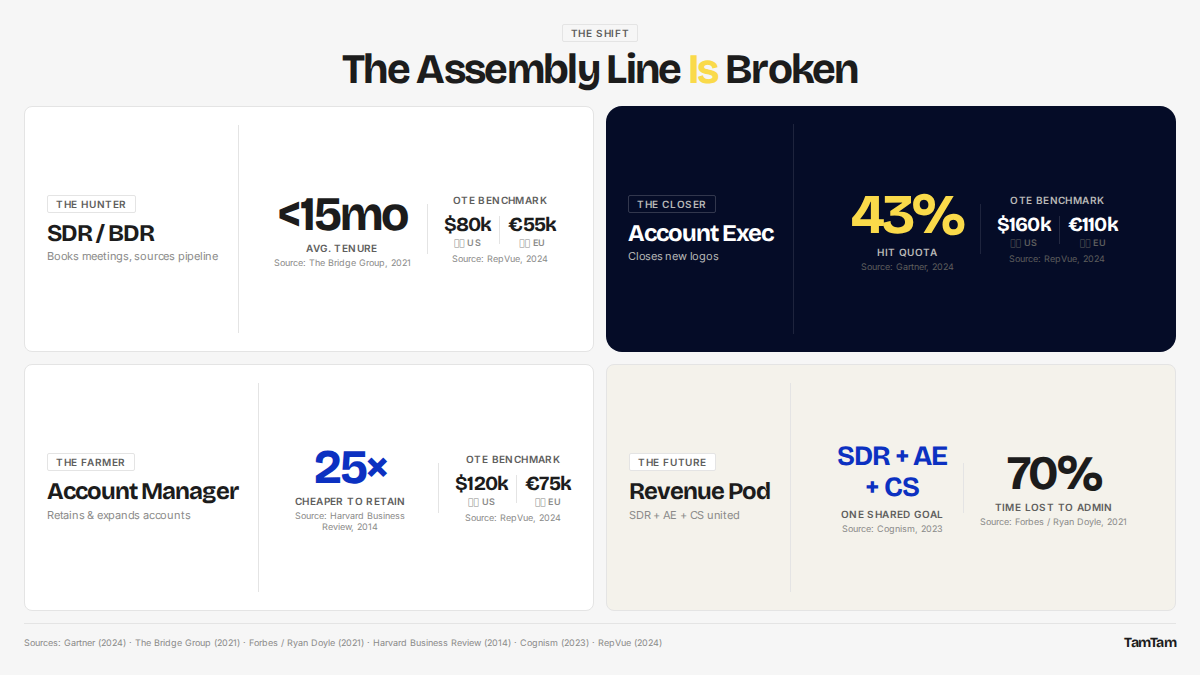
- Account Executive (AE): The AE is a "hunter" focused on acquiring new logos. The AM is a "farmer" focused on cultivating existing relationships. This division of labor is a core concept in the bowtie funnel, which visualizes both pre-sale acquisition and post-sale expansion.
Why the Role Matters
A dedicated Account Management function is critical for sustainable growth, especially in subscription-based businesses. It is generally far more cost-effective to retain and grow an existing customer than to acquire a new one. AMs are the primary engine for protecting this revenue base, turning initial transactions into long-term partnerships, and increasing customer lifetime value. For a company's most important clients, this position may evolve into a more senior, strategic Key Account Manager role.
Also known as: AM