June 23, 2026
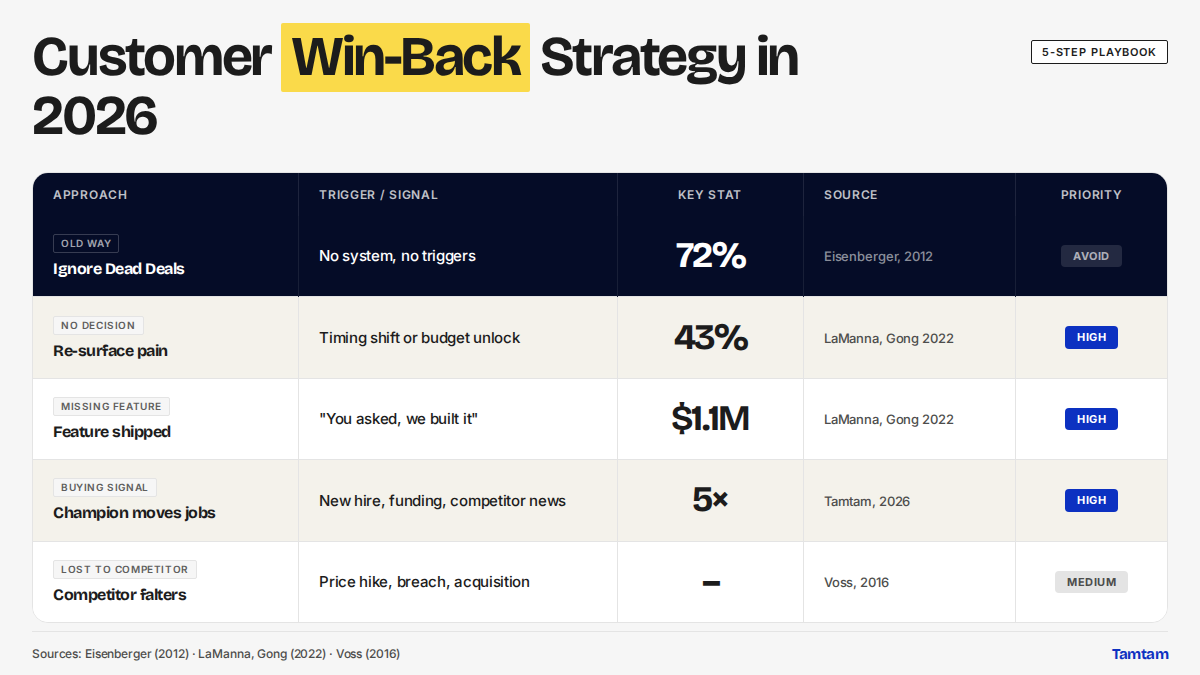
Your closed-lost pipeline is the warmest source of new revenue, yet most sales teams ignore it because social rejection registers as physical pain. The solution isn't more grit; it's a systematic process. This guide provides a five-step playbook for resurrecting dead deals by de-stigmatizing failure, fixing compensation, segmenting lost opportunities, using AI as an emotional buffer, and executing outreach based on real-time signals instead of arbitrary timers.
Let’s be honest. Asking a sales rep to dive back into their closed-lost deals is like asking them to call up an ex who dumped them. It’s awkward, it’s painful, and their brain is screaming, "ABORT! ABORT!"
This isn’t just a metaphor. Neuroscientists have shown that social rejection lights up the exact same regions of the brain as physical pain. When your rep gets that blunt "we went with a competitor" email, their brain processes it in a similar way to touching a hot stove.
So when we, as sales leaders, say, "Go re-engage those dead deals!" we're effectively telling our team to go touch that hot stove again. And again. And again. Then we act surprised when they’re burned out, dejected, and would rather cold-call a list of randoms from the phone book.
Your reps aren't lazy for avoiding closed-lost deals. They're human.
The problem isn't their grit. It's your system. Or lack thereof. A world-class win-back strategy isn't about rah-rah speeches and forcing people to do painful work. It's about systematically removing the pain and replacing it with data, intelligent incentives, and a clear process. Here’s how to build one. It's the recovery arm of a complete customer expansion motion.
Before you can resurrect a single deal, you have to change how your culture treats death. In most sales orgs, losing a deal is a personal failure. It’s a mark of shame on the rep, something to be explained away in a pipeline review and then quickly forgotten. This is both demoralizing and strategically idiotic.
The goal isn't to find someone to blame; it's to find out what happened so you can learn from it.
Rip a page from Google's Site Reliability Engineering playbook and implement "blameless post-mortems." When a massive Google service goes down, they don't drag an engineer into a room and scream at them. They gather everyone involved and ask a simple set of questions: What happened? What was the impact? How can we prevent this from happening again? The focus is on the system, not the person.
What to do: For every significant deal that dies, schedule a 30-minute post-mortem. The rep who owned the deal walks the team through the timeline. The only rule is that no one can assign blame. You can't say, "You should have..." You can only say, "Next time, we could try..."
This simple shift in language detaches the rep's ego from the outcome. "I failed to sell the deal" becomes "We learned our competitor's integration with their CRM was a deal-breaker for this type of client." See the difference? One is a source of shame. The other is a valuable piece of market intelligence.
Common Mistake to Avoid: Don't let the post-mortem turn into an interrogation of the rep. The moment you ask, "Why didn't you bring in a sales engineer sooner?" you've lost. The meeting is about dissecting the deal, the market, the buyer's process, and your product's gaps. It’s about finding patterns across dozens of lost deals, not litigating the performance of one.
Let's say you do a great job with post-mortems. Your reps feel safe, and you're gathering great data. They still won't work the closed-lost pipeline. Why? Because your compensation plan is probably telling them not to.
Most sales comp plans are built for one thing: landing net-new logos. The accelerators, the SPIFs, the President's Club qualifications, they all scream "NEW! NEW! NEW!" A rep looks at their limited time and asks a rational question: "Do I spend a week trying to resurrect a deal that already said no, or do I spend that week prospecting for a fresh lead with a blank slate?"
Nine times out of ten, they choose the blank slate. It feels cleaner, more hopeful, and, crucially, it's where the financial upside is.
What to do: You have to make it worth their while. Introduce a "Lazarus Commission." This is a specific kicker or bonus for any revenue generated from a deal previously marked as closed-lost for more than, say, 90 days. It could be an extra 2% on the commission, a flat-rate bonus, or a multiplier for President's Club.
The amount almost doesn't matter as much as the signal. A "Lazarus Commission" tells the team, "We value this activity. We recognize it's emotionally taxing work, and we will reward you for it." Money is the most direct way to signal what you actually care about, and that alone is often enough to change behavior, even before the first bonus check hits.
Common Mistake to Avoid: Making the rules too complicated. Don't create a complex system with a dozen tiers and conditions. Keep it simple: if a deal was dead and you bring it back to life, you get paid extra. Period.
Okay, you've fixed the culture and the comp plan. Now your reps are motivated. You can't just point them to the CRM and say, "Go get 'em!" The "Closed-Lost" view in your CRM is an overwhelming, undifferentiated sea of failure. Sending a rep in there without a map is a recipe for instant burnout.
Not all lost deals are created equal. A company that went out of business is gone forever. A company that chose a competitor is a tough nut to crack. But a company that lost budget or couldn't make a decision? That's a ticking time bomb of opportunity.
What to do: First, filter out the truly dead. Anyone who went out of business, was a terrible fit from the start, or was acquired by a company you can't sell to gets archived. They are not part of your win-back strategy.
Then, segment the rest into high-potential buckets based on the "close reason." Your main targets should be:
Common Mistake to Avoid: Treating the entire closed-lost list as one monolithic entity. This leads to generic, worthless "just checking in" emails. Segmentation allows for hyper-relevant outreach. The message to a "no decision" lead is about re-surfacing their original pain. The message to a "missing feature" lead is a triumphant "You asked, we listened."
Even with the right culture, incentives, and segments, there's still one massive point of friction: the cringe-inducing CRM archaeology.
Before a rep can even think about re-engaging, they have to spend 30 minutes digging through the CRM, trying to piece together the story. They have to re-read their own hopeful emails, look at the meeting notes from the call where things went south, and re-live the entire painful process. It sucks.
This is where you can use technology to remove the human pain from the process.
What to do: Use an AI-powered system to do the dirty work. Modern conversation intelligence and sales platforms can instantly summarize every past interaction associated with an opportunity. With a single click, a rep should be able to see:
The AI acts as an emotional buffer. It pulls out the objective facts without the emotional baggage. It transforms a 30-minute, soul-crushing review into a 10-second, data-driven briefing. The rep isn't re-living their failure; they're consuming an intelligence report.
Sales leader Brian LaManna famously talked about using AI to summarize past deal conversations. This allowed him to quickly identify context and draft relevant re-engagement emails, ultimately resurrecting over $1.1 million in pipeline he admitted he would have otherwise ignored because the manual effort was just too high.
Common Mistake to Avoid: Assuming your reps will just "power through" the manual work. They won't. Not consistently. The path of least resistance will always win. If digging through the CRM is painful, they will find other, less painful things to do, like prospecting for new leads. You have to make the right thing the easy thing.
The final piece of the puzzle is timing. Most win-back strategies are based on arbitrary calendar reminders. "Follow up in 90 days." Why 90? Why not 87 or 112? It's a complete guess. And your prospects can smell it a mile away. The generic "checking in" email is the modern equivalent of a telemarketer calling during dinner.
Stop guessing and start listening. Your outreach shouldn't be based on the calendar; it should be based on a change in their world.
What to do: Reach out only when you have a specific, relevant reason. Use tools to monitor your segmented lists for real-time buying signals. These are your triggers.
When you have a signal, your outreach is no longer an interruption; it's a valuable update. You're not "checking in." You're delivering contextually relevant information. For a powerful re-engagement question, use a variation of Chris Voss's famous email: "Have you given up on [solving the specific business problem they told you about six months ago]?" It's a pattern-interrupt that cuts through the noise and forces a real response.
Your "Closed-Lost" pipeline isn't a graveyard; it's your single greatest intelligence asset, a pre-qualified list of companies who already know you and have invested hours in conversation. The hard part is done. Turning these past conversations into a systematic revenue stream means swapping emotional avoidance for a real process. It means codifying the triggers that matter and building a machine to watch for them. For teams that get this right, like those building their process with Tamtam, the result is a pipeline that feels less like cold outreach and more like picking up a conversation where it left off.
Set up for you before our first call
Book a demo