June 23, 2026
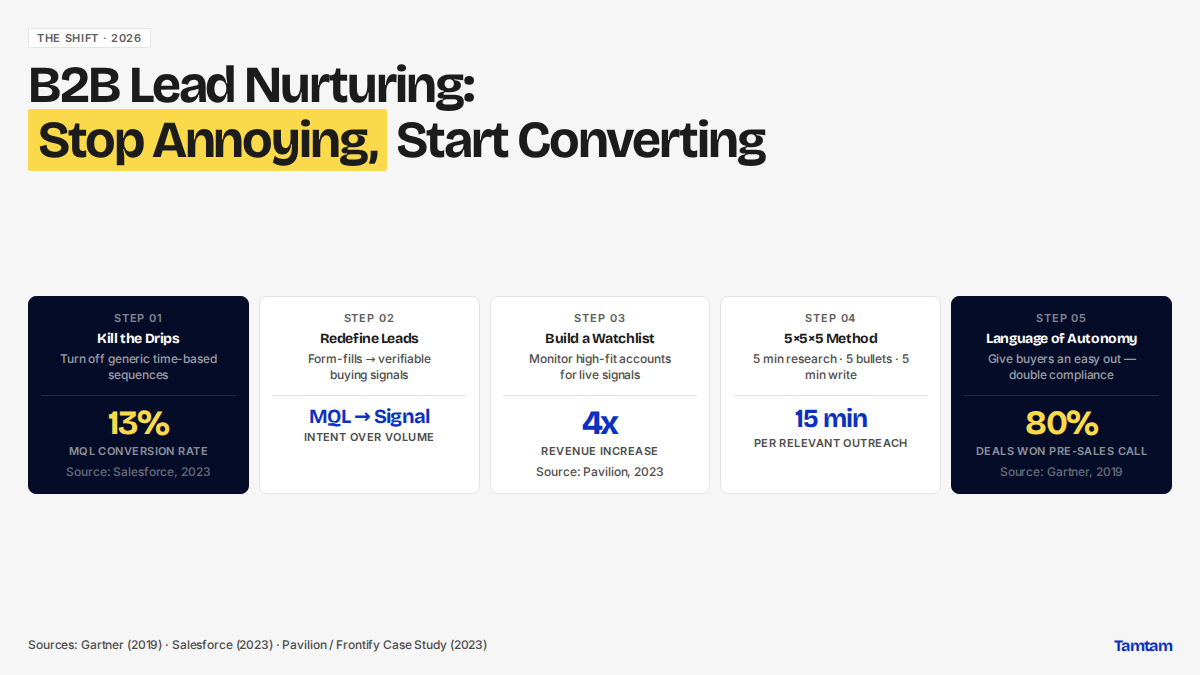
Stop thinking of lead nurturing as a pre-scheduled email sequence. Most automated drips actively hurt your chances by triggering psychological reactance, a buyer's instinct to resist being controlled. The problem stems from vanity metrics like the MQL, which reward volume over intent and force sales teams to process low-quality leads at scale. This guide provides a five-step system to replace scheduled nagging with signal-based relevance, focusing on timing and context to engage buyers when they have real momentum.
Let’s be honest. Your automated lead nurturing sequence is probably doing more harm than good.
It's built on a playbook from 2010 that completely ignores a fundamental law of human psychology: people hate being told what to do. They hate feeling managed, corralled, or pushed down a path that isn’t their own.
Every automated "just checking in" email you send, every pre-scheduled "thought you'd find this valuable" message that lands with a thud, triggers a quiet, defensive alarm in your buyer's brain. You think you're "staying top of mind." What you're actually doing is training them to ignore you, or worse, to actively dislike you.
You're not nurturing a lead. You're creating an enemy.
The good news is, it's not entirely your fault. You were told this was "best practice." You were given tools that made it easy to set up these automated nagging machines. But the game has changed. The buyer has all the power, and they're not going to be "nurtured" by a robot on a schedule.
It's time to burn the old playbook. Here’s how to build something that actually works. Done right, nurturing is the patient half of a real customer expansion motion.
Before you can build, you have to demolish.
Go into your marketing automation platform. Go into your sales engagement tool. Find every single generic, time-based drip sequence designed to "nurture" cold or lukewarm leads.
And turn them off. All of them.
Why this matters: These sequences operate on your timeline, not the buyer's. This triggers a powerful psychological defense mechanism called reactance. First described by psychologist Jack Brehm in 1966, reactance is that feeling you get when someone tries to limit your choices or force your hand. It’s an immediate, gut-level instinct to reassert your freedom by doing the opposite of what you’re being pressured to do.
When your automated email says, "Here's step 2 in your buyer journey," your prospect's brain screams, "The hell it is," and archives the message. You're not adding value. You're threatening their autonomy. You’re becoming the problem they need to solve, not the solution they’re looking for.
Don't take my word for it. Spend five minutes on any sales forum on a social network. You'll find an endless graveyard of reps and buyers roasting these exact tactics. As one user on the r/sales subreddit put it: "If a call ends with little interest and you enroll [them]... you lose a prospect for life." This isn't a theoretical risk. It's the reality on the ground.
Common Mistake to Avoid: Believing that "more touches" equals more value. This is the logic of a spammer. A touch without context is just noise. Your goal isn't to be persistent. Your goal is to be relevant. One perfectly timed, hyper-relevant message is worth more than a hundred automated "check-ins."
The whole reason we have these terrible drip sequences is because we're drowning in terrible "leads."
Your marketing team is goaled on MQLs (Marketing Qualified Leads). So they gate a whitepaper, buy a list, or run a webinar, and suddenly you have a thousand new "leads." The problem is, most of them are crap. They have no real intent. The average conversion rate from MQL to a real, sales-qualified opportunity is a dismal 13%, according to Salesforce.
This is performance theater. It rewards volume over intent and forces you, the sales rep, to use blunt-force automation to sort through the noise. It’s a broken model.
The fix is to stop celebrating MQLs and start hunting for signals. A signal is a verifiable event that indicates an account has a high probability of facing a problem you can solve. It’s evidence of momentum.
Here's the difference:
One of these is a ghost. The other is a five-alarm fire. Chasing the ghost with an automated drip is a waste of everyone's time. Engaging the account on fire with a relevant message is how you print money.
Common Mistake to Avoid: Measuring marketing and sales success by the number of MQLs generated. This is a vanity metric that creates downstream chaos. Start tracking and celebrating a new KPI: "Signal-to-Pipeline Conversion Rate." It’s a much healthier indicator of your go-to-market health.
Once you stop chasing MQLs, you can stop "nurturing" a static list of zombies. Instead, you'll create a dynamic "watchlist" of high-fit accounts.
Your job is no longer to hammer this list with messages. Your job is to monitor it for actionable signals. You're shifting from a brute-force approach to a patient, intelligence-driven one. You're a sniper, not a machine gunner.
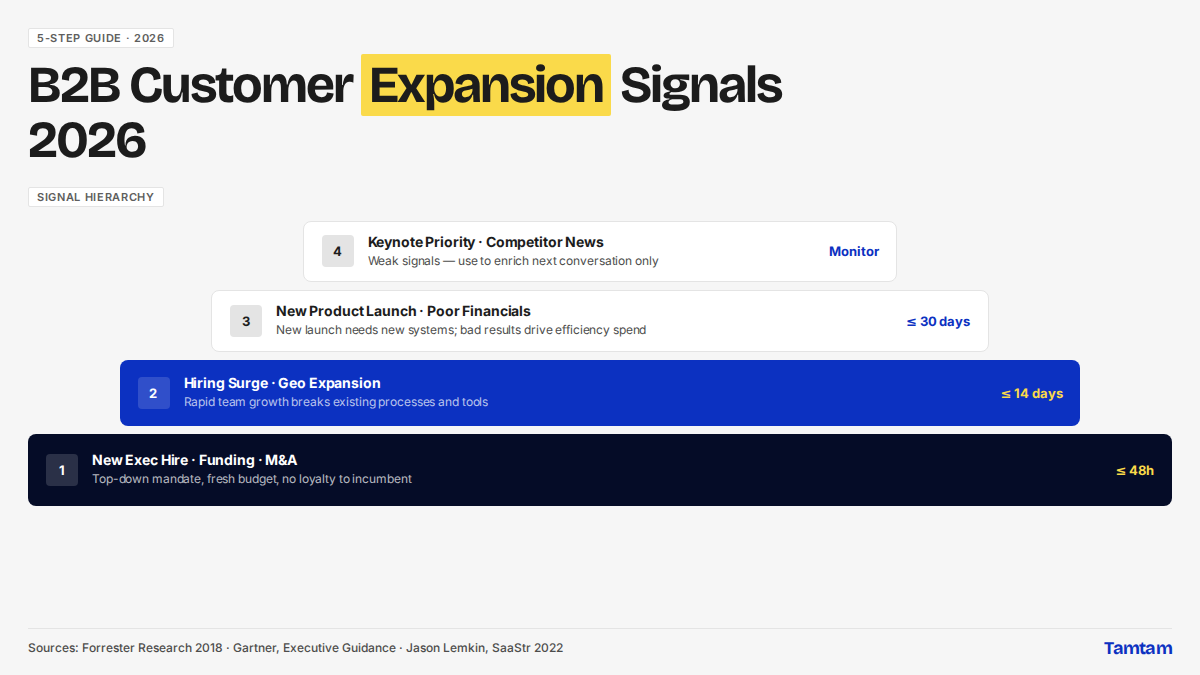
These signals fall into a few key categories. Your specific signals will be unique to your business, but they generally look like this:
This isn't just theory. The B2B brand strategy platform Frontify ditched their old model and shifted to tracking five specific signal types for their top accounts. The result? According to a case study with Pavilion, they achieved a 4x increase in self-sourced revenue and a 35% boost in win rates. Signals work.
Common Mistake to Avoid: Treating all accounts equally. Be ruthless in prioritizing your watchlist. A smaller list of 100 perfect-fit accounts that you monitor closely is infinitely more valuable than a list of 10,000 mediocre-fit accounts you spray with generic messages.
The number one objection to this entire approach is, "This sounds great, but it doesn't scale."
This is flat-out wrong. You don't scale relevance with more automation; you scale it with a better framework. Blind personalization, where you spend an hour researching one person to write the "perfect" email, doesn't scale either. You need a disciplined middle ground.
Enter the "5x5x5 Method." It's a simple, repeatable process for acting on signals quickly and effectively.
Here's a quick example:
This entire process takes 15 minutes. You can do three or four of these in an hour. This is how you scale relevance without burning out or resorting to soulless templates.
Common Mistake to Avoid: Getting stuck in the extremes. Don't spend 30 minutes writing one "perfect" email. And for the love of God, don't spend 30 seconds blasting a generic template. The 5x5x5 framework is your disciplined, scalable sweet spot.
The final piece of the puzzle is how you communicate when you finally do reach out. You've got the right person, the right account, and the right time. Don't blow it by using language that puts them on the defensive.
Stop using presumptive or demanding language. Phrases like "Are you free for 15 minutes on Tuesday?" or "When's a good time to connect?" seem harmless, but they are micro-threats to the buyer's autonomy. You're demanding a decision and trying to lock them into your calendar.
Instead, give them control. Give them an easy out.
This is grounded in a psychological principle known as the "But You Are Free" (BYAF) technique. In a series of studies, researchers found that explicitly reminding someone of their freedom to say "no" can dramatically increase compliance. In one famous experiment, researchers asking strangers for bus fare doubled the number of people who said yes simply by adding the phrase, "But you are free to accept or refuse."
That small linguistic shift removes the pressure. It defuses the reactance. It shows respect for their time and their agency.
How to apply this in your outreach:
Your job isn't to trap someone in a meeting. It's to start a conversation with a peer. Be direct, be relevant, and give them an exit. They will respect you for it, and they'll be far more likely to engage when the timing is actually right for them.
True lead nurturing isn't a sequence of automated actions you take. It's a state of disciplined observation. It’s about shifting your entire mindset from "How can I force this person down my funnel?" to "How can I be the most helpful person on the planet for this company at the exact moment they need it?" Stop nagging. Start listening for the signals. The real challenge, of course, isn't just knowing which signals to look for, but building a system to catch them across your entire market without spending your whole day manually digging. For teams ready to make that leap, platforms like Tamtam are designed to automate the research, not the relationship, surfacing the opportunities so you can focus on the human part of selling.
Set up for you before our first call
Book a demo