June 23, 2026
Most QBRs are a waste of time, forcing you to prove your value with backward-looking reports. This guide flips the script by teaching you to put the customer's strategy on trial instead. You'll learn how to adopt the "Doctor Frame," use the Challenger methodology to create constructive tension, and reframe the QBR as a high-stakes workshop. The goal is to make expansion the inevitable conclusion of your strategic intervention, not a clumsy upsell pitch.
Let's be honest. You’ve sat through a quarterly business review that felt more like a hostage negotiation. You, the account manager, sweating through a 45-slide deck filled with vanity metrics, desperately trying to prove your worth. Across the table (or the Zoom screen), the customer executive is quietly checking their email, their soul escaping their body one bullet point at a time.
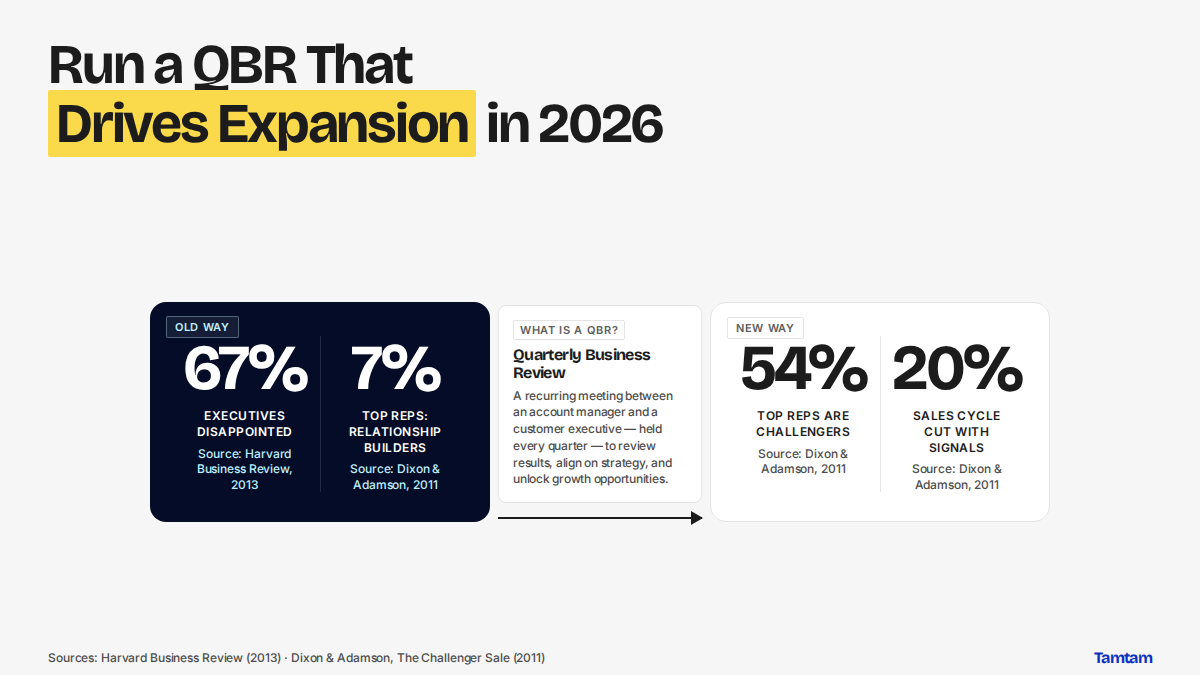
Most executives are disappointed in the meetings they have with salespeople, according to research published in Harvard Business Review. And your QBR is a sales meeting, whether you admit it or not. It's a theatrical performance of your own insecurity. The more you try to “prove your value,” the more you prove you're just another line item on their expense report, waiting to be cut.
This has to stop.
The purpose of a QBR is not to justify your existence. It's to make your existence indispensable. It’s not a review. It’s a reset. It’s not a status update. It’s a strategic intervention, and one of the sharpest levers in customer expansion.
Here’s how you pull it off.
First things first: you need to perform a ritual killing of the status update. The part of the meeting where you walk through uptime stats, tickets solved, and usage dashboards is the single most value-destroying activity in account management. It immediately frames you as a low-level vendor reporting for duty.
What to do: Eradicate the "watermelon dashboard" (green on the outside, red on the inside) from your live meeting. All of it. Every retrospective performance metric, every self-congratulatory chart, every bit of backward-looking data gets sent to the client at least 48 hours before the meeting.
Put it in an automated email or a clean pre-read document. More importantly, state the new rules of engagement directly in the meeting invite. The agenda should say something like: "Live time is reserved for forward-looking strategy around [customer’s key business initiative]."
Why this works: This move is a power play. It does two crucial things. First, it filters out the wrong people. Anyone who only cares about operational metrics will see they don't need to be there. This leaves you with the strategic players. Second, it frames you as a peer. You're communicating that their executive's time is valuable, and you refuse to waste it on information that could have been an email. You've just seized control of the conversation before it even begins.
Common mistake to avoid: Caving when a low-level contact insists on reviewing the metrics live. This is a test of your resolve. Hold the frame. Your response should be calm and assertive: "Absolutely. We sent that data over for your team to review internally. We've reserved this executive time with [Decision Maker] specifically to discuss the financial impact of [Strategic Initiative]. We want to make the most of our time together."
You've just been given permission to stop the most painful, useless part of your job. Take it.
Now that you’ve cleared the deck of tactical crap, you need to show up with a completely different identity. You are not a vendor. You are not a partner. You are a specialist, a diagnostician. You are the doctor.
As Oren Klaff explains in his book Pitch Anything, certain roles carry innate authority. The doctor frame is one of the most powerful. A doctor doesn't walk into the exam room and ask, "So, what do you think is wrong with you?" They run tests, analyze the data, and deliver a diagnosis. They control the frame.
What to do: Your preparation for the QBR is no longer about building slides to showcase your product. It’s about forming a diagnosis of the customer’s business. Your mindset should shift from, "What's keeping you up at night?" to, "Here is what should be keeping you up at night, and I have the data to prove it."
Come prepared with a strong, data-backed hypothesis about a flaw in their current strategy or operations. Craft 3 to 5 sharp, diagnostic questions designed to expose this flaw and lead them to the same conclusion you've already reached.
A tale of two QBRs: Imagine Dave the Account Manager. Dave spends 20 hours building a 45-slide deck. He walks the client through usage trends, feature adoption, and a "roadmap" that's really just a list of his product's features. The executives nod politely, thank him for his time, and then go back to their real problems.
Now imagine Sarah the "Doctor." Sarah walks in with a single, provocative slide. It says: "Your manual customer onboarding process is costing you an estimated $4M a year in churn and delayed revenue."
Whose meeting would you rather be in?
Sarah didn't ask for permission. She didn't try to prove her product's ROI. She diagnosed a business illness and put a price tag on the pain. The entire dynamic of the conversation shifts from a review to a crisis-resolution session. She’s not selling a product; she’s prescribing a cure.
Common mistake to avoid: Asking open-ended, subservient questions like "How can we help you achieve your goals?" You are the expert on the intersection of your solution and their business. Act like it. Lead with your diagnosis.
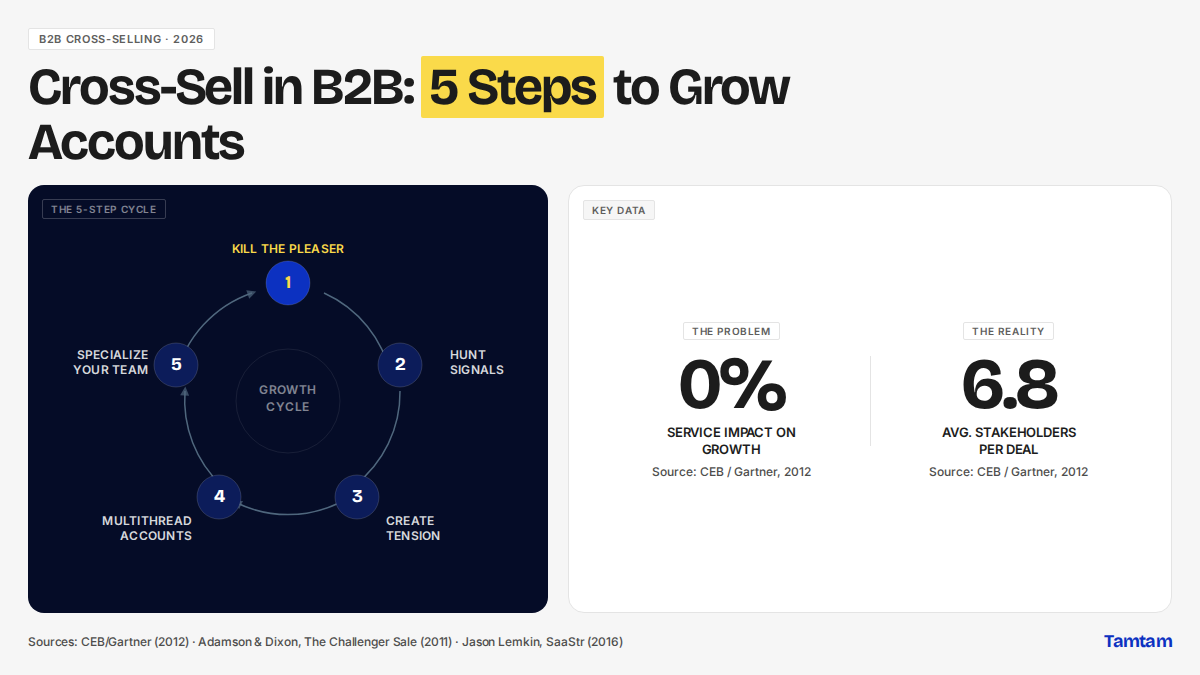
You have your diagnosis. Now you have to deliver it in a way that creates urgency, not defensiveness. This is where the Challenger methodology comes in. (It's the same cross-sell move: constructive tension, not people-pleasing.)
Research behind The Challenger Sale found that in complex B2B sales, top performers are overwhelmingly "Challengers." They make up 54% of elite reps, while "Relationship Builders," who focus on being liked and avoiding tension, make up a paltry 7%.
Challengers aren't afraid of tension. They create it on purpose.
What to do: Your diagnosis must be packaged as a "Commercial Insight." This isn't just any insight; it's a specific piece of information that achieves three things:
You connect an operational flaw they are likely unaware of to a direct and painful financial consequence. This is the "cost of inaction."
Why this works: Without tension, you're just having a nice chat. Nice chats don't get seven-figure budgets approved. C-level executives are paid to solve expensive problems. By presenting a well-researched Commercial Insight, you are elevating their problem to a level that demands their attention and, crucially, their money. You're creating the business case for them.
Common mistake to avoid: Presenting an insight about your product's value. This is a subtle but critical distinction. It’s not, "You're only using 40% of our features, so you're missing out on value." That’s you-focused and makes them feel stupid. It’s, "Our data suggests that teams using your current workflow, which happens to ignore our automation features, are seeing an 18% higher customer acquisition cost. Let's walk through why." That is them-focused and makes you look like a genius.
You’ve presented the diagnosis and created constructive tension. The customer is leaning in, slightly uncomfortable but deeply engaged. Now what? You don’t pitch. You facilitate.
The rest of the meeting becomes a workshop. The "defendant" in this workshop is the customer's current way of doing things. Your job is to act as the prosecutor, guiding them as they convict their own strategy.
What to do: Get up and grab the virtual or physical whiteboard. At the top, write down the Commercial Insight: "Process X is costing us Y." Then, map out their current process on one side. Ask questions. "Walk me through how the team handles this today." "Where are the bottlenecks?" "What happens when that step fails?"
Make them do the talking. As they describe their flawed process, map it out visually. Then, on the other side of the whiteboard, map out the proposed future state, the one where your expanded solution eliminates those bottlenecks. Quantify the gap between the two states in dollars, hours, or risk.
Why this works: This is the moment of co-creation. The expansion plan is no longer your idea that you're trying to push on them. It’s the logical, inevitable verdict from the trial you just conducted together. They become the authors of the business case for the upsell because they helped build it, right there on the whiteboard. When it comes time to ask for the money, it’s not a pitch; it’s just the formal prescription for the illness they just helped you diagnose.
Common mistake to avoid: Saving the expansion pitch for a separate agenda item at the end of the meeting. The entire damn meeting is the pitch. The expansion isn't a slide titled "Upsell Opportunity." It's the natural conclusion to the strategic problem you've spent the entire session solving together.
You've now got a killer framework for running an expansion-focused QBR. The final step is to realize that the QBR itself is an outdated concept. Why wait 90 days to have a conversation that could unlock millions in value?
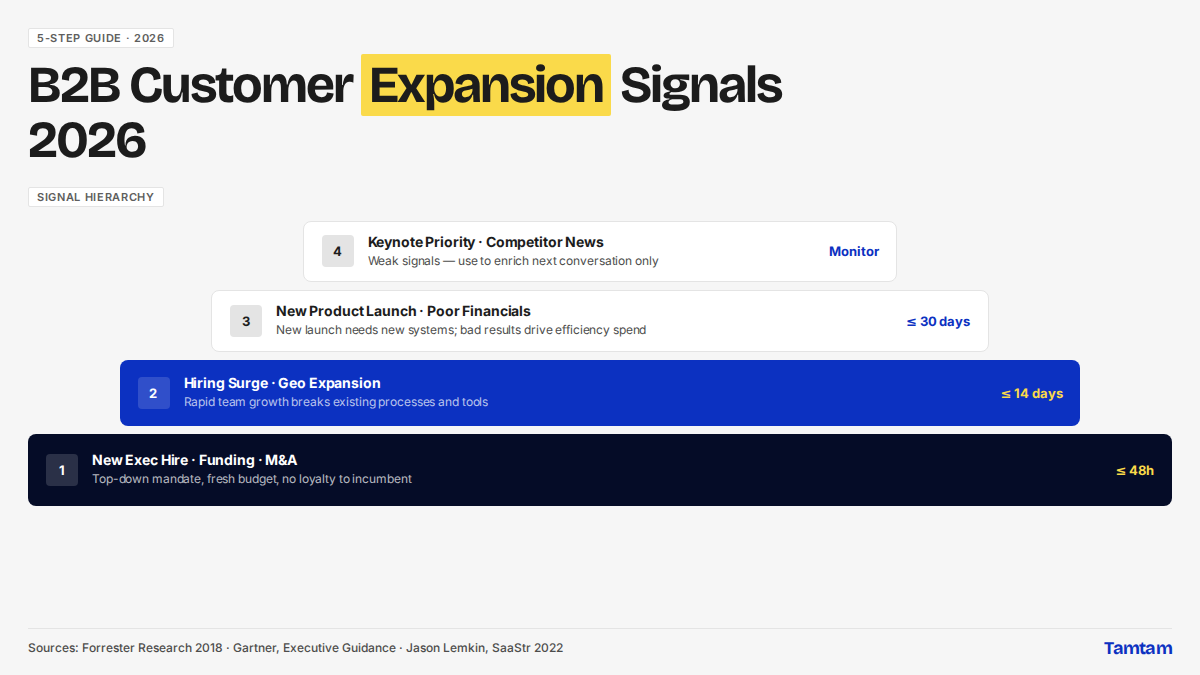
The market moves faster than your calendar. By the time your scheduled QBR rolls around, the window of opportunity may have slammed shut. The most sophisticated account managers operate on signals, not schedules.
What to do: Work with your team to identify 3 to 5 key "expansion signals" for your accounts. These are triggers that indicate a window of opportunity is opening. Examples could include:
When a signal fires, you don't wait for the QBR. You trigger a "Strategic Review" immediately. Your outreach is now hyper-relevant and timely.
Example: The Signal-Based Strike An account manager gets an alert that one of her key accounts just hired a new VP of Revenue Operations. Instead of waiting for the next QBR, she immediately reaches out with a concise email: "Congrats on the new role! Saw the news about your focus on sales efficiency. My team has put together a 90-day plan that helped [Similar Company] cut their sales cycle by 20%. Worth a 15-minute chat next week?" She lands the meeting, bypasses the formal QBR process entirely, and closes a major expansion deal in 14 days.
Why this works: A signal-based intervention is always more powerful than a calendar-based one. It shows you are proactively monitoring their business and bringing timely, relevant insights. You’re not just checking a box on your to-do list; you're operating as a true strategic partner who moves at the speed of their business.
Common mistake to avoid: Believing you need expensive, complex AI software to do this on day one. You don't. Start manually. Set up Google Alerts for your top 10 clients' company names. Check your champion's social network profile once a week. Build a basic usage report in your CRM. The habit is more important than the tool.
The goal isn't just to run a better meeting. It's to fundamentally change your identity from a vendor who proves value to a partner who creates it. You stop asking for the expansion deal and start creating the conditions where the customer demands it from you. This proactive, signal-driven approach is the foundation of modern account growth. It requires systematically researching every account for the triggers that matter. That shift, from reactive check-ins to proactive intelligence, is how you build a pipeline of the highest possible quality, and it's what platforms like Tamtam are designed to automate.
Set up for you before our first call
Book a demo