September 28, 2026
Most B2B go-to-market strategies are corporate fiction designed to soothe executive anxiety, not win deals, leading to impossible quotas and massive SDR burnout. The old playbook of just hiring more reps is dead; the modern approach is to build a dynamic GTM operating system instead of a static slide deck. This guide provides a five-step framework for this new approach, covering unit economics, signal-based ICP definition, killing ineffective programs, designing signal-based plays, and creating fast feedback loops.
Let’s be honest. Your 80-page go-to-market slide deck is bullshit.
It’s a beautiful work of corporate fiction, meticulously crafted to give everyone in the boardroom a warm, fuzzy feeling. It’s a psychological pacifier. It creates what psychologists call the "illusion of control": the comforting belief that you can predict and command the chaotic mess that is the modern market.
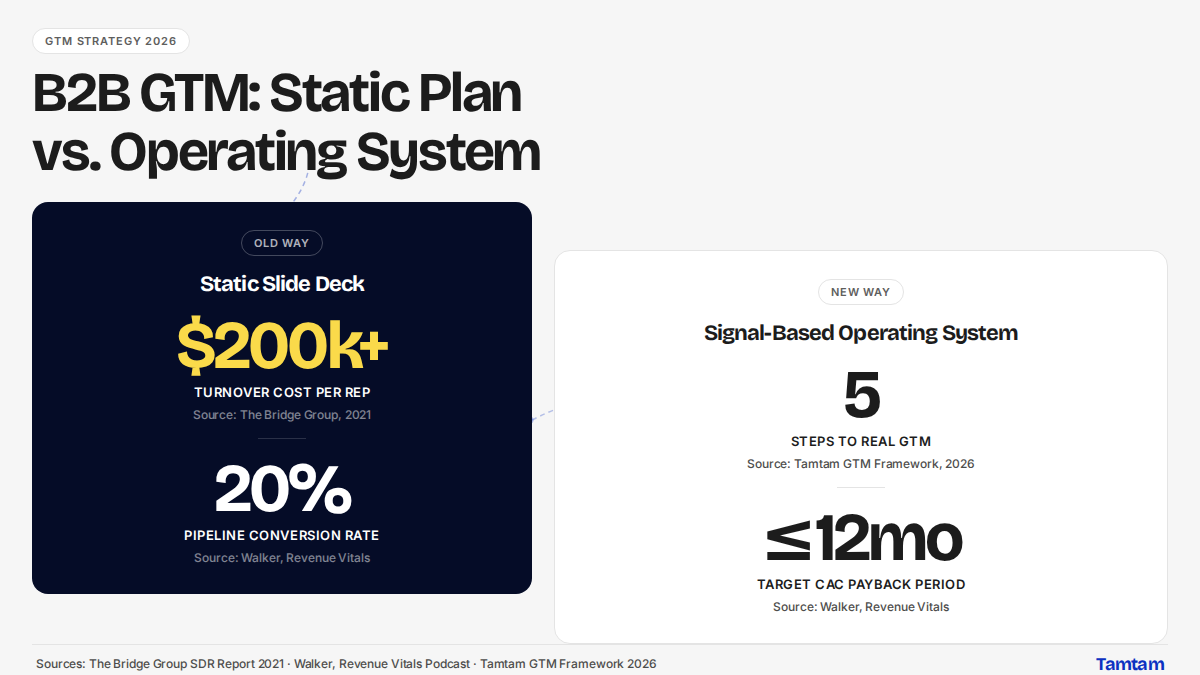
This strategic theater is fun for a quarter. Then reality hits. Quotas get missed. Reps get put on performance plans. The best ones leave, and you’re left footing a bill that can run into the hundreds of thousands per rep in turnover costs. Your beautiful slide deck sits in a forgotten folder, a monument to a plan that never touched the real world.
The problem isn’t your team. The problem is the premise.
The goal isn't to create a static document, a GTM plan. It’s to build a living, breathing GTM operating system. A system that senses the market, adapts to new information, and helps your team make smarter decisions every single week, not just once a year.
It’s time to stop the fantasy and get real. Here’s how.
Before you write a single slide about your Total Addressable Market (TAM) or your grand plans for market expansion, you need to look your business straight in the eye. You need to know exactly where you stand, financially, right now. This is your ground zero.
Why this matters: A GTM plan built on fantasy growth targets ("We need to hit $20M ARR!") is doomed from the start. It forces you to invent math to justify an arbitrary number. A GTM plan built on improving real-world unit economics is a real business strategy. You can't chart a course to a new city without knowing your exact starting coordinates.
What to do: Pull your real financial and operational data from the last 6 to 12 months. No vanity metrics. Just the cold, hard numbers. Calculate three things:
A real-world example: As Chris Walker from Refine Labs often points out, many companies operate with broken math. Imagine you spend $5 million on sales and marketing to generate $10 million in pipeline. Looks good, right? But if that pipeline only converts at a 20% rate, you just spent $5 million to make $2 million. Your economics are completely broken. The answer isn't to ask for a bigger budget. The answer is to figure out why you’re lighting money on fire.
Common mistake to avoid: Starting your GTM planning with a top-down revenue goal from the board. This is the single biggest sin in strategic planning. It puts everyone in a defensive crouch, forcing them to create a fictional narrative to justify a number that has no basis in reality. Start with your current economics, and build the plan up from there.
It's time to kill "Marketing Mary." You know the slide: a stock photo of a smiling professional with a list of vague attributes like "data-driven," "wears many hats," and "frequents industry blogs."
This is useless. It doesn't help your reps find anyone. It's a marketing artifact, not a sales tool.
Why this matters: Firmographics (company size, industry, geography) tell you who could buy your product. That’s a massive, noisy, and mostly uninterested group of people. Behavioral signals and triggers tell you who is likely to buy now. Focusing on the latter is the difference between screaming into the void and having a quiet, productive conversation with someone who is already looking for you.
What to do: Forget the personas. Instead, make a list of the events and signals that happen right before your best customers sign a contract. Get your sales and customer success teams in a room and ask them:
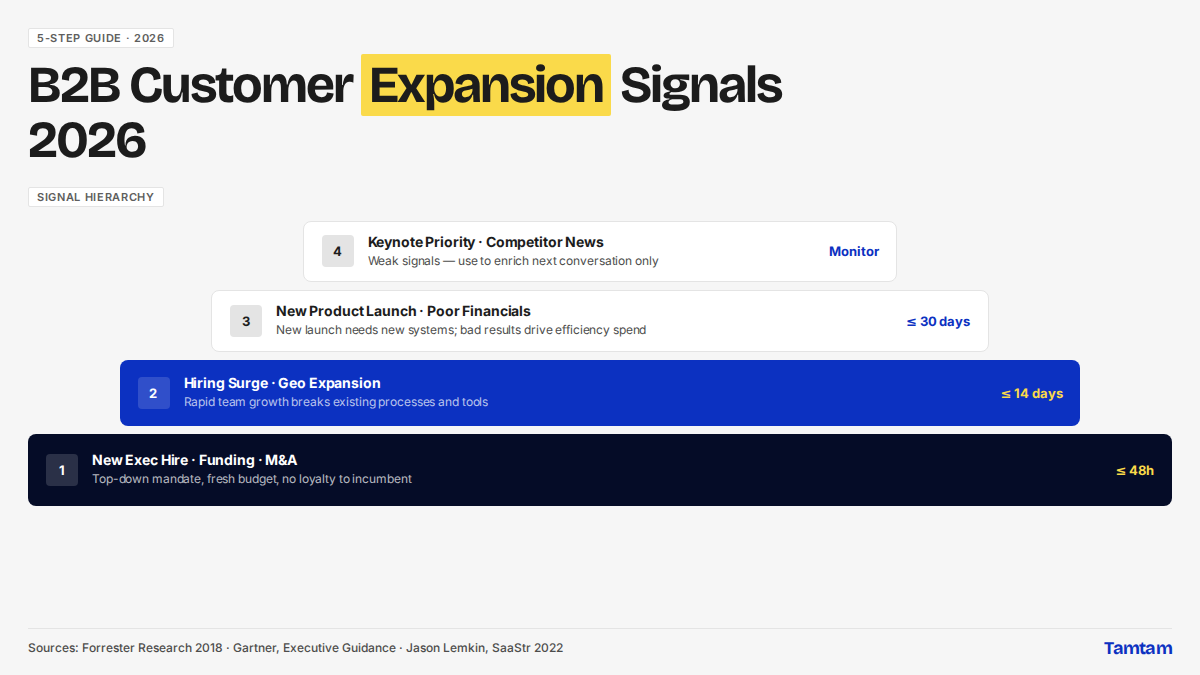
These are your buying signals. Your real Ideal Customer Profile isn't a person. It's a company experiencing one or more of these signals right now.
A real-world example: An SDR team is tasked with selling project management software to "VPs of Engineering at Series B tech companies." That’s a huge, cold list. A signal-based approach changes the directive to: "Find VPs of Engineering at Series B tech companies that just posted five new developer job openings mentioning 'scaling issues' and 'missed deadlines'." The focus shifts instantly from volume to precision. The outreach is no longer "Hey, wanna see a demo?" It's "Saw you're scaling your dev team and running into the exact issues we help companies like yours solve. Here's how."
Common mistake to avoid: Confusing your TAM with your immediate target list. Your TAM is everyone you could theoretically sell to. It's a big number that looks great on a slide. Your signal-based ICP is the tiny fraction of that TAM that you should actually spend time on this week. Obsess over the small, active list, not the big, passive one.
Strategic planning isn't about what you’re going to start doing. It’s about what you’re going to stop doing. The fastest way to improve your GTM is to ruthlessly cut the fat.
Why this matters: Every dollar, every hour, and every brain cell you spend on an activity with poor ROI is stolen from an activity that could actually be working. Deleting ineffective programs is the fastest way to improve your unit economics and free up capital and focus for what matters. It feels damn good, too.
What to do: Open a spreadsheet. List every single marketing and sales expense from the last 6 to 12 months. Be exhaustive: paid ads, content syndication, event sponsorships, every piece of software in your stack, lead gen vendors, you name it. Next to each line item, write down the amount of qualified pipeline and closed-won revenue it generated.
Now, draw a line. Anything that can't be tied to real revenue, or has a pathetic ROI, goes. Be brutal. The goal is to kill the bottom 20% to 40% of your activities.
A real-world example: Your company spent $100,000 to sponsor a massive industry conference. The team came back energized, with a list of 500 "badge scans" (MQLs). Six months later, you look at the data. Those 500 leads resulted in 20 meetings, 2 opportunities, and zero closed deals. The ROI is negative. Kill it. Next year, reallocate that $100,000 to creating a niche podcast for your signal-based ICP that builds real authority and captures demand from people who are actually listening.
Common mistake to avoid: The sunk cost fallacy. This is the voice in your head that says, "But we've already spent so much on it!" or "We've always done this trade show." Your past investment is gone. It's irrelevant to the future. The only question that matters is, "Based on the data, is this the best use of our next dollar?" If the answer is no, you have to have the courage to pull the plug, even if a powerful executive is personally attached to the program.
Your prospects don't care about your 14-day, 8-touch, omni-channel cadence. They don't want to be "touched." They want their problems solved. The rigid, one-size-fits-all sequence is a tool for reps to hit activity metrics, not a system for starting valuable conversations. It’s time to replace it with something smarter.
Why this matters: Signal-based plays ensure your outreach is always relevant and timely. When you reach out because of a specific event (the signal), you have a built-in reason to be in their inbox that has nothing to do with you and everything to do with them. This is how you kill the dreaded "just checking in" email forever and dramatically increase your chances of getting a response.
What to do: Instead of a linear sequence, map out "If-Then" plays. These are pre-designed responses to the buying signals you identified in Step 2.
A real-world example: Let's look at a multithreading play, a concept often discussed on sales podcasts like 30 Minutes to President's Club. The old way is an SDR sends a generic email to one person. The signal-based play is: IF a director-level contact at a target account engages with a piece of content, THEN the AE crafts a 3-part message. They send one version to the director, one to their VP, and one to the CFO. Each message references the original signal but connects it to a business outcome relevant to that specific persona (e.g., project efficiency for the director, team productivity for the VP, ROI for the CFO).
Common mistake to avoid: Automating fake personalization. Using tools to auto-insert \{{company_name}} and \{{job_title}} is not a signal-based play. It's spam with slightly better grammar. A true play is about context, not just data insertion. The value is in connecting the dots between the signal, the prospect's likely problem, and your solution.
Your GTM strategy is not a biblical text. It's a series of hypotheses. And a hypothesis is just a fancy word for a guess. Your job isn't to defend the guess. Your job is to create a system that tests your guesses as quickly and cheaply as possible.
Why this matters: The market changes weekly, sometimes daily. A GTM plan that's only reviewed once a quarter is obsolete by the second month. Short, rapid feedback loops are what turn a static plan into an agile operating system. It allows you to pivot based on real data from the front lines, not on outdated assumptions from the boardroom.
What to do: Ditch the bloated Quarterly Business Review (QBR). Replace it with a weekly or bi-weekly GTM Sync. This is a mandatory 45-minute meeting with leadership from sales, marketing, and product. The agenda is ruthlessly simple and always the same:
A real-world example: A team hypothesizes that CTOs are the key buyer for their new security product. They run a two-week sprint targeting only CTOs with a specific play. At the GTM sync, they review the data: connect rates are terrible, and meeting book rates are zero. The frontline reps share qualitative feedback: every CTO they managed to speak with said, "This is interesting, but you need to talk to my VP of Infrastructure." The team didn't need to wait a quarter to learn this. They pivot immediately. The next two-week sprint targets VPs of Infra with new messaging tailored to their world.
Common mistake to avoid: Blaming execution when the strategy is wrong. When reps aren't hitting quota, the default management reaction is to blame their effort or skill. A fast feedback loop forces you to ask better questions: "Is the quota wrong? Is the ICP we gave them wrong? Is our messaging wrong? Is the product misaligned with the market?" It shifts the burden of performance from being solely on the individual rep to being shared by the entire GTM system.
This isn't easy. Turning your GTM from a dead document into a living operating system means someone has to do the work. Someone has to constantly watch the market, spot the buying signals, and feed the frontline with timely intelligence. For most teams, this is the bottleneck that kills the whole idea, condemning them to another year of generic outreach. The alternative is to build a system that automates the grunt work of signal discovery. Because the hard truth is that reps are for selling, not for spending 80% of their day scrolling social feeds for a single trigger. That's the problem platforms like Tamtam were built to solve: making this entire signal-based approach not just possible, but repeatable.
Set up for you before our first call
Book a demo