October 1, 2026
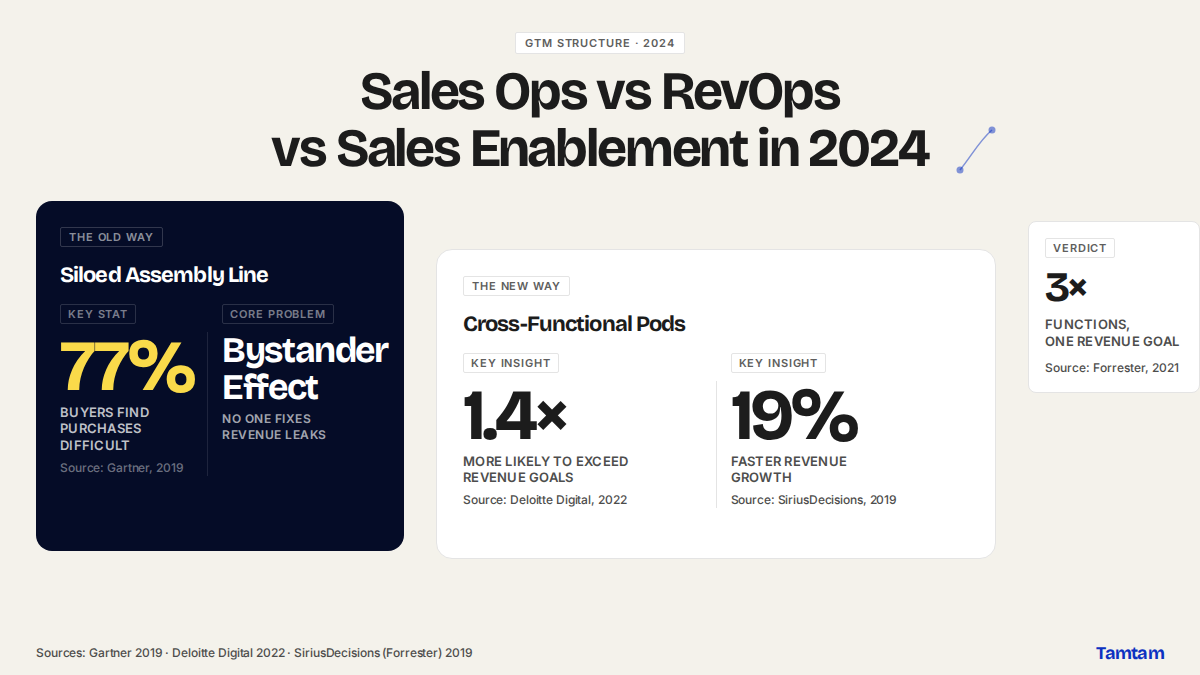
The debate between Sales Ops, RevOps, and Sales Enablement is a trap focusing on the wrong problem. These functions represent an evolutionary path away from the outdated "assembly line" model where siloed departments create friction and kill deals. The modern solution is to use a mature RevOps function as the central nervous system for cross-functional "revenue pods" that share a single goal. Stop drawing lines on an org chart and start building agile teams that adapt to how customers actually buy.
Let's be honest. The endless debate over who owns the CRM, who trains the SDRs, and who reports on the pipeline is a colossal waste of time. It’s a symptom of a much deeper disease: your go-to-market structure is probably based on a 100-year-old factory model.
Back in the day, some guy named Frederick Winslow Taylor came up with "Scientific Management." The idea was to break down complex work into tiny, repeatable tasks. One person puts the widget on the conveyor belt, another person tightens a screw, a third person paints it blue. It worked wonders for building cars. It’s a complete disaster for winning B2B deals in 2024.
This "Taylorist Hangover" is why most companies look the way they do. Marketing generates a "lead" (the widget). They throw it over the wall to an SDR, who qualifies it (tightens the screw). The SDR then throws it over another wall to an AE, who tries to close it (paints it blue). Sales Ops measures how fast the screws get tightened, and Enablement teaches people how to tighten them better.
Everyone is busy. Everyone hits their activity metrics. And yet, deals fall through the cracks, customers get a disjointed experience, and everyone blames everyone else when the company misses its number. It's organizational bullshit, and it's costing you money.
The question isn't "Sales Ops vs RevOps vs Enablement." The question is, which philosophy for running your revenue engine are you going to choose?
Let's be honest. The endless debate over who owns the CRM, who trains the SDRs, and who reports on the pipeline is a colossal waste of time. It’s a symptom of a much deeper disease: your go-to-market structure is probably based on a 100-year-old factory model.
Back in the day, some guy named Frederick Winslow Taylor came up with "Scientific Management." The idea was to break down complex work into tiny, repeatable tasks. One person puts the widget on the conveyor belt, another person tightens a screw, a third person paints it blue. It worked wonders for building cars. It’s a complete disaster for winning B2B deals in 2024.
This "Taylorist Hangover" is why most companies look the way they do. Marketing generates a "lead" (the widget). They throw it over the wall to an SDR, who qualifies it (tightens the screw). The SDR then throws it over another wall to an AE, who tries to close it (paints it blue). Sales Ops measures how fast the screws get tightened, and Enablement teaches people how to tighten them better.
Everyone is busy. Everyone hits their activity metrics. And yet, deals fall through the cracks, customers get a disjointed experience, and everyone blames everyone else when the company misses its number. It's organizational bullshit, and it's costing you money.
The question isn't "Sales Ops vs RevOps vs Enablement." The question is, which philosophy for running your revenue engine are you going to choose?
This is the classic model. Sales Ops is the mechanic, focused on the sales team's engine: territory planning, comp plans, and Salesforce administration. Sales Enablement is the driving instructor, focused on rep training, content, and onboarding. Marketing has its own ops team. Customer Success has its own. Everyone stays in their lane.
This is the first step out of the dark ages. You feel the pain of the silos, so you create a RevOps team. The goal is to get everyone looking at the same data, using the same tools, and speaking the same language. This team typically owns the entire GTM tech stack and is responsible for end-to-end funnel reporting, from first touch to renewal.
This is where high-performing teams are heading. Instead of organizing by function (all SDRs here, all AEs there), you organize around the customer. You create small, autonomous "pods" or "squads." A typical pod might have one marketer, one SDR, two AEs, and a customer success manager, all dedicated to a specific market segment, territory, or list of target accounts.
Crucially, they share one number: the revenue they generate and retain.
In this model, RevOps is not another department sitting on the side. RevOps is the infrastructure. They provide the data, tools, automation, and processes that allow the pods to operate at peak efficiency. They are the city planners building the roads and power grid so the citizens (the pods) can build amazing things.
| Approach | Core Philosophy | Who "Owns" the Pipeline? | Primary KPIs | Biggest Risk |
|---|---|---|---|---|
| Siloed Assembly Line | Scientific Management / Specialization | Ownership is fragmented by stage (MKT owns top, Sales owns middle, etc.) | Activity Metrics (MQLs, Dials, Demos) | The Bystander Effect: Systemic failures are ignored. |
| Centralized Bridge-Builder | Alignment Through Centralization | RevOps "owns" the data & process; departments still own their stage. | Funnel Conversion Rates (MQL>SQL) | The Ivory Tower: RevOps reports on problems but can't fix them. |
| Cross-Functional Pod | Shared Accountability / Agility | The Pod owns a shared pipeline target from creation to close. | Net New Revenue, Net Revenue Retention | Cultural Rejection: Leadership resists giving up the illusion of control. |
The right choice isn't about picking a department name from a hat. It's about honestly diagnosing where your company is on its GTM maturity journey. Ask yourself three questions:
So stop trying to draw perfect lines on a flowchart. The real challenge isn't deciding who owns what; it's creating a system where teams can win together. The turf war is a distraction. The only thing that matters is building an engine relentlessly focused on the customer, and for most growing B2B companies, that engine is a network of agile, empowered pods. But even the best pods can't run on garbage fuel. This new structure demands a new kind of input: high-quality lead lists with real buying context, which is the problem platforms like Tamtam are built to solve, letting your pods spend less time digging and more time winning deals together.
Set up for you before our first call
Book a demo