60 Seconds Summary
Most sales forecasting is organized guesswork designed to make executives feel better, not a science. Traditional methods like Opportunity Stage or Category-Based forecasting fail because they depend on seller sentiment—a flawed mix of "happy ears" and sandbagging. To build a predictable revenue engine, you must analyze what buyers do, not what sellers think. AI and signal-based forecasting offer radical accuracy, but adopting them requires prioritizing hard data over human ego.
We live and breathe B2B sales every single day. We’ve sat through the excruciating weekly forecast calls, seen star reps sandbag their numbers, and watched leaders make terrible hiring decisions based on a pipeline full of hope. This guide isn't academic theory. It's a field report from the front lines, written to help you cut through the noise and find what actually works.
1. Opportunity Stage Forecasting (The Starter Pack)
This is Forecasting 101. You assign a close probability to each stage in your CRM. Discovery might be 10%, Proposal Sent is 60%, Negotiation is 80%. You multiply the deal value by the probability, add it all up, and voilà, you have a forecast.
- Who it's best for: Early-stage startups with no historical data and a simple, linear sales process. It’s a starting point, not a destination. Think of it as the training wheels for your revenue engine.
- Strengths: It’s dead simple to set up and even simpler to understand. Your CRM probably does it for you out of the box. It forces a basic level of discipline and creates a common language for the pipeline.
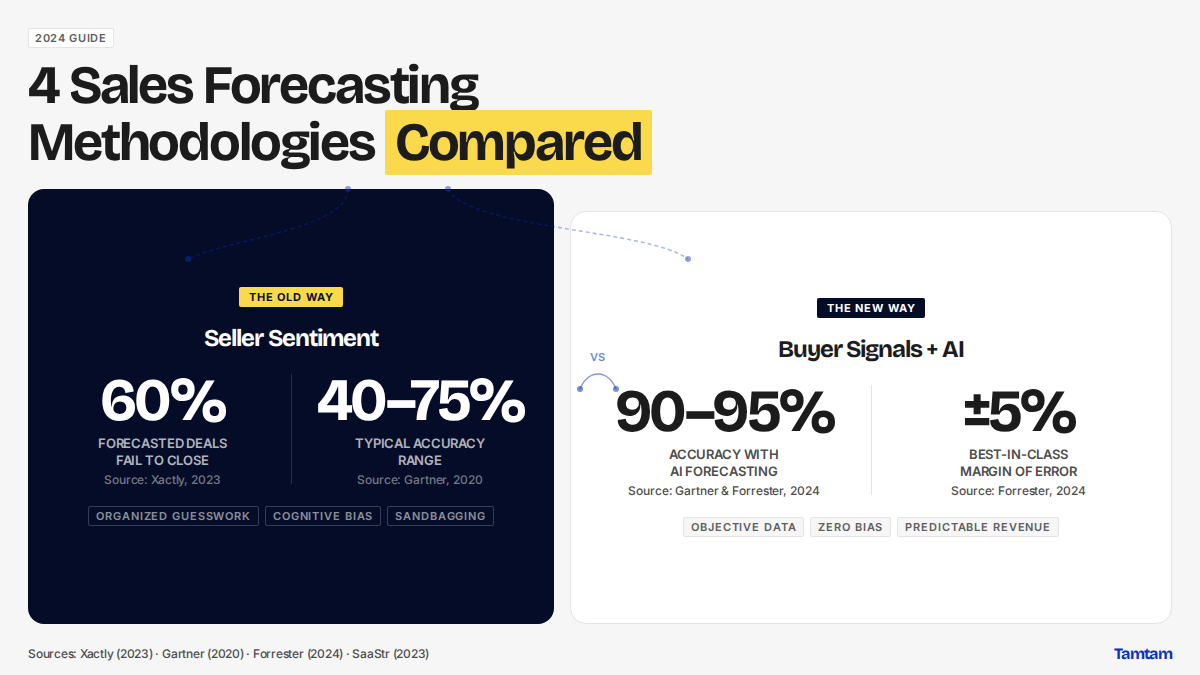
- Weaknesses: This method is wildly inaccurate. Its core assumption, that every deal in the same stage has the same chance of closing, is just plain wrong. A $100k deal with the CFO championing it and a $100k deal with a junior manager who’s gone dark are not both “60% likely to close” just because they’re in the "Proposal Sent" stage. It rewards activity, not progress. A rep can move a deal to the next stage without any real buying signal, instantly inflating the forecast. This is a massive reason why, according to Xactly, a staggering 60% of forecasted deals fail to close.
- Verdict: It’s better than throwing darts at a wall, but not by much. Use it if you have absolutely nothing else, but plan to graduate from it as fast as you possibly can.
2. Category-Based Forecasting (The Ego-Stroker)
This is the classic "Commit, Best Case, Pipeline" model. You go around the room (or the Zoom) and ask each rep to categorize their deals. "Commit" means it's a sure thing. "Best Case" means it could happen if the stars align. "Pipeline" is everything else.
- Who it's best for: Sales teams where leadership trusts individual rep judgment above all else. It's for cultures that prioritize rep autonomy and morale over systemic, data-driven accuracy.
- Strengths: It’s easy to communicate up the chain to the board. It gives reps a strong sense of ownership and accountability for their number. In theory, it taps into the nuanced, human intelligence of the person closest to the deal.
- Weaknesses: This method is a psychological minefield. It’s based entirely on human sentiment, which is vulnerable to every cognitive bias in the book. You get "happy ears," where a rep mistakes politeness for buying intent. You get sandbagging, where top performers hide deals to guarantee they hit their number and maximize commission accelerators. The definitions of "Commit" are hopelessly subjective and vary from rep to rep. The entire exercise becomes a performance, a tool for impression management. It’s a perfect example of the "Illusion of Control," a bias documented by psychologist Ellen Langer where people overestimate their ability to control events. The forecast isn't a reflection of reality; it's a reflection of your team's collective optimism or pessimism that week.
- Verdict: This method swaps a flawed formula for a flawed human. It’s an exercise in managing anxiety, not predicting revenue.
3. Historical Forecasting (The Rearview Mirror)
Here, you look at past performance to predict future results. You might say, "Last Q2 we closed €2M with a 25% win rate from leads generated in Q1, so with a similar pipeline this year, we should expect the same."
- Who it's best for: Highly stable, transactional businesses with years of clean data and predictable sales cycles. Think of a company selling rock salt in northern Europe; their Q4 sales are probably going to look a lot like last year's Q4.
- Strengths: It removes some of the individual rep bias from the equation. If the market, your product, and your team remain perfectly consistent, it can be reasonably accurate. It’s based on what actually happened, not what people hope will happen.
- Weaknesses: This model is incredibly brittle. It shatters the second it touches a dynamic market. It can’t account for new competitors, economic shifts, product changes, or a new go-to-market strategy. It’s like trying to drive a car forward by looking only in the rearview mirror. As Jameson Yung of SaaStr bluntly put it, the "easy money" party of 2021 is over. Using historical data from that era to predict performance today is an act of pure delusion. Your past performance is no guarantee of future results, especially when the entire economic landscape has changed.
- Verdict: It's useful for a gut check or high-level annual planning in a stable industry, but it’s a dangerously misleading tool for in-quarter operational forecasting.
4. AI and Signal-Based Forecasting (The Uncomfortable Truth)
This is the new frontier. Instead of relying on CRM stages (rep activity) or rep sentiment, this method connects directly to the source of truth: your buyers. It analyzes thousands of objective engagement signals like email reply rates, calendar invitations accepted, depth of engagement across the buying committee (multi-threading), and document views. The AI builds a model of what a truly healthy deal looks like and scores every opportunity against that benchmark.
- Who it's best for: Growth-oriented B2B teams ready to treat forecasting as a science, not an art. It’s for leaders who value predictable revenue more than they value protecting their reps’ egos.
- Strengths: It is, by a massive margin, the most accurate method available. According to analyses from firms like Gartner and Forrester, the best-in-class tools consistently land within 5% to 10% of the final number, turning a wild guess into a manageable business variable (Sources 1, 5). It completely bypasses human bias. The AI doesn’t have happy ears, it doesn’t sandbag, and it doesn’t care about office politics. It just looks at the data. It surfaces at-risk deals long before a rep will admit there's a problem, allowing managers to coach and intervene effectively.
- Weaknesses: The biggest challenge is cultural, not technical. Some leaders and reps feel threatened by a "black box" they don't understand. It forces incredibly uncomfortable conversations. Imagine telling your top AE, the one who’s never missed quota, that the AI has downgraded her "sure thing" $250k deal to a 20% probability because the buyer hasn't replied in two weeks and nobody from their engineering team has joined a call. This is the "confrontation with reality" that plays out in every company that adopts this model. The AI’s forecast enrages the star rep but ultimately saves the company from a massive pipeline surprise. Implementing it requires clean data and a leadership team with the conviction to trust the machine over the person.
- Verdict: This is the only method that systematically attacks the root cause of bad forecasts: flawed human judgment. It’s more accurate, it's objective, and it’s the future. But adopting it is a test of leadership.
5. Comparison: Sales Forecasting Methodologies at a Glance
| Methodology | Primary Data Input | Who It's For | Core Weakness | Typical Accuracy Range* |
|---|
| Opportunity Stage | Rep-updated CRM stages | Early-stage startups | Assumes all deals in a stage are equal | 40% to 60% |
| Category-Based | Rep sentiment ("Commit") | Teams that prioritize rep autonomy | Highly subjective, prone to bias | 50% to 75% |
| Historical | Past sales data | Stable, transactional businesses | Useless in a dynamic market | 60% to 80% (in stable conditions) |
| AI / Signal-Based | Objective buyer signals | Data-driven, growth-oriented teams | Requires a major cultural shift | 90% to 95%+ |
Accuracy ranges are industry estimates based on composite data from multiple reports. Reports from Gartner and Forrester consistently show AI-based methods significantly outperforming traditional, sentiment-based models (Sources 1, 5).
6. How to Choose the Right Forecasting Method for You
Picking a forecasting method isn't just about choosing a formula from a spreadsheet. It’s a philosophical choice about what your organization believes is true. It reveals what you value most. To find the right path, ask yourself and your leadership team three blunt questions.
1. What is your source of truth: Seller Sentiment or Buyer Signals?
This is the fundamental divide. Do you want your forecast built on what your reps claim is happening in a deal? Or do you want it built on the verifiable, digital evidence of what the buyer is actually doing? The first path leads to ego management and corporate theater. The second path leads to accuracy.
2. Are you ready for the confrontation?
An AI-driven forecast will, at some point, contradict your star rep's gut feeling. It will tell you their "committed" deal is about to go dark. As a leader, are you prepared to trust the data and have that difficult conversation? Or will you override the machine to avoid bruising an ego? If you aren't ready for that confrontation, you aren’t ready for an accurate forecast.
3. What is your primary goal: Rep Autonomy or Predictable Growth?
There's a real tradeoff here. A system based on "Commit" calls makes reps feel in control. A system based on objective signals gives the business control. Are you optimizing for a system that protects individual autonomy, even at the cost of accuracy? Or are you optimizing for a system that gives the business the predictability it needs to hire, invest, and scale without lighting money on fire?
Your answers to these questions will tell you more than any feature comparison chart. Ultimately, debating forecasting models is like arguing about the best way to arrange the deck chairs on the Titanic if the ship was doomed from the start. A forecast is only as good as the pipeline it measures. If that pipeline is stuffed with garbage leads, no model on earth can spin it into gold. The only way to build a forecast that survives contact with reality is to fix the problem at its root. It means building a pipeline based on verifiable buying triggers from the very beginning, not just wishful thinking. That's the core idea at Tamtam: that the highest-quality outbound lists, researched against real-world signals, make forecasting less of an anxious ritual and more of a boringly predictable science.