October 4, 2026
The traditional AE-led sales model is failing because modern B2B buyers prioritize technical expertise over relationships. The Sales Engineer (SE) has become the key revenue driver in complex deals, but outdated team structures lead to SE burnout and inefficiency. This guide explores four modern organizational models—from SE-led teams to specialized Demo Engineering and hybrid 'Solutions Principal'' roles—that place technical credibility at the center of the sales motion. Choosing the right model depends on your product''s complexity and customer profile, redefining the AE''s role as a commercial orchestrator rather than the primary closer.
Let’s be honest. The B2B sales playbook you were taught is a delusion.
It’s a fantasy from a bygone era, one where a charismatic Account Executive with a firm handshake and a steak dinner budget could close a six-figure deal. In this fantasy, the Sales Engineer is a supporting character, a pocket protector-wearing nerd wheeled in to answer a few technical questions before being politely shuffled off stage.
That world is dead.
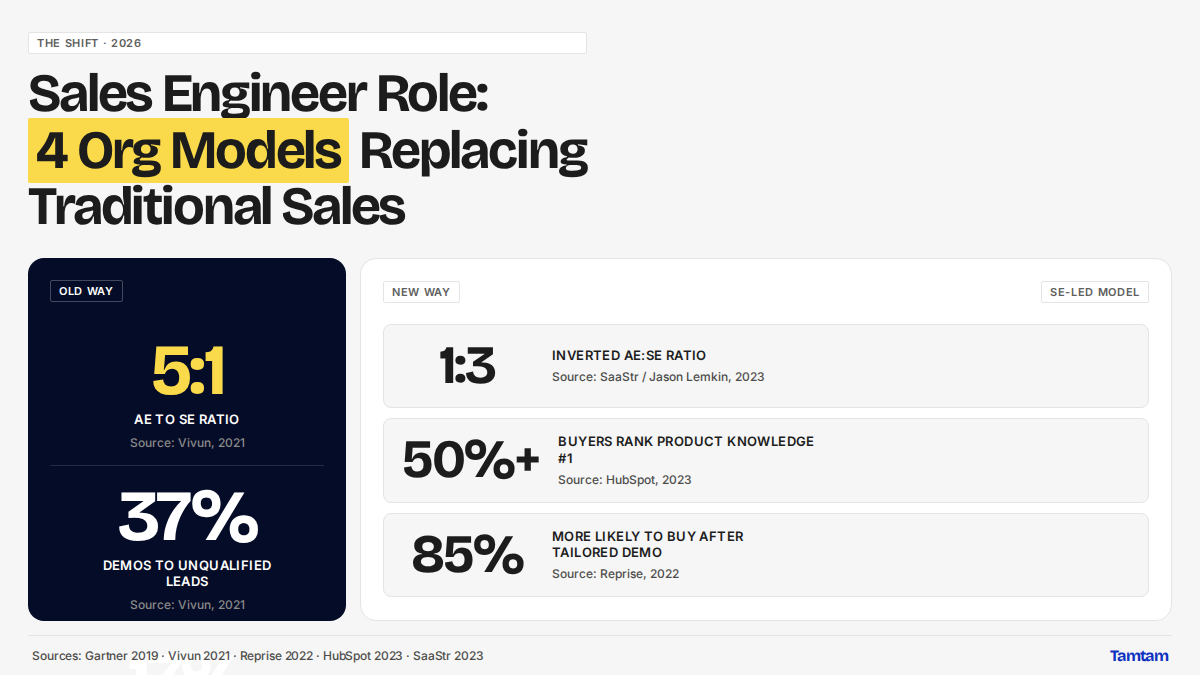
Today’s buyers are armed with more information than ever. They’ve read your G2 reviews, watched your competitor’s video tutorials, and they can smell commission breath from a mile away. Gartner found that B2B buyers spend only 17% of their time meeting with potential suppliers [1]. When they finally agree to a meeting, they aren’t looking for a friend. They are looking for an expert. HubSpot's recent sales report confirms that over 50% of buyers now rank "deep product knowledge" as the number one attribute they look for in a salesperson [14].
This power shift has quietly turned the traditional sales hierarchy upside down. The person who holds the technical credibility now holds the power. And that person is the Sales Engineer. They are no longer the sidekick. In any deal with an ounce of complexity, they are the hero.
The problem is, most sales organizations are still structured for the old world. They treat their SEs like a glorified demo resource, burning them out on unqualified calls and creating a culture of friction. Your org chart has become a liability.
The good news? A few forward-thinking companies have figured this out. They're restructuring their teams to put technical credibility at the center of the sales motion. We’re going to break down the four dominant models, show you who they’re for, and help you figure out which one will stop you from getting left behind.
This is the classic setup. A team of AEs drives the sales process, and a smaller pool of SEs is brought in as needed for demos and technical deep dives. The org chart is pyramid-shaped, with a typical ratio of 3 to 5 AEs for every one SE [4].
This model flips the traditional structure on its head. The Sales Engineer is the primary driver of the deal from the first technical call onward. The AE:SE ratio inverts to 1:2 or even 1:3 [7]. The SE owns the technical validation, the solution design, and the trust-building process. The AE’s role shifts from "closer" to "commercial orchestrator," handling pricing, procurement, legal, and stakeholder management.
Instead of splitting the commercial and technical roles, this model merges them into a single, powerhouse individual: the Solutions Principal (or Solutions Architect, or whatever fancy title you want to use). This person owns the entire sales cycle, from initial discovery and solutioning all the way through commercial negotiation and closing.
As companies scale, they realize that not all presales work is created equal. This model addresses that by splitting the presales function into two distinct teams: a "deal side" and a "scale side."
The "deal side" consists of your classic SEs who are customer-facing and attached to specific opportunities. The "scale side," often called Demo Engineering or the Technical Success team, focuses on building the infrastructure that enables the deal team to be more efficient. They create reusable demo environments, automate data population, build custom proof-of-concept tooling, and handle anything that can be productized.
| Model Name | Typical AE:SE Ratio | Best For (Product Complexity & Buyer) | Primary Failure Mode | Compensation Philosophy |
|---|---|---|---|---|
| Traditional AE-Led | 3:1 to 5:1 | Low-Medium complexity; Non-technical buyers | SE burnout from unqualified demos | AE: High commission; SE: Lower commission/bonus |
| Modern SE-Led | 1:2 to 1:3 | High complexity; Expert/technical buyers | AE role confusion; Finding "hybrid" SE talent | SE: High commission/leverage; AE: Team/revenue-based |
| Hybrid "Solutions Principal" | N/A (single role) | Highest complexity; Enterprise/strategic deals | Failure to scale; Extremely high talent cost | High base salary + significant bonus/commission |
| Specialized Demo Engineering | Varies (split function) | High-growth, complex product; Scaling presales | Infrastructure/tooling overhead; Potential for new silos | Deal SEs: High variable; Scale Team: Lower variable/MBOs |
Sitting on the fence is for losers. You need to make a decision. Here's how to think about it.
1. Product Complexity: How much of a damn nerd do you need to be? Is your product a simple, UI-driven app that solves a clear business problem? The traditional model might still work. But if your product is an API-first platform, requires integration with legacy systems, or involves deep architectural discussions, you need to shift towards an SE-led model. The more code, data, and infrastructure involved, the less patience buyers will have for a non-technical AE.
2. Buyer Persona: Who are you selling to? This is the most important question. Are you selling to a VP of Marketing or a Principal Engineer? A CFO or a Head of DevOps? Technical buyers have zero patience for traditional sales reps. They want to talk to a peer who understands their world, speaks their language, and can solve their problems. If your buyer lives in a code editor or a command line, you need to lead with a technical expert. Match your seller to your buyer, period.
3. Deal Velocity and Volume: Are you hunting rabbits or elephants? Are you closing hundreds of $25k deals a year, or a dozen $1 million deals? High-volume, high-velocity motions with a complex product are the perfect candidates for the Specialized Demo Engineering model. You need that "scale" team to keep the engine running without burning out your customer-facing SEs. Conversely, if your entire year is built on landing a few massive, strategic accounts, the Hybrid "Solutions Principal" model might be worth the investment.
The reality is simple: the more technical your product and buyer, the more you need to dismantle the old AE-first structure. Stop forcing your technical experts to clean up the messes of unqualified discovery. Put them in the driver's seat.
The organizational models we've discussed are a huge part of the puzzle. But even the perfect org chart will fail if you feed it with crap. Choosing the right model gets your team structure right, but that team still needs to know who to talk to and why. The brutal truth is that buyers don't want a "rep-free" experience because they hate salespeople; they want it because they're tired of wasting time with reps who haven't done their homework [2, 13]. Building a modern sales team means not just empowering your technical experts but also ensuring they spend their precious time on prospects who have a genuine, identifiable need. That's where a platform like Tamtam comes in, continuously researching your entire market to surface the leads with real buying triggers, so your SEs can focus on what they do best: solving actual problems.
Set up for you before our first call
Book a demo