June 3, 2026
The debate over AI SDRs is a distraction from the real issue: a leadership crisis. VPs are deploying autonomous agents as a quick fix for broken sales motions, but feeding a bad playbook to an AI only burns your market faster. The data shows that "set and forget" automation fails, while the only teams winning use a hybrid "copilot" model where disciplined humans guide the strategy and AI handles the grunt work. This isn't a tech problem, it's a discipline problem.
Picture this. It’s the last week of the quarter. Your VP of Sales is staring at a Salesforce dashboard that looks like a crime scene. The red line of the revenue target is soaring majestically above the sad little blue line of actual bookings. Panic is setting in.
On one screen, she has the performance review of a 23-year-old SDR who needs more coaching, more motivation, and just asked for a raise despite missing quota three months straight. On the other screen, she has a demo for "Ava," the tireless, uncomplaining AI SDR from a slick new vendor. Ava works 24/7, never has a bad day, and costs less than a human intern.
The temptation is overwhelming. Just sign the check, plug Ava in, and make the problem go away.
This is the big lie of the AI SDR revolution. The desperate push for full automation isn’t a sign of progress. It’s a symptom of a deeper disease. Author Evgeny Morozov calls it "Technological Solutionism," the belief that every complex, messy human problem has a neat, clean technological solution. An AI SDR is just one way to prospect with AI, and the laziest one.
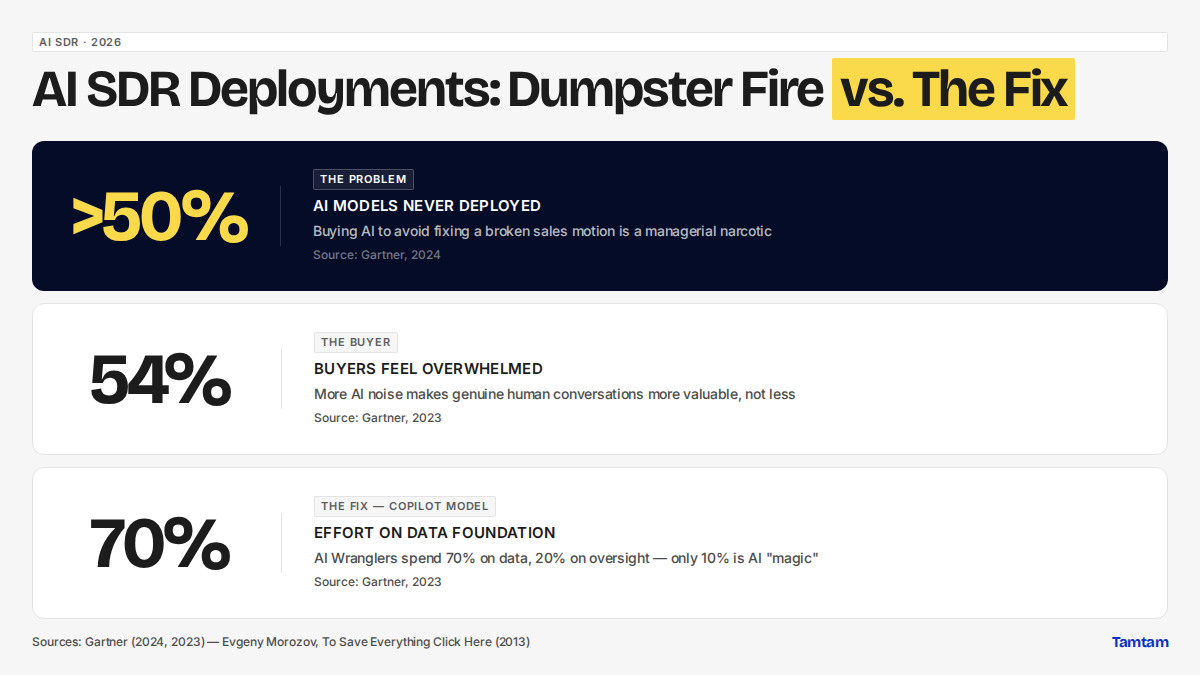
It's an escape hatch. It's a way for leadership to avoid the hard, grinding work of building a resilient sales culture, coaching junior reps, and figuring out if the company’s value proposition is actually any good. A 2024 Gartner survey found that nearly half of organizations report that over 50% of their AI models never even make it to production. The tech isn't the hard part. The process is.
The AI SDR becomes a managerial narcotic. It numbs the pain of a failing go-to-market motion, but it doesn't cure the disease. Before you go looking for a robot to solve your problems, you need to ask yourself a hard question. Are you searching for a force multiplier for a winning team, or are you just looking for an excuse not to lead?
An AI is an amplifier. It takes whatever you give it and scales it to infinity, instantly.
If you give it a brilliant, validated, customer-centric sales playbook, it will execute it flawlessly and fill your pipeline. But if you give it a half-baked, untested, "spray and pray" strategy, it will execute that with the same relentless efficiency. It will burn your entire market to the ground before you even have time to check the campaign analytics.
This isn't a hypothetical. It's what sales leaders are privately calling the "AI trash machine" problem. You feed it low-quality data and a generic prompt, and it produces an avalanche of low-quality outreach that destroys your brand reputation. A single misconfigured campaign can send thousands of generic, context-free emails, alienate key decision-makers, and get your company's domain flagged for spam. The damage to your brand can take years to repair.
The pattern is consistent. Teams using fully autonomous AI SDRs without intense human oversight often see their reply rates plummet. They trade a handful of high-quality conversations for a mountain of ignored emails. In stark contrast, teams using a hybrid "copilot" model, where a human directs the AI's strategy and reviews its output, consistently report higher rates of positive replies and more meetings booked with qualified accounts.
An AI doesn't know your strategy is crap. It can't feel the cringe of a bad email. It will just keep executing your bad ideas at the speed of light until your total addressable market is nothing but a smoldering crater.
So if "set and forget" is a fantasy, what actually works? The successful model is a hybrid. It's a partnership where humans provide the strategy, the nuance, and the quality control, while the AI provides the scale and the speed.
In this model, the role of the sales manager and the senior SDR changes dramatically. They stop being simple coaches and become something new: an "AI Wrangler."
An AI Wrangler is a data architect, a prompt engineer, and a quality assurance manager all rolled into one. They don't just turn the machine on. They spend significant time meticulously managing data flows, refining prompts, and reviewing the AI’s outputs to ensure it stays on track. Success here follows the 10-20-70 rule popularized in data science: 70% of the effort is building the data foundation, 20% is dedicated to human oversight and QA, and only 10% is the actual AI "magic."
The first step for a good wrangler is to codify excellence. They identify their single best human SDR. They study that person's process, their emails, their follow-up cadences, and the buying signals they look for. Then, they painstakingly clone that entire human process into their AI system. For the first few weeks, a human manager should manually review a significant portion of the AI's drafted messages before they go out. They tweak, they correct, they refine.
This isn't a job for a junior employee who just knows how to click "Run Campaign." The AI Wrangler is a hybrid thinker. They have the sales acumen of a top rep, the analytical mind of a rev ops professional, and the creative instincts of a copywriter. They understand that the prompt isn't just a command; it's a strategic brief. They obsess over the negative space: which accounts to exclude, which personas to avoid, which messaging angles have already been saturated. They treat the AI not as an employee to delegate to, but as an incredibly powerful, incredibly stupid weapon that requires constant adult supervision.
This is the boring, unsexy truth. There is no magic box. Winning with AI isn't about abdicating responsibility. It's about doubling down on discipline. The teams that succeed are the ones willing to do the hard, upfront work of building a solid foundation of data and process before they ever let an AI touch an outbound campaign. That discipline is exactly what separates working automated lead generation funnels from market-burning ones.
While sales leaders obsess over internal efficiency gains, they’re ignoring the psychology of the person on the other side of the screen: the buyer.
Modern B2B buyers are not suffering from a lack of information. They are suffering from an overabundance of it. Recent research from Gartner is brutal on this point: 54% of B2B buyers describe their purchase journey as "overwhelmingly complex," not because of a lack of options, but because they are drowning in too much seemingly high-quality, trustworthy information.
They get trapped in cognitive biases, endlessly seeking more data to justify a decision they've already emotionally made, often based on flawed assumptions. They are paralyzed.
What they need in that moment is not another automated email sequence with three bullet points about your features. They need a skilled, empathetic human to intervene. They need a strategic advisor who can listen, challenge their assumptions, and reframe their problem in a new light.
An autonomous AI SDR is fundamentally incapable of this. It can't read the subtext in a terse email reply. It can't pivot a conversation based on a sigh it hears over the phone. It can't build the trust required for a buyer to admit, "You know what, I think we've been thinking about this all wrong."
The more generic, AI-generated noise that floods your buyer's inbox, the more valuable a genuine, insightful human conversation becomes. By chasing the fantasy of full automation, you're not just deploying an inefficient tool. You're actively ignoring the deepest psychological need of your customer. That human layer is the whole point of orchestrating pipeline generation well.
Let's talk about the two main arguments evangelists use to push full automation. They sound smart in a board meeting, and they prey on your desire for a simple solution. But when you look closer, they fall apart.
The first argument is pure spreadsheet logic. A human SDR costs, say, $80,000 a year. An AI SDR license costs $10,000. Therefore, the AI delivers a lower Cost Per Acquisition (CPA). Simple, right?
Wrong. This math only works if you assume your Total Addressable Market (TAM) is infinite. In most B2B scenarios, your TAM is very, very finite. It's a precious, non-renewable resource.
When a poorly implemented AI SDR burns through a good-fit account with a bad message, that account isn't just a lost opportunity for this quarter. It's likely a lost opportunity for the next 18 to 24 months. You're not just losing a lead; you're poisoning the well.
The real cost isn't on the vendor's invoice. It's a massive, hidden "Brand Tax." You're not lowering your CPA; you're just exhausting your only source of future revenue at an accelerated rate. You’re trading a short-term P&L gain for long-term market suicide.
The second argument is more optimistic, but equally flawed. "Sure, the tech isn't perfect today," they say, "but LLMs are getting better every month! Soon, AI will be indistinguishable from a human."
This misses the entire point. This isn't a computational problem. It's a human trust problem.
Even if an AI could perfectly mimic human conversation (and it's still a long way from that), it can't build the strategic relationships required to navigate a complex enterprise deal. It can't grab a coffee with a champion, navigate internal politics, or build a multi-threaded consensus across departments. As generic AI communication becomes the new spam, authentic, strategic human interaction becomes the ultimate differentiator.
The future, then, isn't replacing reps with bots. It's about building a system where your smartest humans are freed up to do the deep, creative, relationship-building work that no machine can ever replicate. This shift means the AI wrangler's most critical job isn't writing prompts; it's ensuring the AI is aimed at the right targets, for the right reasons, at precisely the right time. Feeding an AI a generic, static database is the direct path to burning your market. The only durable advantage comes from building lists based on what your past wins tell you, continuously researching your entire market for those same triggers. It's this obsession with list quality that inspired us to build Tamtam.
Set up for you before our first call
Book a demo