November 20, 2026
Your reps are drowning in admin work, spending only 28% of their time actually selling. The common advice to track dozens of "buying signals" is a fantasy that leads to burnout. The truth is that only four types of signals really matter: executive job changes, funding or M&A events, new core technology adoption, and competitive displacement. These "hard triggers" signal an active buying window is open, allowing you to build a go-to-market strategy based on timing and relevance, not just volume.
Let’s get one thing straight. The old playbook is broken.
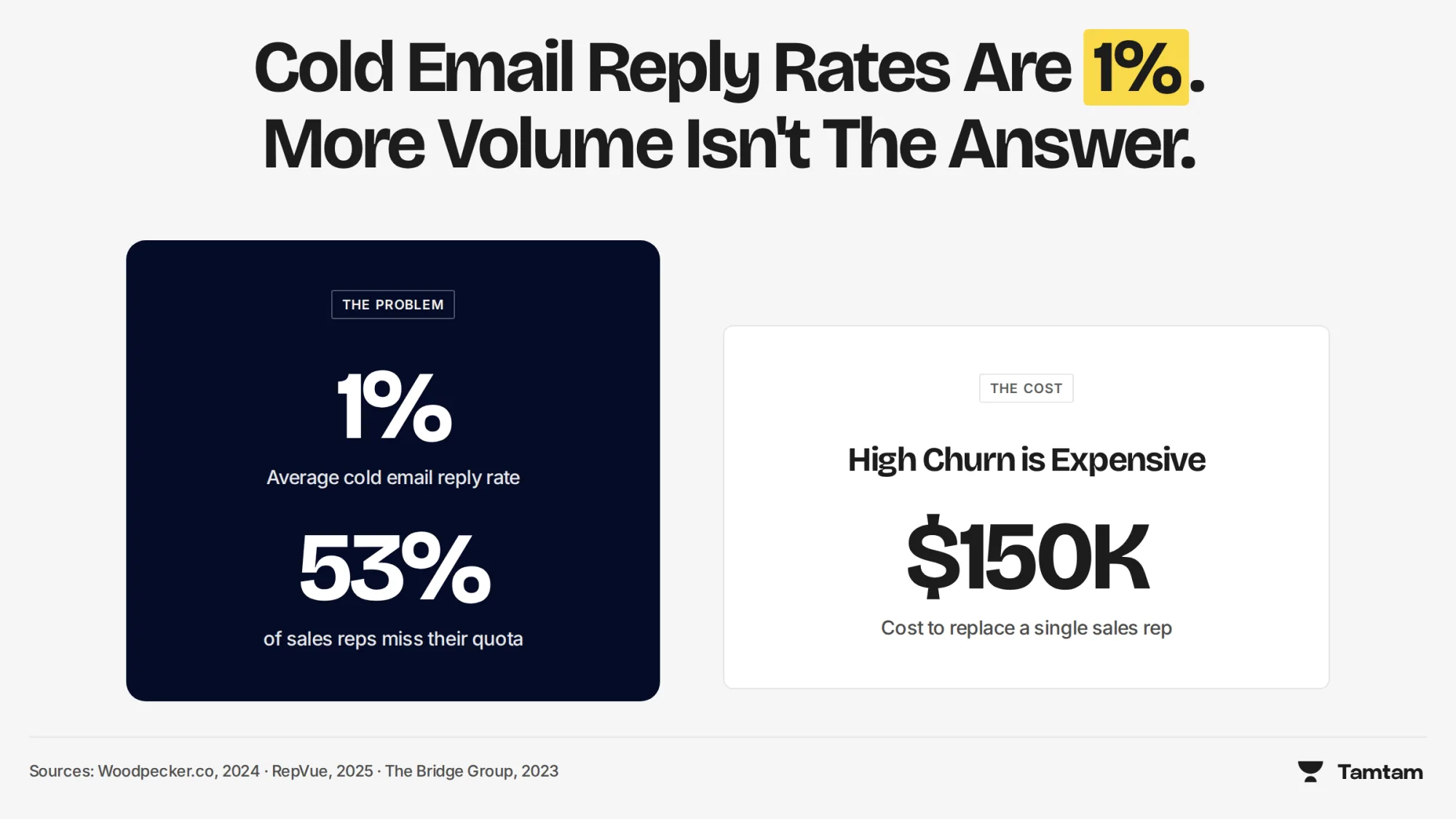
The world of Predictable Revenue taught a generation of sales leaders that success was a math problem. More dials, more emails, more activity. Just fill the top of the funnel and something good is bound to fall out the bottom.
It worked for a while. Then everyone started doing it. Now, your buyers’ inboxes look like a digital landfill, and your reps are paying the price.
According to research from Salesforce, the average sales rep spends a miserable 28% of their week actually selling (Salesforce, 2022). The other 72% is a soul-crushing vortex of CRM updates, manual research, internal meetings, and toggling between a dozen different apps.
Now, into this reality of extreme cognitive overload, the industry introduces a new fantasy: “intent data.” The promise is that you can track dozens, sometimes hundreds, of "buying signals." Website visits, content downloads, webinar attendance, a new follow on a social network. The idea is that if you just track everything, you’ll magically find buyers who are ready to talk.
This is a trap.
You’re not giving your team a map to buried treasure. You’re giving them a bigger haystack and telling them the needle is in there somewhere. It’s a recipe for burnout, missed quotas, and reps who feel like they’re failing at an impossible task.
The solution isn’t more signals. It’s fewer, better signals. It's about separating the noise from the triggers.
Soft signals are the digital breadcrumbs a prospect leaves behind as they browse the internet. They’re easy to track, abundant, and make for pretty dashboards. And for a sales team trying to book meetings this month, they are almost completely useless.
Treating a whitepaper download as a reason for a sales call is like proposing marriage on the first date. It’s premature, a little desperate, and it misunderstands the nature of the relationship. Your reps' time is too expensive to be spent chasing ghosts.
Unlike soft signals, hard signals aren't about what a person is thinking. They’re about what their company is doing. These are verifiable, structural events that force a company to re-evaluate its strategy, budget, and technology stack. They create a powerful, short-lived window of opportunity where the status quo is no longer good enough.
Focus your team here. These are the only four that matter.
Here are the four essential hard signals.
A new executive, particularly in the C-suite or VP level, is the single most powerful trigger in B2B sales. They have a mandate to make a mark, a budget to spend, and zero loyalty to the old way of doing things.
Research consistently shows that new executives are aggressive in re-evaluating their department's tools and processes. They often "rip-and-replace" existing technology within their first 90 days to implement the stack they know and trust from previous roles (Forrester, 2019; DDI, 2021). This is your opening. Your outreach isn't an interruption; it's a perfectly timed offer to help them achieve their early goals and secure a quick win.
Money creates motion. A new round of funding isn't just a number in a press release; it's a strategic imperative to deploy capital and grow. That cash is earmarked for specific purposes: scaling the sales team, expanding into new markets, improving product infrastructure, or beefing up cybersecurity.
Similarly, a merger or acquisition creates chaos. Two different companies, two different tech stacks, two different cultures all have to be integrated. This forces a complete re-evaluation of every system, from CRM and finance to HR and marketing. Both scenarios create massive demand for new solutions that can solve the immediate, painful problems of growth and integration (Forrester, 2019; Bain & Company, 2022).
A company's tech stack is like an ecosystem. When a major new platform is adopted, it sets off a domino effect. Think about a company that migrates from a legacy CRM to Salesforce. Suddenly, their old marketing automation tool doesn't integrate well. Their sales engagement platform is incompatible. Their data enrichment provider is redundant.
This creates a "rip-and-replace" wave across the entire go-to-market stack. By monitoring for the adoption of these foundational "platform" technologies, you can predict the secondary and tertiary needs that will emerge weeks or months later. Your product might be the perfect fit for a company that just bought a new ERP, cloud data warehouse, or customer service platform (Forrester, 2019; Gartner, 2023).
Your competitor’s problem is your opportunity. This can happen in several ways. It could be a simple contract renewal date, which always prompts a customer to look at alternatives. Or it could be a more dramatic event, like a competitor announcing a major price hike, a sunsetting of a popular product, a public service outage, or getting acquired by a company the customer doesn't like.
These events break the inertia that keeps customers locked in with their current vendor. They create an urgent, often emotional, reason to shop around. A well-timed, empathetic message that acknowledges their frustration and offers a clear path to a better solution can be incredibly effective (Gartner, 2020; Forrester, 2021).
Okay, so you know where to look for opportunity. You're focused on hard triggers. Your reps are reaching out with relevant, timely messages. But what about when an opportunity looks you in the eye and says "no"?
Most sales training teaches reps to "overcome" objections. To fight them with logic, features, and benefits. This is a mistake.
An objection is not a rejection. It's a buying signal.
Think about it. A prospect who is truly not interested doesn't object. They ghost you. They ignore your emails. They send you to voicemail. An objection is a form of investment. They are investing the time and energy to tell you what they think.
According to research from Gong, using empathy-based objection handling techniques can boost win rates by nearly 30% (Gong, 2021). When a prospect says, "It's too expensive," don't jump to defend your price. Respond with curiosity.
This simple shift validates their concern and invites them to tell you more. It changes the dynamic from a confrontation to a collaboration.
| Common Objection | What They're Really Saying | How to Respond with Empathy |
|---|---|---|
| "It's too expensive." | "I don't see enough value to justify this cost, and I'm scared of making a bad financial decision." | "It sounds like making sure you get a clear return on this investment is the top priority." |
| "We're happy with our current vendor." | "Changing vendors is a huge pain and a big risk. I'm not convinced it's worth the effort." | "It seems like the stability and predictability you have right now is really important." |
| "Now isn't a good time." | "I'm overwhelmed with other projects, and I can't even think about adding something new right now." | "Sounds like you have a ton on your plate. What are the biggest priorities you're facing this quarter?" |
| Criterion | Soft Signals (The Noise) | Hard Signals (The Triggers) |
|---|---|---|
| Example | Whitepaper Download | New VP of Sales Hired |
| Implied Intent | "Researching a concept" | "Has budget and mandate to buy" |
| Typical Conversion to Pipeline | Very Low (<2%) | High (5-10%+) |
| Best Team to Handle | Marketing Nurture | Sales Outreach |
| Action to Take | Add to newsletter | Immediate, personalized outreach |
Talking about this is easy. Actually changing how your team operates is hard. Here’s a simple, three-step framework to get started.
Before you change anything, you need a brutal baseline of reality. For one week, have your reps track their time. How many hours are they actually selling (on calls, writing personalized emails, in demos) versus doing everything else (prospecting, data entry, internal meetings)?
If your number is anywhere near the 28% industry average, you cannot afford to waste a single minute on soft signals. You simply do not have the capacity. The team at Bolt Today found their reps spent so much time on low-value tasks that it was costing them the equivalent of "$1 million a week" in lost selling opportunities. You have to free up your reps to focus on what only they can do: have high-quality conversations with people who are actually in a buying window.
Scrap the vanity metrics. Dials made, emails sent, talk time. These metrics reward activity, not results. They encourage reps to behave like robots, and you will get robotic results.
Replace them with one core metric: Signal-to-Pipeline Conversion Rate.
For the next 30 days, run a simple experiment. Track the conversion rate of leads generated from your top 3 soft signals (e.g., webinar attendees). In parallel, track the conversion rate of leads generated from the 4 hard triggers. The data will not lie. It will show you exactly where the revenue is, and it will give you the political capital you need to shift your team's focus permanently.
In the world of hard signals, speed is everything. The value of a signal decays exponentially over time. According to studies by both Forrester and the Journal of Marketing, responding to a high-intent lead within an hour can double your success rate compared to waiting 24 hours (Forrester, 2021; Journal of Marketing, 2011).
You need a clear service-level agreement (SLA). When a hard trigger is identified, what is your team's required Time-to-Contact? Is it 4 hours? Is it 1 hour? The London Stock Exchange Group (LSEG) found that by using trigger data to prioritize accounts, they were able to act on opportunities before their competitors even knew they existed. Your ability to act on a trigger while it's still fresh is your single biggest competitive advantage.
The era of brute-force sales is over. It’s too expensive, burns out your best people, and your buyers hate it. Winning in 2026 isn't about celebrating activity; it’s about working with extreme precision on the few triggers that signal a real deal is possible. The problem isn't the strategy, it's the execution. Finding these triggers manually is the very definition of the low-value admin work you need to eliminate. This is the problem we're obsessed with at Tamtam, building a platform that surfaces these hard-to-find triggers across your entire market, so your reps can focus on selling instead of endless research.
Set up for you before our first call
Book a demo