Buying committee
A buying committee is the group of individuals within a company who are collectively involved in making a B2B purchasing decision.
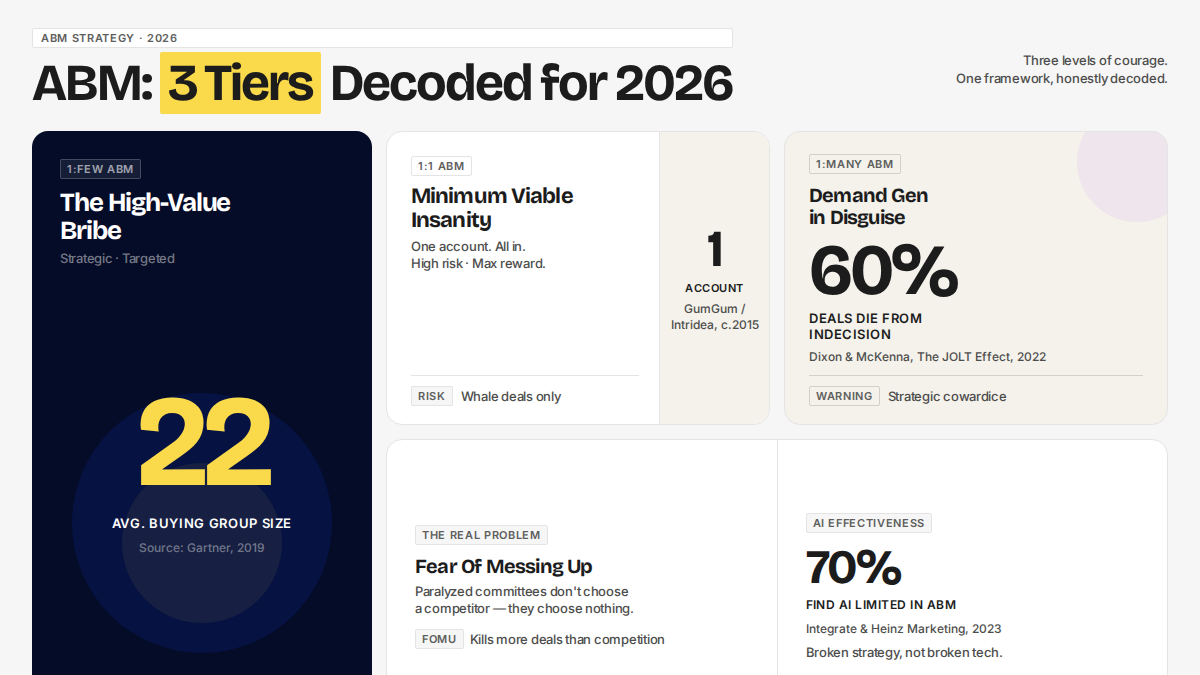
A buying committee is the group of people within a prospect's organization who participate in a B2B purchase decision. This is rarely a formal, named committee; rather, it is the informal collection of stakeholders whose input is required to approve a deal. As business-to-business sales have grown more complex, so have these committees. Modern enterprise deals often involve six to ten or more individuals, each with distinct priorities and influence over the outcome.
Common Roles in a Buying Committee
While the exact composition varies by company and deal size, buying committees typically include several archetypal roles. Identifying and engaging each member is a core part of effective account-based selling.
- Economic Buyer: The individual with ultimate budget authority who gives the final approval. This is often a department head, VP, or C-level executive.
- Champion: The person inside the prospect's organization who advocates for the solution. A strong champion helps navigate internal politics and provides crucial information.
- End Users: The team members who will use the product or service day-to-day. Their adoption and satisfaction are critical, and they often influence the technical requirements.
- Technical Evaluator: The person responsible for vetting the solution's technical specifications, security, and integration capabilities. This might be someone from IT, engineering, or a counterpart to a vendor's sales engineer.
- Influencers: A broad category of other stakeholders who have a say in the decision. This can include legal for contract review, procurement for pricing negotiation, and finance for ROI validation.
Why Mapping the Buying Committee Matters
Failing to identify and engage the full buying committee is a leading cause of stalled or lost enterprise deals. A comprehensive understanding of the committee allows sales teams to execute a multi-threaded engagement strategy, which reduces risk and improves outcomes.
By mapping the stakeholders and their respective concerns, a sales team can tailor its messaging and demonstrations to resonate with each member. This detailed intelligence is a central output of the account planning process. Engaging the right people with the right information at the right time helps build consensus, preempt objections, and ultimately increase deal velocity.
Also known as: buying group, decision-making unit, DMU
See how Tamtam handles account-based & key accounts in practice.
Learn more →