June 3, 2026
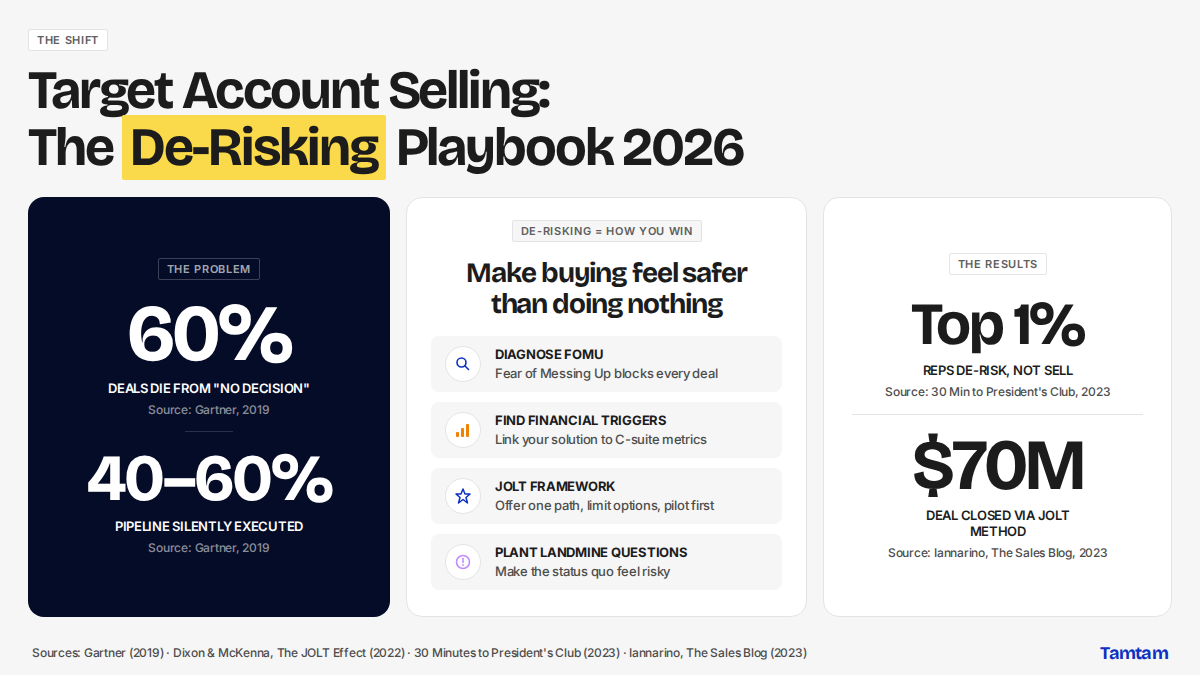
Your target account strategy is failing because you're fighting the wrong enemy: your buyer''s ''Fear of Messing Up'' (FOMU), not the competition. With 40-60% of enterprise deals dying from ''no decision,'' the key is to shift from selling to de-risking. Ditch useless activity metrics and become a financial detective, hunting for signals in 10-K reports and earnings calls that link your solution to executive-level financial pain. Your job is to make the decision to buy feel psychologically safer than doing nothing at all.
Most Target Account Selling programs, like a lot of the traditional sales methodologies reps are handed, are built on a bullshit military siege metaphor. The strategy assumes if you just bombard an account with enough brute force, they’ll crack. You think you're losing to the competition, but you're not. According to Gartner, somewhere between 40% and 60% of your enterprise pipeline is dying from "no decision." It’s being silently executed by your buyer's paralyzing terror of getting fired for making the wrong call. And what's your sales leadership’s brilliant solution? More activity. They're pushing you to do the very things that amplify your buyer's anxiety and kill your deals. This isn't a selling problem; it's a psychology problem. To solve it, you need to throw out the old playbook and adopt a new mission.
The first and most important step is a mental reset. Your job is not to convince. Your job is to de-risk.
Why This Matters:
In a complex B2B sale, your buyer isn't motivated by Fear of Missing Out (FOMO). They are paralyzed by the Fear of Messing Up (FOMU). They aren’t lying awake at night worried about the amazing features they might miss. They’re having nightmares about having to explain to their CEO why the expensive software they championed just lit a pile of cash on fire.
This fear leads to something psychologists call "omission bias." It’s the tendency to judge harmful actions as worse, or less moral, than equally harmful inactions. For your buyer, this means it feels psychologically safer to do nothing and fail than to make a choice and fail. Doing nothing is a passive mistake. Making a bad purchase is an active one, a career-ending one.
Your job is to make buying from you feel safer than the status quo. Every single action you take, from the first email to the final proposal, must be designed to reduce their perceived career risk.
What to Do:
Example in Action:
A buyer says, "I'm concerned about security. I need to see all your documentation on compliance."
A traditional rep, eager to please, attaches five whitepapers, a SOC 2 report, and a 50-page technical document. They just made the buyer's job harder.
A de-risking rep says, "I can send you a mountain of stuff, but honestly, 90% of it is noise. Based on my work with other companies in your industry, the only two things that will actually get you in trouble with your CISO are data residency and vendor access protocols. I've put together a one-pager that shows exactly how we make those two specific risks disappear. Can we agree to ignore the rest for now?"
See the difference? The first rep sells features. The second rep sells safety.
Common Mistake to Avoid:
Applying end-of-quarter pressure tactics to a buyer experiencing FOMU. This is like trying to put out a fire with gasoline. A discount doesn't reduce their fear of getting fired; it only amplifies their anxiety and makes you seem desperate and untrustworthy. You're trying to solve a psychological problem with a financial tool. It will backfire every time.
You cannot do the deep, thoughtful work required to de-risk a multi-million dollar deal if your manager is breathing down your neck about hitting 100 dials and 200 emails a day.
Why This Matters:
Often, the biggest obstacle to winning your most important target accounts is your own company's addiction to vanity metrics. It's a psychological trap called "surrogation." This is what happens when the metric you use to measure progress (e.g., number of calls made) completely replaces the actual strategy (e.g., win the account). Your team ends up optimizing for the metric, even when it directly harms the goal.
You must ruthlessly protect your time and focus for high-leverage research and strategic thinking, not mindless activity that just makes a dashboard look green.
The Story of a Metric Gone Wrong:
Look no further than the Wells Fargo scandal of the 2010s. The stated strategy was noble: "deepen customer relationships." The metric chosen to measure this was "open 8 accounts per customer."
What happened? The metric became the strategy. To hit their numbers, employees opened 3.5 million fake bank and credit card accounts without customer consent. They hit their targets, and in the process, they destroyed decades of brand trust, incurred billions in fines, and ruined countless careers.
Now ask yourself honestly: Is your sales floor's obsession with "100 dials a day" any different? You're being incentivized to make shallow, irritating, low-value contacts that burn your reputation with the very accounts you’re supposed to be winning.
What to Do:
Common Mistake to Avoid:
Confusing "action bias" with progress. Action bias is our innate psychological need to look busy, especially when we're uncertain about what to do next. Sending 50 generic emails feels productive. Spending three days reading a target account's 10-K report and making zero calls feels like laziness to a traditional sales manager. But one of those activities leads to a generic "no thanks," and the other leads to an eight-figure contract. Choose wisely.
Stop talking about your product. Seriously. Stop talking about its features, its speeds and feeds, its bells and whistles. Nobody at the executive level gives a damn.
They care about three things: making money, saving money, and mitigating risk. Your entire job is to find the specific, non-obvious financial trigger that makes staying with their current solution far riskier than switching to you.
Why This Matters:
Mid-level managers care about features that make their own lives easier. The C-suite, the people who actually sign the checks, care about the financial metrics they are personally compensated on. If you can't draw a straight line from your solution to the CFO's bonus structure, you're not selling, you're just presenting.
This means you have to go beyond surface-level "pain points" and uncover the deep-seated financial pressures driving the business.
What to Do:
Example in Action:
Kish Patel, a legendary enterprise rep, tells the story of landing an 8-figure deal. He spent 30 days in total silence. No calls, no emails. He became a financial detective. He dug into the company's financials and discovered immense pressure to improve their EBITDA (Earnings Before Interest, Taxes, Depreciation, and Amortization).
He didn't pitch cybersecurity features. He didn't send a 50-slide deck. He engineered a two-line proposal that connected his solution directly to their EBITDA target. The CFO, whose bonus was tied to that exact number, signed the deal in 30 seconds. Kish wasn't selling software; he was selling a guaranteed financial outcome that helped the CFO get paid.
Common Mistake to Avoid:
Relying on generic intent data or asking a low-level manager about their "challenges." Intent data tells you someone is looking, but it doesn't tell you why, or if it's connected to a C-level priority. A manager might complain about their clunky UI, but the CFO doesn't care. You need to find the pain the C-suite is being paid millions of dollars to solve.
Once you've done your research and engaged the right people, your sole focus must be on making the buyer feel safe. Your biggest enemy is their indecision. To combat it, you need a tactical framework. The best one is the JOLT methodology, from the book "The JOLT Effect."
Why This Matters:
When a buyer is frozen with FOMU, giving them more options, more data, or more time is the worst thing you can do. It's like asking someone who is lost to draw their own map. They don't need a map; they need a guide. The JOLT framework turns you into that guide, systematically dismantling their indecision one piece at a time.
What to Do:
Example in Action:
Mike Sullivan, another top enterprise rep, tells the story of a $70 million pharma deal. He was personally $80,000 in debt at the time and felt immense pressure to rush the sale. He resisted. He spent two years running 20 separate, small-scale use cases to systematically eliminate every ounce of "Outcome Uncertainty" for the client. By the time he finally got to the C-suite, the decision was already made. He had smothered their fear with an overwhelming mountain of proof.
Common Mistake to Avoid:
Being a passive "order taker." When a prospect asks for something, a weak rep just sends it. This makes their indecision worse. Your job is to be the expert consultant who confidently diagnoses their hesitation and clears a path forward for them.
In almost every large deal, you're not selling into a vacuum. There's an incumbent provider, and the buyer has a relationship with them. Attacking that incumbent head-on is a rookie mistake.
Why This Matters:
When you directly attack a competitor, you trigger the buyer's defensiveness. They chose that tool. So, by telling them their choice was bad, you are indirectly telling them they are bad at their job. Their ego will kick in, and they will start defending their past decision, effectively doing the incumbent's sales job for them.
The goal is not to prove the incumbent is bad. The goal is to make sticking with the incumbent feel riskier than switching to you.
What to Do:
Example in Action:
Let's say in Step 3 you discovered the company just hired a new CFO whose #1 mandate for the next 18 months is improving EBITDA efficiency.
Your landmine question sounds like this:
"It makes total sense why you chose [Incumbent]. They were perfect for when the entire market was focused on growth at all costs. Now that your new CFO has made EBITDA efficiency the top priority, how are you adapting their rigid, high-cost platform to that new reality? How are they helping you get more efficient?"
You haven't said a single negative word about the competitor. You've simply tied the changing business priority to their solution's inherent weakness, making the status quo feel dangerous. You've reframed the risk. Now, sticking with the old tool is the scary choice. Switching to you is the safe one.
Common Mistake to Avoid:
Trashing the competition. It makes you look petty, unprofessional, and insecure. Even worse, it forces the buyer to defend the tool they chose, and by extension, their own intelligence. Let them arrive at the conclusion that the incumbent is a poor fit on their own, guided by your strategic questions.
For decades, we’ve treated enterprise sales like a brute-force numbers game, rewarded with stalled deals and burned-out reps. It's time to stop. Stop acting like a salesperson hitting a quota and start acting like an advisor de-risking a career-defining decision for another human being. This playbook works, but it requires rejecting the easy dopamine hit of "activity" for the difficult, often lonely work of a detective. The ultimate challenge isn't just knowing these steps; it's having a system to find the right financial triggers and incumbent cracks for every single account. It's about turning that deep research into a list that isn't dead on arrival, which is the entire problem platforms like Tamtam were built to solve.
Set up for you before our first call
Book a demo