June 5, 2026
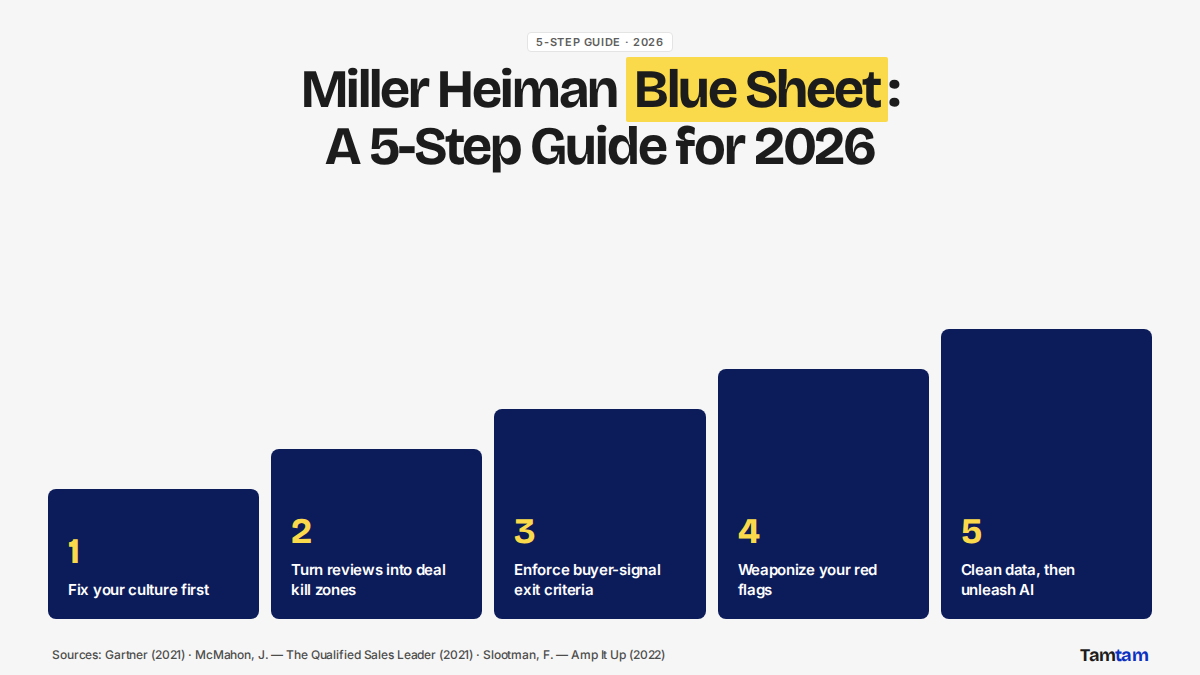
The Miller Heiman Blue Sheet isn't outdated; your sales culture is. When honesty is punished, ''happy ears'' becomes a survival mechanism, not a rep-level bug. To fix your forecast, stop running pipeline reviews like interrogations and adopt a ''Structured Paranoia'' mindset focused on killing bad deals early. Enforce ruthless, buyer-signal-based exit criteria to separate fact from fiction. You must fix the human behavior before trying to solve the problem with technology.
Let’s be honest. You clicked on this because your pipeline is a masterpiece of hopeful fiction. That "commit" forecast you presented last week? You knew, deep down in your gut, that 47% of it was going to evaporate. And it did.
You probably blame the Miller Heiman Blue Sheet. It’s old, it’s complicated, it feels like homework your reps pencil-whip five minutes before the pipeline review.
But the Blue Sheet isn’t the problem. It never was.
The Blue Sheet is a lie detector, and it’s telling you that your sales culture is fundamentally broken. It’s a tool designed to force brutal honesty in an environment that systematically punishes it. When your reps fill out a Blue Sheet with vague "next steps" and unverified "champions," they aren't being lazy. They're being rational. They're surviving.
You've created a system where telling the truth gets them interrogated, but telling a convenient story gets them a pat on the back until the end of the quarter.
This guide isn't about filling out a form. It's about fixing the broken culture that makes the form useless. It's about turning a compliance exercise into a strategic weapon. Here's how.
Before you can fix anything, you have to admit you’re the one holding the hammer. The reason your CRM is a polluted swamp of "happy ears" and wishful thinking isn't because your reps are bad at their jobs. It’s because you’ve made it professionally unsafe for them to be honest.
Think about your classic Monday morning pipeline review. It’s not a strategy session. It's accountability theater. You, the manager, scroll through the CRM like a cop pulling someone over for a broken taillight.
"Is this close date real?" you ask.
The rep, who knows the prospect has gone dark but also knows admitting it will trigger a 20-minute lecture on "creating urgency," says the only rational thing they can: "Yep, feeling really good about it."
They aren't lying to you. They are managing you. They're giving you the answer that ends the interrogation the fastest. You have incentivized fiction. Every time you punish a rep for surfacing a red flag or admitting a deal is stalled, you teach them to invent green ones next time.
The Blue Sheet, or any of the enterprise sales methodologies reps love to blame, is simply a stress test. And your organization is failing it spectacularly.
The common mistake here is catastrophic: Believing a new sales methodology, a CRM plugin, or some "AI-powered" forecasting tool will fix a culture of fear. You cannot buy a technical solution for a trust problem. You're just putting a prettier dashboard on top of the same old lies.
Your first step isn't to retrain your team on the Blue Sheet. It's to look in the mirror and ask, "Have I created an environment where the truth is a liability?" If the answer is even a hesitant "maybe," you know where the work needs to begin.
Your current pipeline review is a waste of everyone's time. It's a series of status updates and "story time" anecdotes that could have been an email. It’s focused on the wrong question: "How do we win this?"
Stop. Your new focus, your only focus, is this: "How will this deal die?"
Welcome to the "Deal Kill Zone." The goal is not to hear good news. The goal is to apply "Structured Paranoia" and collaboratively hunt for the single fatal flaw your rep is either missing or subconsciously ignoring. Your job as a leader is to be the most paranoid person in the room.
Here's how you do it. Stop reviewing every single deal. Focus on the "strike zone," deals that are either new, stuck, or about to close.
The rep gives a one-sentence update based on a verified buyer action, not their own feelings. For example: "The prospect sent the internal org chart we requested after the demo."
Then, you attack the deal. Not the rep, the deal. You ask probing questions designed to uncover blind spots:
This shifts the dynamic entirely. You're no longer an interrogator demanding updates the CRM should already provide. You're a co-conspirator, a partner in crime, helping the rep see the board clearly. You're stress-testing the deal's architecture to see where it collapses.
The common mistake is asking for updates the CRM already has. "Did they email you back?" is a question that tells your rep two things: you don't read their notes, and you view the CRM as a surveillance tool, not a strategic one. This trains them to put in the bare minimum.
By turning your review into a kill zone, you make it the most valuable meeting of the week. It’s where deals come to either be fortified against reality or die a quick and merciful death, saving everyone a hell of a lot of time.
Your sales stages are probably based on what your sellers do.
This is garbage. It measures your activity, not your buyer's intent. A pipeline based on your own actions is a vanity metric. It tells you how busy you are, not how likely you are to win.
A deal doesn't advance because your rep "had a great call." It advances because the buyer took a specific, verifiable action that demonstrates commitment and gives up value. These are buyer signals.
Your job is to map these signals to your sales stages and make them non-negotiable gates. No signal, no stage progression. Period.
Let's take a page from John McMahon's legendary playbook at PTC, the foundation of MEDDIC. A rep can't just claim they have a "Champion." That's a feeling. They have to prove it with evidence.
See the difference? One is a story. The other is a fact.
Here’s how to rebuild your stages:
Old Stage (Seller Action): "Discovery"
New Gate (Buyer Signal): Buyer confirms budget range and provides written confirmation of the top 3 pain points we solve for.
Old Stage (Seller Action): "Solutioning / Demo"
New Gate (Buyer Signal): Buyer introduces us to the technical decision-maker and provides access to their internal performance metrics for our business case.
This removes all emotion, all "happy ears," and all wishful thinking from your forecast. The pipeline becomes an objective scorecard based on evidence. It might look smaller at first, which will probably scare you. Good. You've just traded a bloated pipeline of lies for a smaller, more lethal pipeline of truth. Now you know where you actually stand.
In most sales cultures, a Red Flag is a problem. It’s a blemish. It’s something to be minimized or explained away. In a high-performance culture, a Red Flag is an asset. It's intelligence. It’s a gift.
The most critical part of the Miller Heiman framework isn't identifying your strengths; it's obsessing over your weaknesses, your "Red Flags." You must create a culture that not only accepts the early identification of these flags but actively celebrates it.
The rep who comes to you in week one and says, "My champion just went quiet and I can't get a meeting with the Economic Buyer. This deal is a high-risk long shot and we should probably disqualify it," hasn't failed. That rep is a hero. They just saved the company weeks of wasted time, energy, and resources that can now be deployed on a deal that can actually be won. They should be praised. Loudly. In front of their peers.
The rep who hides that same information until the last week of the quarter because they're afraid of "de-committing" a deal? That's the rep who needs coaching.
Look at how Frank Slootman operated at Snowflake. His entire leadership style was built on a foundation of intellectual honesty that bordered on confrontational. When a rep presented a "sure thing" forecast, Slootman's immediate reaction was to attack its weakest point. His default position was, "Buyers lie. Procurement lies. Everyone is lying. Show me the evidence that proves they aren't."
By relentlessly challenging the happy-path narrative, he forced the entire organization to confront reality. He made it safer to bring him bad news early than to bring him a surprise loss late.
The common mistake is treating Red Flags as signs of a bad rep. A Red Flag isn't a symptom of failure; it's a symptom of a complex B2B sale. The only failure is ignoring it. When you celebrate the discovery of Red Flags, you weaponize them. You turn them from liabilities into strategic tools for qualification and forecasting accuracy.
Every vendor on earth is trying to sell you an AI co-pilot, an AI forecasting tool, an AI-powered magic box that promises to fix your pipeline.
Here’s a fun fact: AI cannot turn crap into gold. It can only turn crap into algorithmically-validated, confidently-presented crap.
If your CRM data is a cesspool of your reps' defensive fictions and fear-based inputs, your shiny new AI tool won't fix it. It will weaponize it. It will learn from the lies, identify patterns in the bullshit, and generate forecasts that are just very, very confident about being very, very wrong. As Gartner notes, poor data quality can cost companies millions, with some estimates putting the figure as high as $12.9 million annually.
Think about it. An AE is at 30% of their quota with a pipeline review in ten minutes. They frantically update a few close dates, bump a deal stage without the required buyer signal, and write a vague "next steps" note. Now, imagine your AI model slurping up that panicked, low-integrity data point and thousands more like it. It's laundering fear and presenting it back to you as a data-driven prediction.
Data integrity is not a software problem. It's a behavioral and cultural problem. It's the sum of all the steps we just covered.
You get clean data when your culture makes it safe to tell the truth (Step 1). You get clean data when your reviews focus on killing bad deals, not just advancing them (Step 2). You get clean data when stage progression is tied to objective, verifiable signals (Step 3). And you get clean data when reps are rewarded for finding the ugly truth early (Step 4).
Only after you have fixed the human behaviors that generate the data can you even think about deploying AI on top of it. Buying AI to solve a data hygiene problem is like installing a turbocharger on a car with four flat tires. You're just going to get nowhere, faster and more expensively.
This whole framework, from structured paranoia to weaponizing red flags, hinges on one thing: access to the truth. The brutal, unvarnished reality of what is happening inside your buyer's world. Forcing your reps to manually dig for that truth on every single account is an insane tax on their time and energy. A far more lethal way to operate is to build your entire outbound motion on a foundation of verifiable signals from the very beginning. That's the entire philosophy behind platforms like Tamtam: starting with a list where the 'why you, why now' is already embedded, based on the very triggers you're training your team to look for, so your sellers can stop being detectives and start closing deals.
Set up for you before our first call
Book a demo