June 8, 2026
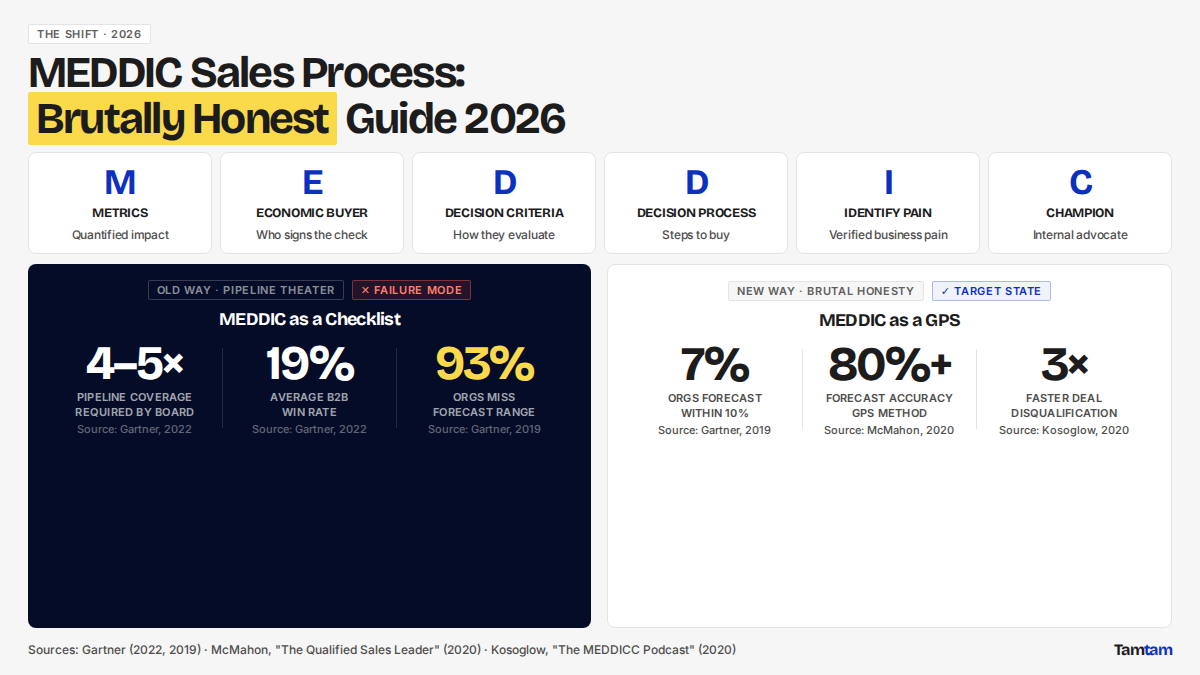
MEDDIC isn't a magical checklist, but a diagnostic tool. Most organizations use it incorrectly to justify bloated pipelines, creating ''Paper MEDDIC'' to meet unrealistic 4x+ coverage ratios amidst plummeting 19% B2B win rates. The real problem is a sales culture that rewards the illusion of a full pipeline over the reality of a small, winnable one. Fixing this requires replacing subjective deal reviews with strict, buyer-verified stage exit criteria and using objective data to expose the truth about your deals.
Let's get one thing straight. If your MEDDIC implementation isn't working, the problem isn't the framework. MEDDIC is still one of the sharpest sales methodology frameworks ever written down. And it's probably not your reps' "happy ears," despite what your sales manager screams after a bad forecast call.
The real problem is a giant, unspoken contradiction at the heart of modern B2B sales.
On one hand, your board and investors demand a fat pipeline, usually a 4x or 5x coverage ratio. "Show us the logos! We need to see momentum!"
On the other hand, the actual B2B landscape is a graveyard. According to Gartner, the average B2B win rate has tanked to a miserable 19%.
You don't need a math degree to see the issue. You're being asked to fill a swimming pool with a garden hose during a drought, and then act surprised when most of it is just mud.
This mathematical trap forces entire sales organizations into a delusional state we call Pipeline Theater. It’s a performance where everyone pretends the deals in the CRM are real, even when they know, deep down, most of them are zombies.
And MEDDIC? It becomes the script for this play. Instead of a tool for finding the truth, it becomes a box-checking exercise to justify keeping dead deals on life support. This is how you end up with a "commit" forecast full of deals where the champion has gone dark and the economic buyer thinks your name is a typo.
So, the question isn't whether MEDDIC is good or bad. The question is: are you using it to find reality, or are you using it to stage a play for your boss?
This is the most common, and most destructive, way to implement any sales qualification framework. It turns MEDDIC into a bureaucratic hurdle, not a strategic tool.
What it is: MEDDIC as a simple checklist. A rep has to fill in a field for M, E, D, D, I, and C in the CRM before they can move a deal to the next stage. The quality of what's in those fields is secondary to the fact that they are, in fact, filled.
Who it's best for: Honestly? It's best for organizations where leadership values the appearance of a full pipeline over actual predictability. It’s for sales cultures driven by fear, micromanagement, and vanity metrics.
Strengths:
Weaknesses:
Verdict: This is a recipe for disastrous forecast calls, burned-out reps, and a GTM strategy that’s perpetually running on fumes.
This is MEDDIC as it was intended. It's not a set of boxes to check. It's a diagnostic tool, a sort of GPS for your deal.
What it is: A framework for continuously stress-testing your deal against reality. Each letter isn't a field to fill; it's a question to be answered with verifiable evidence from the buyer.
Who it's best for: Elite revenue teams focused on ruthless disqualification, efficiency, and predictable revenue. It’s for cultures that value brutal honesty over comforting lies.
Strengths:
Weaknesses:
Verdict: This is the only way to build a predictable revenue engine in 2024, but it requires real leadership and a stomach for the truth.
| Feature | MEDDIC as a "Checklist" (Pipeline Theater) | MEDDIC as a "GPS" (Brutal Honesty) |
|---|---|---|
| Core Philosophy | Qualification is a box-checking exercise. | Qualification is a continuous diagnostic process. |
| Primary Goal | Maintain a 4x+ pipeline coverage ratio. | Maximize win rate on qualified deals. |
| Deal Review Style | "Story Time": based on rep's feelings and anecdotes. | "Forensic": based on verifiable buyer evidence. |
| Key Metric | Pipeline Coverage | Forecast Accuracy & Win Rate |
| CRM Data Integrity | A work of fiction; "Paper MEDDIC." | A source of truth; ruthlessly vetted. |
| Typical Outcome | Missed forecasts, wasted resources, low morale. | Predictable revenue, high efficiency, empowered reps. |
You can't fix a problem until you admit you have one. This isn't about choosing which approach you want. It's about diagnosing which one your organization is actually running, right now. Answer these three questions honestly.
Is your manager asking, "So, how are you feeling about this one?" or "Do you think they're serious?" That's a "story time" review. It's therapy.
Or are they asking, "Show me the email where the Economic Buyer confirmed they have the budget allocated for this," or "Forward me the meeting notes where the Champion agreed to our implementation plan." That is a forensic, evidence-based review.
The first is based on a seller's hope. The second is based on a buyer's actions. Which one sounds more like your last pipeline meeting?
Does a deal move from "Discovery" to "Solutioning" because a rep sent a proposal? That's seller activity. It means nothing.
Or does it move forward because the buyer initiated a security review with their IT team and invited you to the kickoff? That is a buyer commitment signal. It means everything.
Look at the definitions for your sales stages. If they are based on things your reps do, you're running the Checklist playbook. If they are based on things the buyer does that you can prove, you're on the path to the GPS model.
Here's a simple test. What percentage of the deals in your "Commit" or "Closing" stage have had zero email or meeting engagement from the identified Economic Buyer in the last 14 days?
If you don't know the answer, or if finding it would require a manual, multi-hour archeological dig through your CRM and inboxes, then you are flying blind. You are running on assumptions, not data. The Checklist model thrives in this data vacuum. The GPS model cannot function without this kind of objective truth.
Stop blaming your reps for having "happy ears" and take a hard look in the mirror. Your culture, driven by the mathematical insanity of demanding 4x pipeline coverage against a 19% win rate, is forcing them to lie. MEDDIC is a powerful tool for finding truth, but it's useless if your GTM motion rewards fiction. The fix isn't more training; it's a commitment to brutal honesty, starting with how you build your pipeline. When you focus outreach on accounts already showing verifiable buying signals, qualification becomes a confirmation of reality, not an invention of it. That’s the entire philosophy behind a platform like Tamtam that ditches the theater and helps you sell in reality.
Set up for you before our first call
Book a demo