May 29, 2026
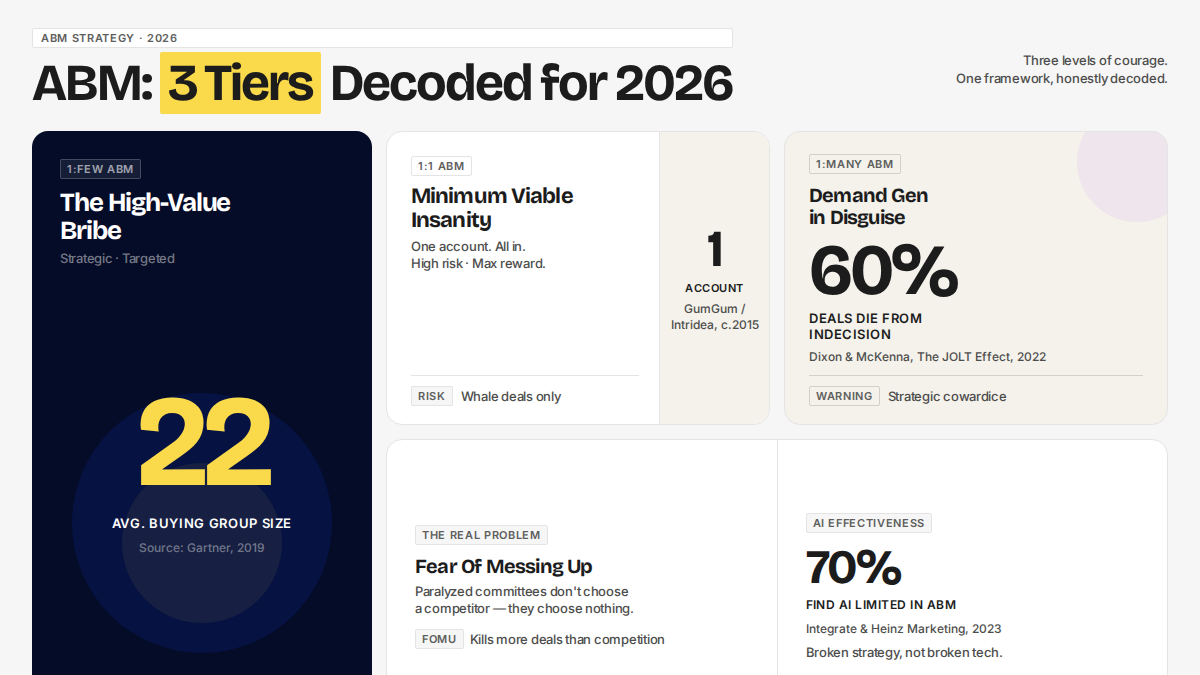
The classic 1:1, 1:few, and 1:many ABM framework is often a corporate pacifier, allowing teams to feel strategic while avoiding the real work of sales. In reality, you're not selling to an account; you're convincing a large, terrified buying committee paralyzed by the Fear Of Messing Up (FOMU). True ABM is a measure of courage: 1:1 is 'minimum viable insanity,' 1:few is a strategic high-value bribe, and 1:many is just demand generation in disguise. This guide helps you choose the right level of commitment to win high-value accounts.
Before we dive into the holy trinity of ABM, let's kill a sacred cow. You are not selling to a faceless logo called "an account."
You are selling to a dysfunctional committee of 22 people.
Yes, twenty-two. That's the average size of a B2B buying group today, according to Gartner. It’s a messy, chaotic group of stakeholders, saboteurs, and champions, all terrified of one thing: the Fear Of Messing Up (FOMU).
Research from the authors of The JOLT Effect found that between 40% and 60% of deals don't die because the buyer chose a competitor or the status quo. They die from simple indecision. The committee gets so paralyzed by the risk of making a bad choice that they make no choice at all.
The classic ABM framework of 1:1, 1:few, and 1:many is often used as a shield to avoid this uncomfortable truth. It gives us neat little boxes and budgets, but it fails to address the core problem: breaking through the noise and giving a paralyzed group of humans the courage to say yes.
So, let's decode these tiers for what they really are: different levels of commitment to doing the hard, unscalable work required to win. It all starts by pointing that work at the right accounts: your ideal customer profile.
This is the stuff of marketing legend. One-to-one ABM means treating a single, high-value account like it's the only account in the world. It’s a bespoke, deeply creative, and often expensive campaign designed for one company.
Who it's best for: Teams with the institutional guts to bet a significant amount of time, creativity, and budget on a single whale account. The potential deal size has to be company-changing, because the risk of failure is very, very real.
Strengths:
Weaknesses:
A classic example is when the ad-tech company GumGum targeted the CEO of T-Mobile, John Legere. Knowing he was a massive Batman fan, they didn't send a whitepaper. They created a custom, 100-page comic book called "T-Man and Gums," casting Legere as the hero. The unscalable, insane effort paid off. Legere loved it, posted about it to his massive online audience, and GumGum got the meeting.
Another is the story of Intridea, a web development agency. They wanted to work with the advertising giant Ogilvy. So they bought a billboard directly across from Ogilvy's office in New York that said, "Ogle this, Ogilvy." It was a high-stakes, public gamble that made them look either brilliant or foolish. It worked. They landed the business.
Verdict: 1:1 ABM is the high-risk, high-reward path for winning accounts that can define your company's future.
This is the pragmatic middle ground. One-to-few ABM targets a small, well-defined cluster of high-value accounts with a similar campaign. Think of it as a personalized play run at scale, but "scale" here means maybe 10 to 50 companies, not thousands.
Who it's best for: Teams targeting a small group of accounts that share a common trait. This could be executives in a specific vertical, companies attending a key conference, or businesses facing the same strategic challenge.
Strengths:
Weaknesses:
At Dreamforce, the massive Salesforce conference, the call tracking company Invoca faced a huge challenge: cutting through the noise. Instead of handing out stress balls, they ran a 1:few campaign targeting a specific list of high-value attendees. The offer? A private meeting and a free Apple Watch.
This wasn't a cheap gimmick. It was a calculated investment. The cost of the watch was trivial compared to the potential deal size. It was a high-value bribe that respected the time of busy executives and guaranteed Invoca got meetings with the right people. The campaign drove a massive amount of pipeline and became a case study in smart, targeted marketing.
Verdict: 1:few ABM is a strategic investment to secure mindshare and meetings with clusters of your most important prospects.
And here we have the most popular, and most abused, form of ABM. One-to-many is essentially taking ABM principles, like targeting a specific list of accounts, and applying them to broad, automated marketing channels like programmatic ads and email nurtures.
Who it's best for: Teams who are being honest with themselves that what they really want is a slightly more targeted version of demand generation, not true ABM. (If that's you, build proper campaignable ICP segments instead.) It can work for raising broad awareness or for lower ACV products that don't have 22 stakeholders.
Strengths:
Weaknesses:
Verdict: 1:many ABM is just demand generation with a better guest list; don't confuse it with a strategy for winning enterprise accounts.
| Approach | Core Philosophy | Best For (Deal Size / Guts Level) | Primary Goal | Key Tactic Example | Scalability | Risk Level |
|---|---|---|---|---|---|---|
| 1:1 ABM | "Minimum viable insanity." | Massive ACV / Extreme guts. | Shock and awe to win a whale. | Custom comic book for the CEO. | None | Very High |
| 1:Few ABM | "The high-value bribe." | High ACV / Calculated courage. | Secure meetings with a key cluster. | Apple Watches for conference meetings. | Low | Medium |
| 1:Many ABM | "Demand gen in disguise." | Low ACV / Low to zero guts. | Broad awareness and vanity metrics. | Targeted display ads to a list. | High | Very Low |
Stop asking, "Which tier is right for me?" That's the wrong question. It assumes you can just pick one from a menu. The right approach is to ask a series of more honest, slightly uncomfortable questions.
1. What's the ACV vs. the cost of insanity? This is just math. Is a potential $1 million ACV deal worth a $10,000 unscalable, creative play? Hell yes. Is a $25,000 ACV deal worth that? Probably not. Your deal size dictates your approved level of insanity. Be realistic about the potential reward before you sign off on the risk.
2. What is your organization's actual pain tolerance? Be brutally honest here. Does your CRO have the stomach to defend a failed comic book experiment to the board? Does your culture punish failed experiments or celebrate bold attempts? If you don't have the cultural green light for high-risk plays, you don't have a culture for true 1:1 ABM. Don't pretend you do. Stick to 1:few, where the ROI is easier to model.
3. How paralyzed is their buying committee? The bigger the company and the more complex the deal, the higher their collective FOMU. A high FOMU score requires a high-impact pattern interrupt, like a 1:1 or 1:few play, to jolt the committee out of its indecision loop. Your job is to make it feel riskier for them not to talk to you. For smaller deals with fewer stakeholders and lower FOMU, a more traditional, 1:many approach might be sufficient.
The most dangerous place to be is in the middle: running a cowardly 1:many strategy against accounts with a massive ACV and a terrified buying committee. That’s how you fill your pipeline with deals that go nowhere. The core job in ABM is to arm your champion to build consensus and de-risk the decision for the other 21 people in the room. Choose the strategy that actually accomplishes that.
The intellectually honest choice is to commit to one end of the spectrum. Either go all-in on true, terrifying, high-stakes ABM by picking 5 to 10 accounts that could change your company's future and doing the unscalable work to win them. (Need more of them? Here's how to find lookalike accounts.) Or, stop calling it ABM and just run a smart, targeted demand-generation program. The real challenge in true ABM isn't the creative execution. It's the soul-crushing manual research to find the reason for that outreach in the first place. Platforms like Tamtam are built to solve this exact problem, continuously researching your entire target market to surface the specific buying triggers that justify that high-impact, creative play. It lets your team focus their courage on the campaign, not on finding the opportunity.
Set up for you before our first call
Book a demo