May 21, 2026
Your static Ideal Customer Profile is likely a theoretical document that's burning cash and causing friction between sales and marketing. Instead of chasing a massive, undefined market, the key is to clone your best customers by identifying their shared behavioral triggers and buying signals. This guide explains how to break your monolithic ICP into actionable micro-segments, allowing you to build targeted campaigns that reach accounts ready to buy now and end the waste.
Let’s be honest. That Ideal Customer Profile document your team spent a quarter building is probably bullshit.
It sits in a shared drive, collecting digital dust, a monument to a series of workshops that felt productive but produced nothing. Everyone nods at it in meetings, but no one actually uses it to make decisions. Marketing uses it to justify casting a wide, expensive net for "MQLs" that sales will inevitably reject. Sales leaders use it to justify hiring more SDRs to call a list of accounts that have no reason to talk to them.
The result is a slow-motion disaster.
Your sales and marketing teams are in a state of low-grade, perpetual civil war. Your SDRs are burning out at an alarming rate. And your board is wondering why customer acquisition cost is creeping up while pipeline stays stubbornly flat.
This isn’t a strategy problem. It’s a courage problem.
Leadership clings to a massive, theoretical market out of fear. It’s a cognitive bias called loss aversion: the pain of losing something feels twice as powerful as the pleasure of gaining something equivalent. Shrinking your focus feels like a loss, even if it is the only way to win.
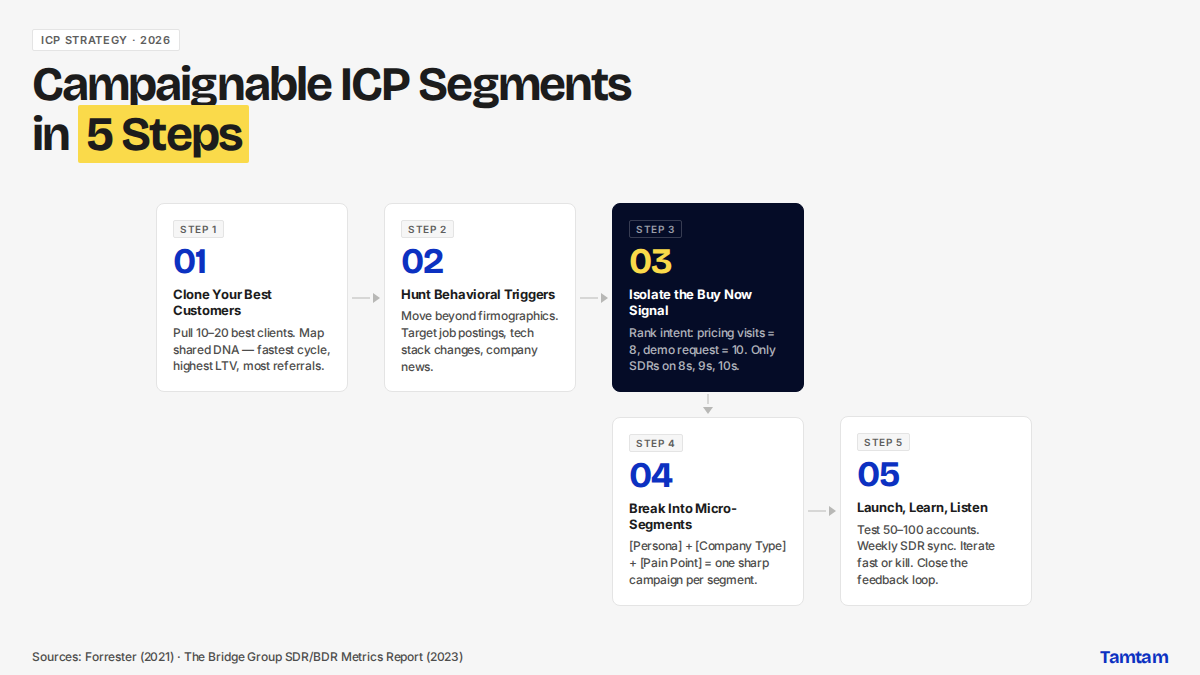
We’re going to fix that. Here are five steps to turn your useless ICP into a dynamic machine for generating high-quality pipeline. It all builds on a tight ideal customer profile.
Most companies build their ICP top-down. They look at a massive market, slice off a piece, and declare, “That’s our market!” This is ego talking, not data. (That’s a sizing problem: see TAM, SAM, SOM.) It’s a recipe for chasing accounts that look good on paper but will never, ever buy from you.
Stop. The right way to build an ICP is bottom-up.
Why this matters: Your best customers are a cheat code. They’ve already proven they get value from your product, they were easy to sell to, and they stick around. Their shared DNA is your true ICP. Focusing on them isn't about shrinking your market; it’s about creating a repeatable playbook for success before you try to conquer the world.
What to do:
Real-world example: The team at Dock, a customer collaboration platform, noticed they were getting inbound interest from HR teams. That was real revenue on the table. But they made the courageous call to ignore it and focus exclusively on serving revenue teams (sales, marketing, customer success). They willingly "lost" a piece of their potential market to absolutely dominate a niche. This gave them a powerful beachhead to build brand authority and a superior product before expanding.
Common mistake to avoid: Defining your ICP based on who you wish you sold to, not who actually buys and succeeds with your product today. Aspirational ICPs are for business plans, not for hitting quota this quarter.
Firmographics (industry, company size, location) and demographics (job title) are table stakes. They tell you who a company is, but not what they’re doing. They describe a static state, but buying decisions are driven by change.
The gold isn't in the description; it's in the action. It's in the behavioral triggers.
Why this matters: A trigger is an event that signals a company is moving from a state of "everything is fine" to "we have a problem we need to solve." Targeting companies based on triggers means you show up at the exact moment they start looking for a solution. You’re not a cold interruption; you’re a timely, relevant expert.
What to do: Brainstorm a list of potential buying triggers for your product. Think beyond the obvious ones like funding rounds or hiring sprees. Get specific.
Real-world example: Imagine you sell compliance software.
Which list do you think an SDR would rather call? The second one isn't just a list; it's a campaign with a built-in point of view. You don't have to boil the ocean. You just need to find the signal in the noise.
Not all triggers are created equal. Someone downloading a whitepaper is curious. The VP of Sales from a target account visiting your pricing page three times in one week is showing intent. The failure to distinguish between these two is why sales teams claim over 80% of MQLs are worthless, according to research from Forrester.
This step is about defining what a "now" moment looks like for your business. It's how you finally end the MQL civil war.
Why this matters: Automating outreach to a broad, low-intent list doesn’t make you efficient; it just makes you annoying at scale. As sales leader Kyle Coleman famously warned, you "burn the orchard." You spam 99% of your potential market with irrelevant messages so they’ll never listen to you again, all for the hope of finding the 1% who might be ready. True efficiency comes from identifying that 1% before you reach out.
What to do: Get your best sales and marketing people in a room. Don’t let them out until you have a short, clearly defined list of high-intent signals. These are the non-negotiable indicators that an account is actively evaluating solutions.
Common mistake to avoid: Treating all "engagement" as equal. Create a hierarchy. A blog subscription is a 1. A webinar attendance is a 3. A pricing page visit is an 8. A demo request is a 10. Focus your expensive human resources (your SDRs) on the 8s, 9s, and 10s.
Your ICP is not a single person. It’s a collection of different people inside a target company, all with different jobs, different problems, and different priorities. A one-size-fits-all message sent to everyone is a one-size-fits-none message that will be promptly ignored.
To be effective, you have to break your single ICP into multiple campaignable micro-segments.
Why this matters: Specificity sells. A vague message about "increasing efficiency" gets deleted. A sharp, specific message about "cutting your cloud infrastructure costs by 30% without sacrificing performance" gets a reply from a CFO. Micro-segmenting allows you to stop shouting generic platitudes at a crowd and start whispering specific solutions to an individual.
What to do: Take your trigger-based ICP from Step 2 and fracture it by persona and pain point. The formula is simple: [Persona] at [Company Type] who is experiencing [Specific Pain].
Real-world example: Let's say your ICP is "growth-stage tech companies" and you sell a project management tool.
Suddenly, you don’t have one generic marketing campaign. You have three laser-focused sales plays. Run those plays against a named list and you're doing real account-based marketing. This is the moment the lightbulb goes on. This is when you realize your one-size-fits-all messaging was the problem all along.
This entire process is not a one-time project that results in a perfect document. It's a dynamic, living system. The final, most crucial step is to create a tight feedback loop between marketing, who creates the segments, and sales, who activates them.
Why this matters: Your SDRs are your ground truth. They are the first to know if a list is gold or garbage. Ignoring their feedback is not only arrogant; it’s incredibly expensive. As sales leader Tim Hester has pointed out, many SDRs burn out because they are forced to grind on shitty lists they know are dead ends. This "Burnout Tax," which The Bridge Group estimates can cost a company over $155,000 per rep they have to replace, factors in recruitment, training, and lost productivity.
What to do:
This agile approach turns your SDRs from resentful drones into strategic partners. They feel ownership, they see their insights are valued, and they get to work on lists that actually have a chance of success.
Common mistake to avoid: Marketing building a "perfect" campaign in isolation and throwing it over the wall to sales. This fire-and-forget approach guarantees that the same mistakes will be repeated, quarter after quarter, while everyone blames the other department.
The point of this whole exercise isn't to create a perfect portrait of a customer you can frame on the wall. It's to build a machine that consistently finds buyers who have a problem you can solve, right now. Moving from a static list of "who they are" to a dynamic system that tracks "what they are doing" is the only way to build a pipeline that scales efficiently without destroying your team. This is a lot of work, and the real bottleneck quickly becomes the manual effort of finding these signals and connecting the dots across countless sources. The core question isn’t whether this process works, but how you can run this playbook consistently without hiring an army of researchers. That's why platforms like Tamtam are designed around this exact philosophy of turning real-world buying signals into the highest-quality lead lists.
Set up for you before our first call
Book a demo