June 16, 2026
Your massive TAM slide is a lie killing your sales team's quota. This "spray and pray" approach, born from a fake market size, needs to stop. This guide shows you how to ditch top-down delusions and build a lethal, bottom-up SOM (Serviceable Obtainable Market) that focuses your team on deals you can actually win. You'll learn how to define your real market, find the accounts within it, and build a GTM machine that drives revenue instead of burning cash.
Let’s be real for a second. The massive Total Addressable Market (TAM) in your pitch deck is a coping mechanism. It feels good to tell your board you’re playing in a $50 billion sandbox. It feels powerful. It also feels like you’re building something huge.
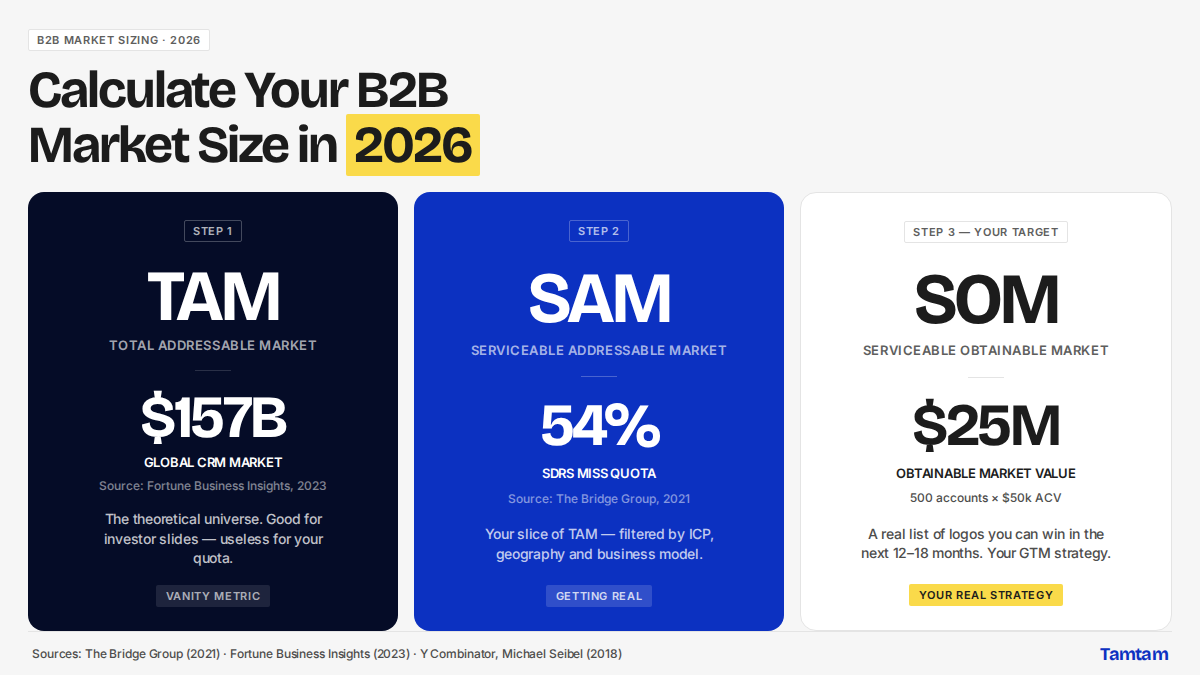
But it’s a lie. And that lie is the direct cause of SDR burnout, missed quotas, and millions in incinerated venture capital. It’s the original sin that leads to hiring ten reps when you only need two, buying bloated contact lists, and celebrating "activity" while your pipeline quality circles the drain. This delusion is why a reported 54% of sales development reps (the frontline soldiers of your GTM strategy) fail to hit their quota, according to a 2021 report from The Bridge Group. They're not bad at their jobs; they’ve been sent on a suicide mission into a fake market.
It’s time to stop playing house and get real about who you can actually sell to. Market sizing isn't a boring financial exercise. It’s the foundation of your entire GTM strategy. Get it right, and you build a precision-guided missile. Get it wrong, and you’re just making expensive noise. And it all starts with a brutally specific ideal customer profile.
First, let’s get the useless part out of the way. Your investors will want to see a top-down TAM calculation. So, you’re going to give it to them. This is the intellectual masturbation of market sizing.
Why this matters: You need this number for exactly two reasons. One, to give VCs the vanity metric they pretend to care about. Two, to establish the absolute, theoretical ceiling of your universe. It's a context-setting exercise, not a strategy. It's the equivalent of saying, "The total market for shoes is everyone with feet." Cool. Now what?
What to do: This is painfully simple. Find the big industry report from a respectable-sounding firm like Gartner or Forrester. Search for something like "Global [Your Industry] Market Size." They’ll give you a giant, impressive number. For example, "The Global CRM Market is projected to reach $157.6 billion by 2030" (Fortune Business Insights, 2023).
There. That’s your TAM. Write it down on a slide, make the font nice and big, and then mentally file it away under "Things That Don't Matter."
A cautionary tale: Remember when NYU professor Aswath Damodaran valued Uber at a mere $6 billion pre-IPO by looking at the existing $100 billion global taxi and limo market? That was a top-down TAM. He saw the world as it was. Bill Gurley at Benchmark, one of Uber's biggest backers, saw it differently. He looked at customer behavior: how people used the service, what trips they took that weren't taxi trips, and how the market could expand. He built a bottom-up view and saw a multi-hundred-billion-dollar future. The top-down number wasn't just wrong; it was blind to the entire revolution.
Common Mistake: Believing this number has any bearing whatsoever on your Q3 sales strategy. It doesn’t. It’s an academic abstraction. Using it to set quotas is like using the world population to plan your dinner party.
Okay, you've appeased the board. Now let’s do the real work. The bottom-up approach isn't about finding a number in a report. It's about building your market from scratch, account by account.
Your SAM is the slice of that giant TAM pie that you could actually serve. It’s the part of the market that fits your product, your geography, and your business model. And the only way to define it is with a psychotically specific Ideal Customer Profile (ICP). (Here's how to turn that ICP into campaignable segments.)
Why this matters: This is the first, most critical step in moving from delusion to reality. A generic ICP like "mid-market tech companies" leads to a generic, ineffective sales motion. It’s a recipe for burning cash on ads that don't convert and reps who don't know who to call. A specific ICP creates a target you can actually hit.
What to do: Define your ICP with brutal honesty. Go way beyond basic firmographics.
Your ICP isn’t "Series B+ tech companies." It's "Series B+ fintechs in the US and UK with 50-200 employees, using Salesforce and struggling with lead routing latency because their small sales ops team is overwhelmed." See the difference? One is a vague wish. The other is a list of companies you can find.
As Y Combinator's Michael Seibel argues, a bottom-up market sizing forces founders to be hyper-specific about their first customers. It’s not an accounting exercise; it's a strategy exercise.
Common Mistake: Making your ICP too broad because you have Fear Of Missing Out (FOMO). You’re afraid that if you get too specific, your market will look small. Get over it. A small market you can dominate is infinitely more valuable than a massive one where you’re completely invisible.
This is where the rubber meets the road. Your SOM, or Serviceable Obtainable Market, isn’t a concept. It’s a goddamn list of actual companies. It's the subset of your SAM that you can realistically capture in the next 12 to 18 months.
Why this matters: This number, and only this number, should dictate your sales hiring plan, your quotas, and your marketing budget. It’s your reality. It’s the battlefield you've chosen to fight on. Everything else is just noise.
What to do: Roll up your sleeves and build the list.
The story goes that legendary Sequoia investor Doug Leone used to grill founders with a simple question: "What percentage of the Fortune 2000 will ultimately buy this product?" Your SOM is the answer to that question for the near term. It's not a percentage; it's a list of logos.
Common Mistake: Creating a static list and calling it a day. Your SOM is a living, breathing thing. Companies enter and leave it constantly based on buying triggers. The job of your GTM team isn't to cold call the entire SAM. It’s to relentlessly monitor the SAM for signals that an account is ready to enter your SOM.
Now that you have your lists, you can finally attach a dollar value to them. But unlike the top-down number you pulled out of thin air, this one will be defensible. It will be real.
Why this matters: This gives you a bottom-up number that connects directly to your revenue goals. When a board member asks, "How will you hit $10M ARR?" you can give them a real answer: "Our SOM is currently 1,000 companies. Our Average Contract Value is $25k. We need to capture 400 of them to hit that goal. Here’s our plan to engage those 1,000 accounts." That’s a plan. "$50 Billion TAM" is a prayer.
What to do: The math is simple.
Let's see how this stops you from making catastrophic hiring decisions.
Common Mistake: Using a vague, aspirational ACV. Use your actual, historical ACV from closed deals. If you're pre-revenue, use the price of the closest competitor or the budget your customers would otherwise spend on a manual alternative. Do not lie to yourself. The whole point of this exercise is brutal honesty.
Your SOM is not a slide in a deck. It’s the single source of truth that should align your entire company. If an activity does not serve the purpose of winning a greater share of your SOM, you stop doing it.
Why this matters: This is how you escape "Pipeline Theater," where everyone is busy but nothing is closing. This is how you fix the broken system that causes most SDRs to fail. You stop forcing human beings to compensate for a crap strategy. You build a system designed for high win rates, not just high activity.
What to do: Align your entire GTM engine to your SOM list.
Think about the cautionary tales of hyper-growth flameouts like Hopin or Better.com. They scaled massive sales teams based on a temporarily inflated, top-down market view. When the market corrected, they were left with an impossibly bloated cost structure. A durable company is built on a durable, bottom-up SOM. It focuses its resources with the precision of a surgeon, not the blast radius of a bomb.
Common Mistake: Shrinking the target list but keeping the old, activity-based quotas. The metrics must change with the strategy. You have to arm your reps with a new playbook. The goal is no longer "100 calls." It’s "one qualified meeting with a key decision-maker at a target account." The whole system, from comp plans to QBRs, must reflect this shift from volume to value.
Market sizing isn't a math problem; it's a test of courage. It’s having the discipline to ignore the 99% of the market that won't buy from you to relentlessly focus on the 1% that will. But here's the final, brutal truth: that 1% changes every single day. The real work isn't building a static list once. It’s building a revenue engine that constantly scours your market for the subtle triggers that signal an account is ready to talk. It's about knowing who to talk to, but more importantly, when. This obsession with turning market sizing from a static snapshot into a live feed of opportunity is why we're building Tamtam.
Set up for you before our first call
Book a demo