June 15, 2026
Most account scoring models are a psychological security blanket based on the 'Illusion of Control,' ignoring that B2B buying research happens in the 'dark funnel.' This guide explains how to abandon outdated, point-based systems for a dynamic, signal-based approach. You'll learn how to audit your biased ICP, build a 4-tier signal taxonomy for real-time prioritization, and create effective sales plays that connect with buyers at the right moment.
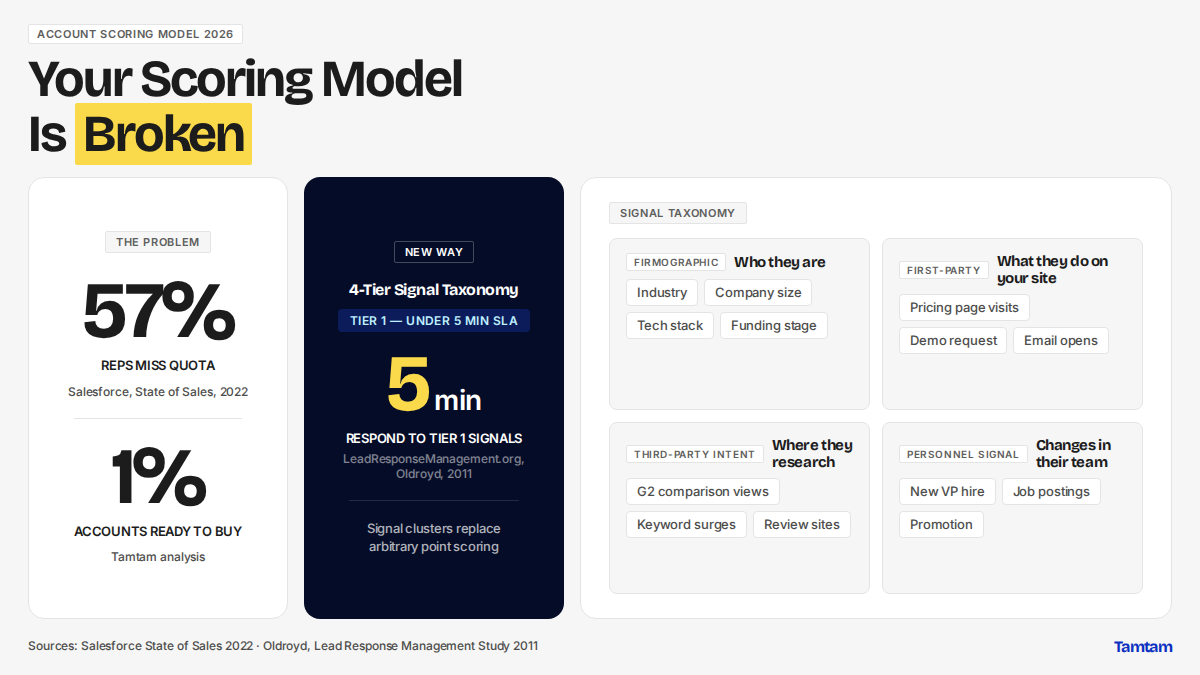
Let's be honest: your account scoring model is a beautifully organized lie. It's a relic from a bygone era, a beautifully formatted spreadsheet that gives you the warm, fuzzy feeling of being in control. Scoring only earns its keep once you've sized the market it ranks: your TAM, SAM and SOM. It’s built on the cognitive bias known as the "Illusion of Control," a psychological pacifier that makes you feel in charge while, according to Salesforce research, a staggering 57% of your reps expect to miss their quota.
That Excel sheet is your security blanket. It’s neat. It’s rational. It has columns and points and a tidy little score at the end. And it’s completely, utterly disconnected from how people actually buy things in the real world. Your buyers don't follow your rules, they don't care about your points system, and they’re doing the vast majority of their research before they ever talk to you. It's time to stop pretending they do.
It’s time to build something that works.
Before you can build something new, you have to tear down the flawed foundation. And your current Ideal Customer Profile (ICP) is almost certainly a house built on sand. (Start by fixing the ideal customer profile itself.)
Why this matters: Your current ICP is likely a product of "survivorship bias." It’s a term from World War II, when engineers wanted to reinforce bombers. They analyzed the planes that returned from missions and saw they were riddled with bullet holes in the wings and fuselage. Their first instinct was to add armor there.
A brilliant statistician named Abraham Wald pointed out their fatal error. The military wasn't analyzing the planes that didn't come back. The real lesson was that the returning planes could take hits to the wings and survive. The planes that were shot in the engines never made it home. They should have been reinforcing the engines, the very places that had no bullet holes on the surviving planes.
Your sales data is the same. You've built your entire GTM strategy around the "planes" that made it back: your closed-won deals. You’ve ignored the mountain of data from deals that crashed and burned.
What to do: Pull every deal from the last 12-18 months. Not just the wins. Pull the closed-lost, the no-decisions, the ones that ghosted you after the demo. Now, analyze all of them across the same dimensions: industry, company size, tech stack, funding stage, sales cycle length, and eventual churn rate if they became a customer.
A real-world example: A fintech company we know had "Financial Services" as a top-tier segment in their ICP. Their scoring model awarded these accounts a ton of points. Why? Because they had a few big logos they loved to brag about. They were looking at the bullet holes on the wings.
When they finally did a full audit, the truth was brutal. Yes, they won some of these deals. But they lost over 80% of them. The deals they did win took 40% longer to close, required massive discounts, and had double the churn rate of any other segment. They were actively prioritizing and spending money to acquire their worst, least profitable customers.
Common mistakes to avoid: Don’t just trust the "Industry" field in your CRM. It's often wrong, too broad, or self-reported. Dig deeper. Is it a retail bank or a VC firm? A B2B insurance carrier or a D2C neo-bank? The details are where the truth lives. You aren't selling to "Financial Services." You're selling to a specific type of company with a specific set of problems. Your losses will tell you who that isn't, which is exactly how you build your Anti-ICP.
Now that you’ve confronted the ugly truth in your data, you can build a new foundation. This one isn’t based on static firmographics. It’s based on dynamic, real-time buying signals.
Why this matters: Your old points-based system is a joke. "Downloaded a whitepaper: 5 points. Attended a webinar: 10 points." It’s arbitrary nonsense. It treats a CEO visiting your pricing page and an intern downloading an ebook as vaguely similar events. They are not.
A signal taxonomy forces you to get real about what actually indicates intent. It brings clarity and, more importantly, dictates the speed and type of response required from your team. This is how you move from "busy" to "effective."
What to do: Create a tiered system for incoming signals. This becomes the operating system for your sales team. Everything flows from these tiers.
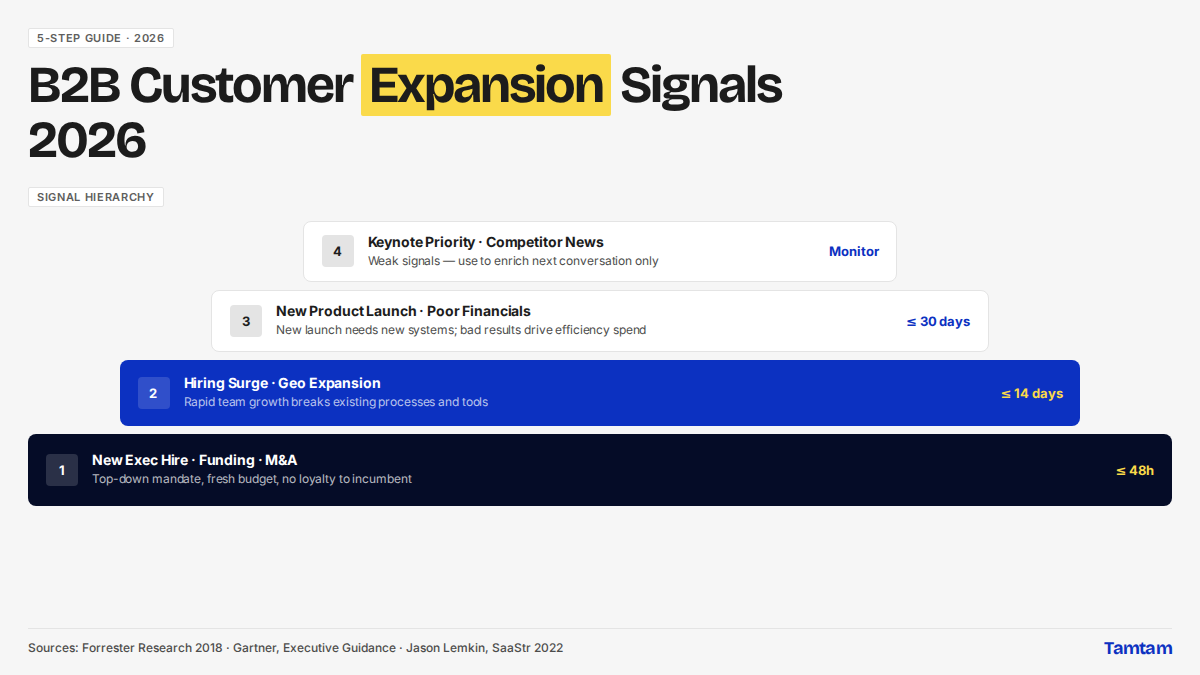
Tier 1: Explicit Demand
Tier 2: Active Research
Tier 3: Window of Change
Tier 4: Weak Awareness
This framework replaces guesswork with logic. It's the moment you stop asking reps to "just make more calls" and start directing them to the conversations that matter.
A single signal is just noise. An alert that someone visited your website is useless. The magic, and the real competitive advantage, comes from finding clusters of signals around a single account.
Why this matters: This is how you solve "alert fatigue" and stop chasing ghosts. An intern from a 50,000-person company visiting your blog is a Tier 4 signal. It’s noise. Ignore it.
But when a VP of Sales (a key persona) from a 200-person SaaS company (your ICP firmographics) who just connected with your Account Executive on a network (a first-party signal) starts showing a surge on G2 for your category (a third-party intent signal), that's a high-priority Tier 2 opportunity. The combination of signals provides the context and confidence to act.
What to do: Set up a system (or find a tool) that looks for these combinations. Your model should only fire off an alert when multiple signals converge.
Here’s a simple example:
This isn't a lead. This is a goddamn Bat-Signal. This is a Tier 1 account right now, and your team needs to be on it immediately.
Common mistakes to avoid: The most common mistake is buying an expensive intent data subscription, exporting a CSV, and handing it to your SDRs with a "good luck." This is like buying a Formula 1 engine and dropping it in a go-kart. Without layering that intent data against your specific ICP and your own first-party data (who’s visiting your site, who’s opening your emails), it’s just a list of random companies. It’s useless.
Having a great scoring model is one thing. Knowing what to do with the alerts is another. For each Signal Tier, you need to define the exact sequence of actions your team will take.
Why this matters: This is what turns a theoretical model into an operational go-to-market strategy. It provides clarity for your reps and ensures a consistent, high-quality response. Most importantly, it prevents the single most common and destructive failure mode of signal-based selling: creepy outreach.
We’ve all seen it. The email that makes your skin crawl. "Hi Jen, I saw someone from your company was checking out our G2 page and downloaded our whitepaper on QBRs..."
This is the fastest way to get your domain blacklisted and your brand associated with stalkers. As sales expert Nick Cegelski puts it, the signal is for your context, not for their inbox. You use the signal to know who to talk to and what to talk about, but you never, ever mention the signal itself.
What to do: Create a simple playbook for each Tier. It should answer:
Let’s go back to our example of the VP who was on your G2 page.
The Creepy Way (Behavior-Based): "Hi Jen, I noticed you were looking at our G2 page..."
The Right Way (Topic-Based): "Hi Jen, I see you're scaling your sales team with a few new enablement hires. Leaders at similar B2B SaaS companies are often focused on improving ramp time for new reps right now. Is that a priority for you as well?"
The first approach is about you. The second is about them. That’s the entire game.
None of this matters if it lives in a spreadsheet that a RevOps person updates once a week. You’ve done all this work to identify real-time signals. If your system isn't built for real-time action, you've already lost.
Why this matters: Signal decay is a real and ruthless force. A Tier 1 signal, like a demo request, is white-hot for about an hour, then it cools rapidly. A Tier 2 intent signal might have a 48-hour window before the prospect gets distracted or finds a competitor. Your process has to match the urgency of the signal.
What to do: Your new scoring model must live and breathe where your sales team works: your CRM. This is non-negotiable. Use a tool or build integrations that automatically:
A cautionary tale: I once saw a company spend over $35,000 a year on a fancy intent data platform. The VP of Sales would look at the dashboard once a week, export a CSV of the "surging" accounts, and email it to the sales team. The reps, already drowning in their own leads, would get to it a few days later.
The whole investment was a ghost town. The process was broken, not the data. They treated dynamic, time-sensitive signals like a static list of names to cold call. The entire investment went up in smoke because they failed to operationalize it.
Common mistakes to avoid: Don’t build a perfect, complex model that only RevOps understands. If your reps have to log into three different platforms and cross-reference a spreadsheet to figure out who to call next, they won't do it. Simplicity and integration into the existing workflow are everything. The goal is to make the right action the easiest action.
The goal of a modern account scoring model isn't to predict the future. It's to build a system that sees the present more clearly than everyone else and reacts faster. But the strategy you just read has a brutal catch: the execution. The real bottleneck is the soul-crushing, continuous effort of researching your entire market to find these signal clusters. Making sure your reps get the full context on why an account is a priority, not just that it is, is the difference between theory and revenue. That’s the problem we are obsessed with solving at Tamtam.
Set up for you before our first call
Book a demo