June 15, 2026
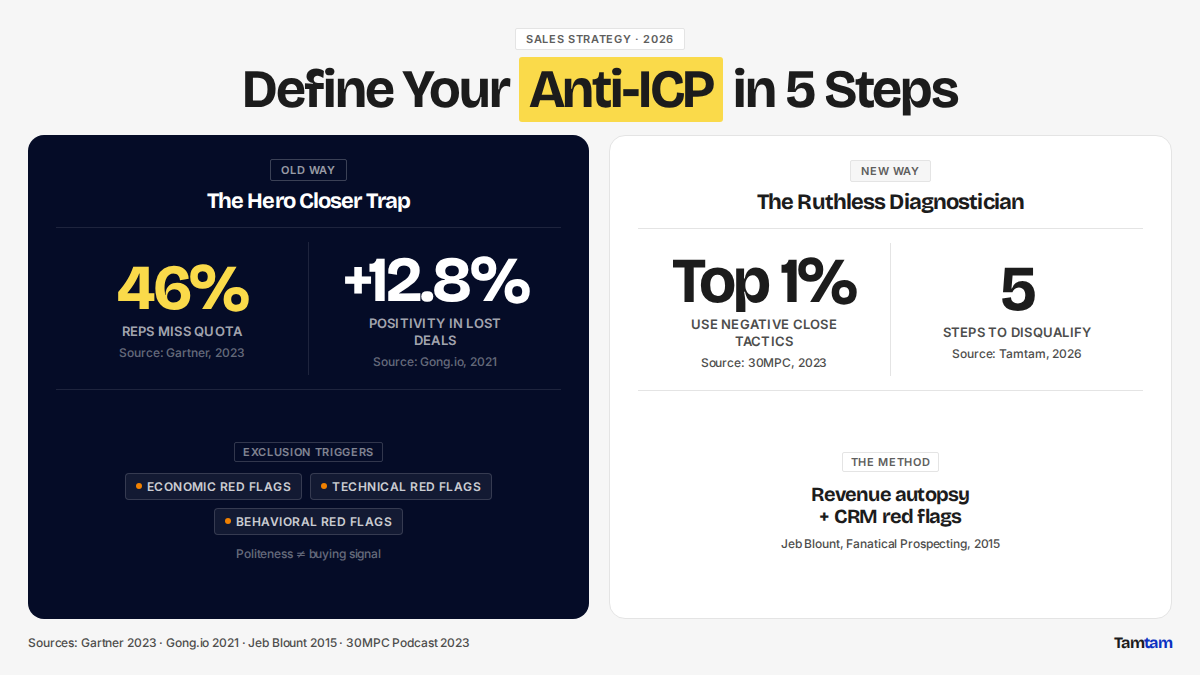
Stop coddling a pipeline full of dead-end deals. The problem isn't a lack of hustle; it's a "Hero Closer" sales culture that celebrates any win, no matter how toxic. This guide provides a 5-step process to define your Anti-ICP by performing an autopsy on your worst customers and setting concrete disqualification triggers. Learn how to embed these rules in your CRM and re-engineer your culture to celebrate the intelligent 'no,' turning your sales team into ruthless diagnosticians who focus only on good-fit buyers.
Your sales pipeline is a lie.
It's a bloated, comfortable fantasy filled with polite "maybes," single-threaded "champions," and optimistic forecasts that will never, ever close. Your ideal customer profile tells you who to chase; your Anti-ICP is the other half of that decision, who to refuse. And every quarter, you and your team stare at that lie, pretend it's real, and then act surprised when you miss your number by a mile.
The problem isn't your reps' work ethic. It's their identity. It's the fact that your entire sales culture is probably fucked.
We are still operating on a playbook written in 1992 by David Mamet for the film Glengarry Glen Ross. "Always Be Closing." It was meant to be a cautionary tale about desperate, unethical salesmen. Instead, we turned it into a goddamn instruction manual.
This "Hero Closer" archetype has created a culture that glorifies the difficult "yes" while treating the intelligent "no" as a personal failure. We celebrate the rep who "saved" the impossible deal, the one who clawed a signature out of a bad-fit customer through sheer force of will. We don't celebrate the rep who disqualified that same deal in the first 15 minutes, saving the company hundreds of hours of wasted time.
This cultural rot is the root cause of your pipeline problem. A rep who sees themselves as a "closer" suffers from cognitive dissonance when faced with a bad-fit deal. To resolve the conflict between "I am a closer" and "This deal is garbage," they start rationalizing. They log happy notes in the CRM. They keep the dead deal on life support to protect their ego, not the forecast.
This isn't some abstract theory. It's a quantifiable crisis. According to Gartner, only 54% of sellers achieved their quota in 2023. That means nearly half the reps out there are failing, in large part because they're spending their precious time on deals that were never going to close in the first place.
Think about your top Enterprise AE, the one who's been "working" a $150k deal for six months. They're single-threaded with a mid-level manager who is "super nice" and "loves the product." But the economic buyer is nowhere to be found, the tech stack is incompatible, and the company just had layoffs. The rep insists the deal is real. They're not lying to you. They're lying to themselves, because admitting the deal is dead means admitting they failed. It's time to stop the self-sabotage.
To figure out who you should never sell to, you have to stop looking at your wins and start dissecting your losses. Your happiest customers will teach you what to repeat, but your worst customers and lost deals will scream what to avoid. It’s time to perform an autopsy.
Why this matters: Your bad-fit customers leave a trail of evidence. They had the wrong tech stack, were too small to get value, demanded features you'll never build, or their champion lacked the internal political capital to get anything done. This isn't about guessing what your Anti-ICP should be. It’s about forensics. You’re looking for the patterns that reliably predict failure.
What to do: Pull two lists from your CRM and billing system right now:
Now, get your sales, customer success, and implementation teams in a room. For every logo on those lists, ask the hard questions:
Write down every common thread. This isn't a blame game. It's an evidence-gathering mission.
Common mistake to avoid: Only looking at deals you lost to a competitor. Those hurt, but the deals that die of "no decision" are far more toxic. They're the ones that drain the most time, energy, and resources because you fail to disqualify them early enough. They are the ghosts in your revenue machine.
Once you've finished your autopsy, you'll have a messy pile of observations. Now it's time to turn that mess into a set of sharp, non-negotiable rules. Those rules become the negative weights in your account scoring model. A vague Anti-ICP is useless. You need bright lines that a rep can use on a live call to make a swift, confident decision.
Why this matters: Clarity is kindness. It’s kind to your reps, who will waste less time on dead ends. It’s kind to your prospects, who won't be dragged through a sales process for a product that can't help them. And it's kind to your company, which will have a much more predictable and profitable pipeline.
What to do: Group your autopsy findings into three buckets of red flags. These are your Disqualification Triggers.
These are the objective, top-level facts about a company that make them a poor fit. They are the easiest to spot and should be used to disqualify before a rep even picks up the phone.
These are the "how they work" problems. They might look good on paper, but their internal reality makes success impossible.
These are the trickiest, but most important, red flags. They are about how the prospect engages with you during the sales process. They reveal the difference between a serious buyer and a professional time-waster.
An Anti-ICP document that sits in a Google Drive folder is worthless. It's a nice thought, not a tool. To make it work, you have to build it directly into the machinery of your sales process. You need to make it impossible for a rep to ignore the red flags.
Why this matters: You are trying to override years of "Always Be Closing" conditioning. That won't happen through a memo. You have to use systems to protect reps from their own worst instincts, like "happy ears" and the fear of an empty pipeline. Enforcement through your CRM turns a guideline into a rule.
What to do:
This is the hardest part. You've done the analysis and built the system. Now you have to change the human behavior. You must shift your sales culture from one that celebrates activity to one that celebrates accuracy.
Why this matters: Reps will do what they are paid and praised to do. If your pipeline reviews are all about volume ("How many meetings did you book?") and your SPIFFs reward closing any deal, no matter how toxic, you are incentivizing the exact behavior you're trying to stop. Culture eats strategy for breakfast.
What to do:
Common mistake to avoid: Implementing an Anti-ICP as a purely punitive measure ("You guys are closing bad deals!") without also providing the tools and prospecting support to fill the pipeline with better ones. Disqualification and prospecting are two sides of the same coin. You need both.
The final step is to change how your reps talk. Ditch the needy, people-pleasing language that screams "commission breath" and adopt the posture of a skeptical, expert diagnostician. You need to actively invite the "no."
Why this matters: The negative close, or permission-based disqualification, flips the power dynamic. It positions the rep as a busy expert whose time is valuable, not a desperate vendor. It forces the prospect to justify why they are a good fit for your solution and filters out the tire-kickers and time-wasters almost instantly.
What to do: Train your reps on simple, powerful phrases that give the prospect an easy "out." This isn't reverse psychology. It's about getting to the truth faster.
Instead of: "Are you interested in a demo?"
Try: "It sounds like you have a lot going on right now. It might make sense to put this on pause for a few months. What do you think?"
Instead of the desperate "Just checking in..." email.
Try the "closed file" email: "Hi John, I haven't heard back from you on this. Usually, when that happens, it means this is no longer a priority. I'm going to go ahead and close your file for now. If solving [problem] becomes a priority again, please feel free to reach out."
As the team at the 30 Minutes to President's Club podcast suggests, one of the most powerful questions you can ask is, "Have you given up on solving this problem?". A "no" forces them to recommit to the process. A "yes" is an immediate, clean disqualification that saves everyone weeks of follow-up. It's the ultimate test of a secure, professional sales identity.
The goal of an Anti-ICP isn't to be a pessimist. It's to be a professional. A doctor who promises to cure every patient regardless of their ailment is a quack. A mechanic who tries to rebuild a car with a cracked engine block is a scammer. Defining and enforcing your Anti-ICP is about having the professional discipline to know which problems you were born to solve, and more importantly, which ones you should walk away from.
So where does the courage to disqualify come from? It comes from knowing, with absolute certainty, that there are better conversations to be had. It's born from a prospecting process that doesn't just fill the top of the funnel with noise, but identifies the handful of accounts that are actually ready to listen. When your reps' next call is a warm introduction to a company with a real, verifiable need, letting go of a tire-kicker isn't a loss. It's a strategic allocation of time. This is the shift from chasing volume to chasing relevance, a principle at the core of what we're building at Tamtam.
Set up for you before our first call
Book a demo