June 16, 2026
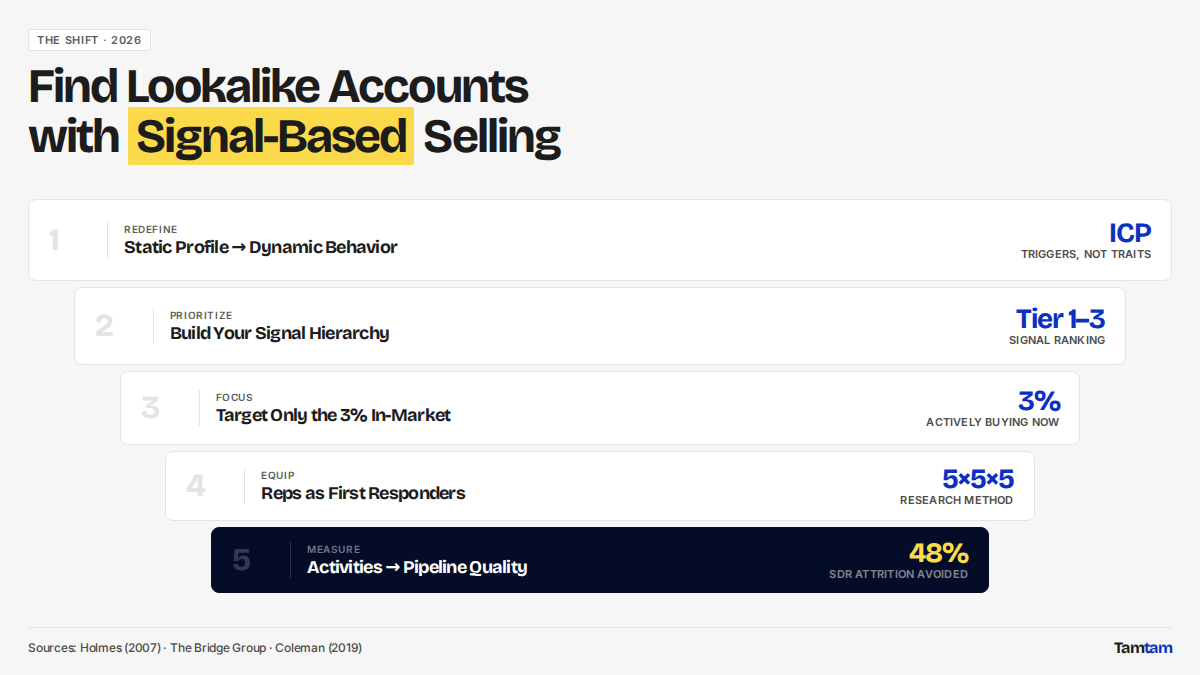
Building lookalike account lists based on company size and industry is a recipe for SDR burnout and wasted resources. This outdated approach mistakes structural similarity for buying intent, ignoring the critical factor of timing. The modern playbook focuses on dynamic, signal-based selling to identify accounts showing real intent right now. This guide provides a 5-step process to help you prioritize outreach based on behavior and measure pipeline quality instead of just call volume.
Everyone tells you to build a list of "lookalike accounts." Find your best customers, copy their firmographics like industry, employee count, and revenue, and then go find a thousand more just like them.
It sounds logical. It feels productive. And it is setting your sales team on fire.
This model is mathematically and psychologically broken. It’s the direct cause of the SDR burnout crisis, costing companies a fortune in turnover and lost productivity. Why? Because it’s based on a fundamentally flawed assumption: that companies who look the same will buy the same.
That's like assuming everyone who owns a golden retriever wants to buy the same brand of dog food on the same day. It's insane.
Your best customers didn't buy from you because they had 250 employees and were in the SaaS industry. They bought from you because they had a specific, urgent problem that you were uniquely positioned to solve at that exact moment in time.
The "lookalike" model ignores the single most important variable in sales: timing.
It forces your reps to waste 95% of their effort trying to create urgency out of thin air, cold calling companies that have no need, no budget, and no interest. This isn't selling. It's a soul-crushing game of volume that rewards busywork over results. It’s time for an intervention.
This guide will walk you through the five steps to ditching the obsolete lookalike model and embracing a signal-based approach that targets companies based on their behavior, not just their profile. It's the account-selection engine behind any real account-based marketing motion.
The first step is a mental one. You have to destroy the idea that an ideal customer is a static list of attributes. It’s not. Your best customers are defined by the problems they’re trying to solve right now.
Why This Matters
Basing your targeting on firmographics is like trying to find a life partner based only on their height and hair color. You might find people who fit the description, but you have no idea if you're compatible, if they're even single, or if they think you're a creep for staring at them in the produce aisle.
Static traits are weak proxies for intent. Dynamic behaviors, on the other hand, are clear evidence of pain or opportunity. A company hiring a "Head of Revenue Operations" is screaming that they have a problem with their sales process. A company whose CISO complains about compliance headaches on a podcast is telling you exactly what keeps them up at night.
What to Do
Get your sales, marketing, and customer success leaders in a room. Pull up your last 10-20 closed-won deals, especially the ones that closed fast and at a high value. Now, play detective. For each one, ask:
Your goal is to reverse-engineer the triggers. Forget "SaaS companies with 50-500 employees." Your new ICP definition might look like "Companies that just hired their first VP of Sales and are posting jobs for 'Salesforce Admin' and 'Sales Enablement'." This is the dynamic, behavioral side of your ideal customer profile.
Example in Action
Look at a company like Vanta, which sells security compliance software. They could just target "tech companies." But the smart play is to find the signals of pain. They reverse-engineered their best deals and found hyper-specific triggers. One trigger might be a CISO mentioning "SOC 2 audit" on a social network. Another might be a company posting a job for a new security compliance manager. These signals don't just tell Vanta who fits their profile; they tell them who is feeling the pain today.
Common Mistake to Avoid
Don't treat this as just adding another filter to your existing list-building tool. Buying a list of "companies that are hiring" is still too broad. You need to identify the specific patterns of behavior that preceded your best deals. This isn't about adding a single "intent" data point. It's a fundamental shift in how you define a qualified account in the first place.
Once you start looking for signals, you'll see them everywhere. A prospect visited your blog. Their CEO was on a podcast. They downloaded an ebook. An intern liked one of your posts.
If you treat all these signals as equal, you'll create a new kind of chaos. Your reps will be chasing ghosts, burning time on low-intent activities, and quickly learning to distrust the "data" you're feeding them. This is how you get right back to burnout city.
Why This Matters
Prioritization is everything. A VP of Engineering visiting your pricing page is a five-alarm fire. An entry-level marketer from the same company downloading a whitepaper is a gentle knock on the door. You need a system to tell the difference, so your team can focus their expensive human time on the opportunities that actually matter.
What to Do
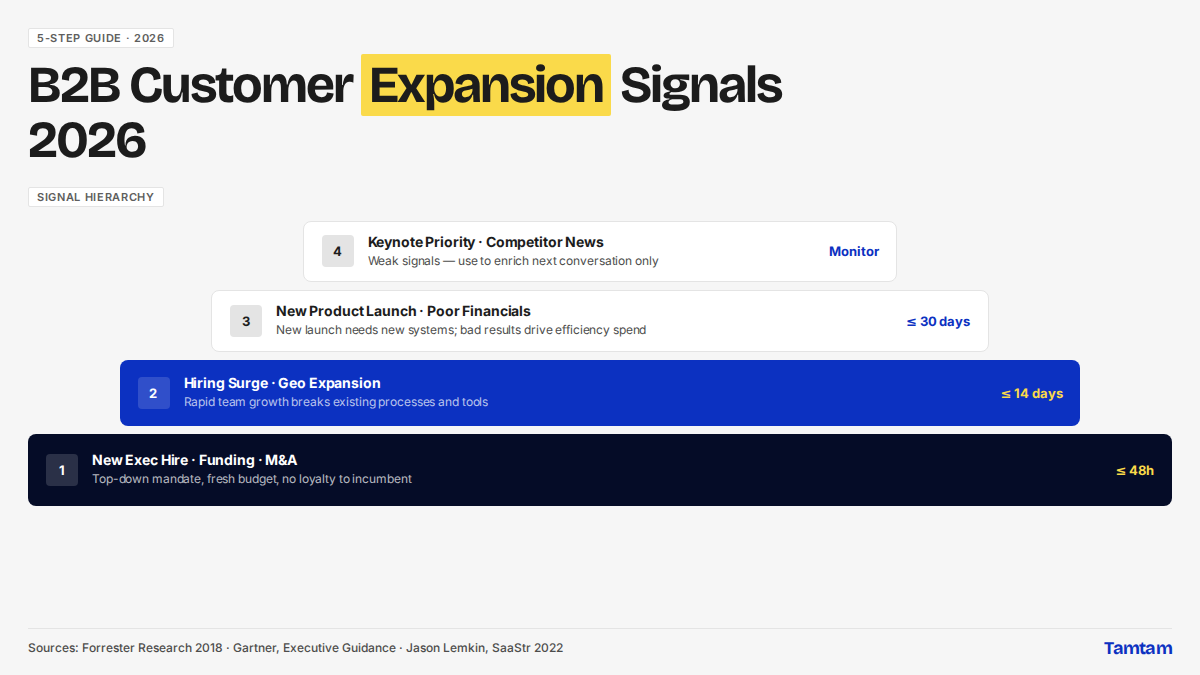
Create a simple, tiered system for your signals. Rank them based on their correlation with closed-won revenue. This isn't an academic exercise. It's a practical playbook for your SDRs, and the same logic powers a signal-based account scoring model.
Example in Action
Here's what a signal hierarchy might look like for a B2B software company:
Common Mistake to Avoid
The biggest mistake is launching a signal-based program without a clear hierarchy. You end up flooding your reps with "leads" that are mostly noise. They quickly conclude the system is crap, ignore the alerts, and go back to cold calling their static list because at least it feels predictable.
Here’s a hard truth that should be liberating: at any given time, only about 3 to 5% of your total addressable market is actively looking to buy a solution like yours. The other 95% are not.
The entire point of signal-based selling is to gain the discipline and the courage to ignore the 95% and focus all your team's energy, creativity, and resources on the tiny sliver of the market that's actually in-market.
Why This Matters
The traditional territory model forces reps to spread their attention thinly across hundreds of accounts, most of which are not going to buy this quarter or even this year. It's a recipe for inefficiency and despair. By focusing only on the active 3 to 5%, you transform the job from "manufacturing interest" to "channeling existing demand." This is a profoundly different, and infinitely more effective, way to sell.
What to Do
Radically change how you assign and manage territories. Instead of giving an SDR a static list of 200 accounts to "work" for the quarter, give them a dynamic feed of accounts that are actively showing Tier 1 and Tier 2 signals.
Their job is no longer to make 100 dials a day to uninterested people. Their job is to be the best-prepared, most relevant person to engage with the handful of accounts that have raised their hands. This requires a complete re-architecting of the SDR role, from their daily workflow to their compensation.
Example in Action
Imagine an SDR named Jane. In the old model, Jane starts her day by opening a list of 200 cold accounts in her CRM. She has to figure out who to call, what to say, and why anyone should care. It’s a grind.
In the new model, Jane starts her day by opening a dashboard showing her 5 "priority accounts."
Jane’s job isn't to randomly interrupt strangers. It's to connect the dots and start a relevant conversation based on what’s already happening.
Common Mistake to Avoid
The most common way to screw this up is to introduce signals but still force reps to hit arbitrary activity quotas (dials, emails) on their entire static territory list. This sends a mixed message and defeats the purpose. You're telling them to be strategic, but you're still paying them to be a volume machine. The system will default to what's measured and compensated.
If you change the inputs (signals) and the strategy (focus on the 3%), you must also change the SDR's identity and tactics. They are no longer a human spam-cannon. They are now a data-driven "first responder" arriving at the scene of a known problem with critical context.
Why This Matters
A signal without context is just an alert. An SDR who receives a notification that "John Doe visited the pricing page" and immediately calls with "Hi John, I saw you were on our website" is creepy and ineffective. The signal is the start of the research, not the end. The rep's job is to use the signal as a clue to uncover the underlying story and then use that story to make their outreach relevant and valuable.
What to Do
Train your reps on how to use signals to craft hyper-personalized messages. One of the best frameworks for this is Kyle Coleman's "5x5x5 Method". The idea is simple:
This structure forces reps to move away from generic templates and into a research-first mindset. It replaces hours of aimless browsing on a cold account with a fast, targeted, and repeatable workflow for hot accounts.
Example in Action
Let's go back to Jane the SDR. She sees Account A hired a new CFO who used her competitor.
Her 5x5x5 research might uncover:
Her 5-sentence email isn't about the signal. It's about the story: "Hi Sarah, congrats on the new role. Saw your post about building a world-class finance org, which reminded me of the work we did with your old team at [Previous Company]. Many finance leaders we work with are focused on improving operating margins, a topic that came up on your recent earnings call. Our platform helps by [one-line value prop]. Given your goals, thought it might be worth a brief chat."
This isn't a cold call. It's a warm, informed, and damn near irresistible conversation starter.
Common Mistake to Avoid
Giving reps access to a firehose of signal data without training them on how to interpret it and weave it into their outreach. You get cringey emails that lead with the signal itself ("I saw you downloaded our ebook..."). The signal is for your internal use; it gives you the reason to reach out. The outreach itself should be about them and their problem.
You can do everything right in the first four steps, but if you keep measuring and paying your team based on the old rules, the entire system will collapse. If you measure dials and emails, you will get dials and emails, regardless of their quality or impact.
Why This Matters
Incentives drive behavior. Full stop. To make a signal-based selling motion stick, you must change your KPIs. You have to stop celebrating busywork and start rewarding results. This is about aligning your team's compensation with the company's actual goal: generating high-quality pipeline, not just hitting activity numbers.
There's a famous case study of a 40-person SDR team that suffered a staggering 48% annual attrition rate. The root cause? They were managed on a dashboard that glorified activity metrics: 100 dials a day, 50 emails, etc. Reps were burning out in a cycle of "learned helplessness," doing pointless work for a number on a board.
What to Do
Scrap the activity-based dashboard. Replace it with one that tracks metrics that actually predict revenue.
When you shift the scoreboard, the game changes. Reps are no longer rewarded for spamming the 95% of the market that isn't listening. They are rewarded for having fewer, better, more intelligent conversations with the 3% that are.
Example in Action
Imagine two SDRs. SDR Bob makes 120 dials and sets 4 meetings. SDR Alice makes 30 calls and sets 3 meetings.
In the old model, Bob is the hero. He hit his activity target. In the new model, you look deeper. All 4 of Bob's meetings were with low-level contacts at companies showing no signals, and the AEs rejected 2 of them as unqualified. All 3 of Alice's meetings were with power users at companies with Tier 1 signals, and all 3 converted to qualified pipeline.
Who is actually better at their job? Who should be rewarded? Changing the scoreboard makes the answer obvious.
Common Mistake to Avoid
The absolute fastest way to kill this initiative is to launch a signal-based GTM motion but keep the old, activity-based compensation plan. Your reps are coin-operated, as they should be. They will follow the money. If you pay for volume, you will get volume, even if you preach quality.
The obsession with lookalike accounts comes from an era of lazy, brute-force sales. It treats reps like robots and buyers like targets on a spreadsheet. Shifting to a signal-based model is more than just a new tactic. It’s about restoring dignity to the profession and being smarter, not just hustling harder. The obvious bottleneck is the research. Finding and interpreting these triggers across your entire market is a soul-crushing manual task. That’s the problem platforms like Tamtam are built to solve. It automates the signal discovery process laid out in this guide, turning your team's trigger criteria into a living, prioritized list of accounts. It frees your reps from the grunt work of finding who to talk to, so they can focus on having a conversation that matters.
Set up for you before our first call
Book a demo