June 12, 2026
Traditional outbound metrics like 4x pipeline coverage are a trap, forcing sales teams into "Pipeline Theater" where they pad the CRM with dead deals to look busy. This isn't a moral failing; it's a rational response to a broken measurement system. To build a pipeline that actually closes, you must shift from measuring seller activity to measuring buyer intent. Ditch outdated coverage ratios and focus instead on High Intent Revenue Opportunities (HIRO) and objective engagement signals to see the unfiltered reality of your sales process.
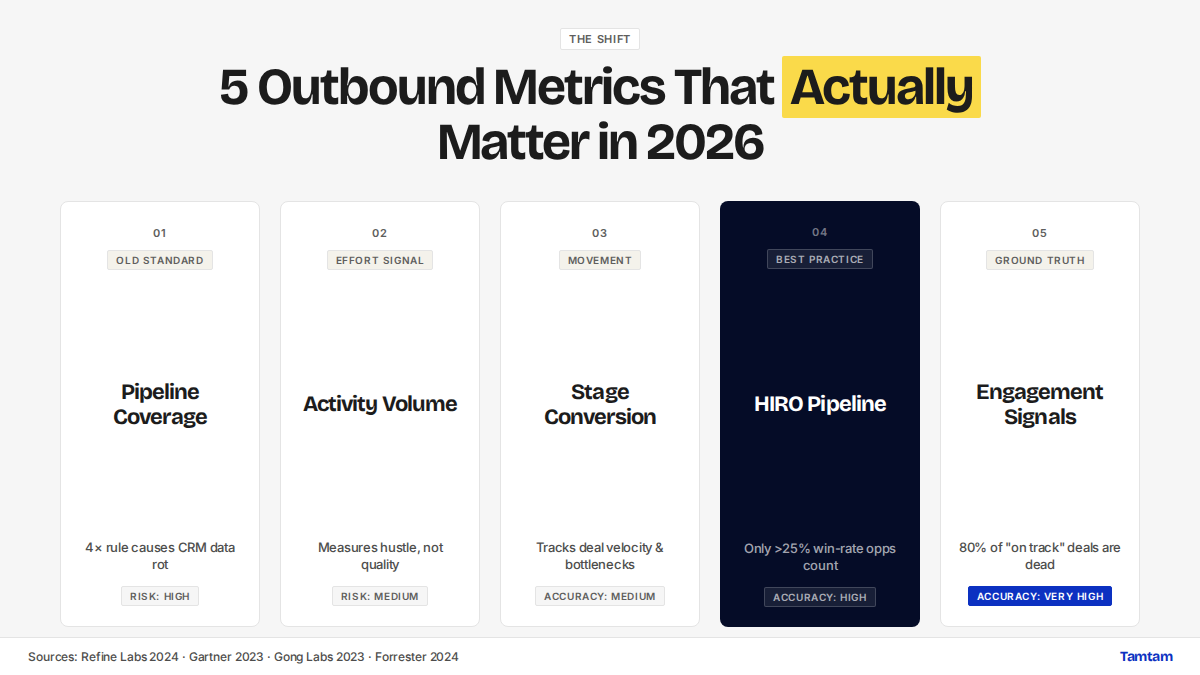
Every sales leader swears they run a data-driven team. Then they manage to a pipeline number that quietly rewards lying. The truth is that most outbound sales metrics measure seller activity, not buyer intent, which is why forecasts keep missing and pipeline generation starts to feel like guesswork. Here are the five numbers that actually tell you whether your pipeline is real, ranked from worst to best.
This is the one you know. The one your board asks for. The one your VP of Sales has tattooed on their brain. For every dollar in revenue you need to hit, you must have three to four dollars sitting in your pipeline at the beginning of the quarter. Simple. Comforting. And complete, unadulterated bullshit.
Who it's best for: Old-school sales leaders who need a single, simple (but deeply flawed) number to report upstairs. It’s for organizations that prefer the comfort of a big, fat pipeline number over the uncomfortable reality of what’s actually winnable.
Strengths:
Weaknesses:
Verdict: The 4x pipeline rule is the root cause of most forecasting inaccuracies and CRM data rot.
When the big pipeline number fails to deliver, management’s next move is predictable: crack the whip. If we’re not hitting our number, it must be because reps aren’t doing enough. More dials. More emails. More meetings. The focus shifts from the outcome (revenue) to the input (raw, brute-force activity).
Who it's best for: Managers of very junior, entry-level SDR teams where the main goal is to instill work ethic and establish a baseline of effort. It’s a tool for diagnosing if someone is actually showing up and doing the work.
Strengths:
Weaknesses:
Verdict: Measuring activity is like measuring how many times a novelist hits the keyboard instead of reading the book they wrote.
Okay, so we agree that a giant, stagnant pipeline is useless and that pure activity is a trap. The next level of maturity is to start looking at movement. How quickly are deals moving from one stage to the next? Where are they getting stuck?
This involves tracking two key components:
Who it's best for: RevOps professionals and sales managers who are ready to graduate from basic reporting and start diagnosing the health of their pipeline.
Strengths:
Weaknesses:
Verdict: A necessary and valuable step up, but it's a diagnostic tool, not the source of truth.
This is where the real change begins. Coined by Chris Walker at Refine Labs, a High Intent Revenue Opportunity (HIRO) is an opportunity that has reached a stage in your sales process with a historical win rate of 25% or higher. For most companies, this isn't the first meeting. It's much later, perhaps after a technical validation or a mutual action plan is signed.
You don’t forecast on anything before this stage. Everything else is just lead flow.
Who it's best for: Modern, go-to-market-aligned organizations that are sick of the marketing-sales blame game and want to hold everyone accountable for generating actual revenue.
Strengths:
Weaknesses:
Verdict: HIRO is the single most powerful framework for shifting from a culture of activity to a culture of results.
The final evolution in sales metrics is to stop relying on what your sellers say is happening and start measuring what the buyer is actually doing. A deal's progress isn't defined by a dropdown menu in the CRM. It's defined by the buyer’s tangible actions and engagement.
These are objective, verifiable signals:
Who it's best for: Forward-thinking, tech-enabled sales teams who want to replace human guesswork and happy ears with objective data.
Strengths:
Weaknesses:
Verdict: This is the ground truth. Combining a HIRO framework with objective engagement signals is as close to a crystal ball as you can get in sales.
| Metric / Approach | What It Really Measures | Risk of Pipeline Theater | Predictive Accuracy | Best For (Team Type) |
|---|---|---|---|---|
| Pipeline Coverage | Comfort | High | Low | Old-school, board-reporting-focused leadership |
| Activity Volume | Hustle | Medium | Low | Junior SDR teams needing baseline enforcement |
| Stage Conversion | Movement | Medium | Medium | RevOps and maturing sales teams |
| HIRO Pipeline | Quality | Low | High | GTM-aligned orgs focused on revenue |
| Engagement Signals | Truth | Low | Very High | Tech-enabled teams obsessed with accuracy |
This isn't about picking one metric off a menu. It’s about a fundamental shift in philosophy.
Commit to Honesty First. Are you and your leadership team truly willing to face the music? This means conducting a "Pipeline Purge" and accepting that your real, winnable pipeline might be a fraction of what your CRM claims. If the answer is no, stop here. You can’t fix a problem you refuse to see.
Measure the Buyer, Not the Seller. Restructure your 1:1s and pipeline reviews. The central question should never be "What did you do this week?" (seller activity). It must be "What did the buyer do this week?" (buyer intent). If the rep can't point to a concrete, meaningful action from the buyer: an email reply, a calendar invite accepted, a key document reviewed, an introduction to a decision-maker. Then there was no progress. The deal did not move. Period.
Align the Entire GTM on One Number. Make HIRO Pipeline (or a similar revenue-centric metric) the god metric for both Marketing and Sales. It’s the ultimate silo-buster. When the demand gen team and the sales team are both compensated and judged based on their ability to create high-quality, late-stage pipeline, the petty arguments over lead quality magically disappear. Everyone is suddenly on the same team, rowing in the same direction: toward predictable revenue.
The goal isn’t a bigger pipeline; it's a real one. For years, we’ve rewarded the performance of confidence over the reality of data. That era is over. The tools now exist to see the truth, and the market no longer rewards teams who choose to fly blind. The future belongs to sales organizations brave enough to stop playing theater and start measuring the objective signals that actually lead to revenue. It begins by finding the right prospects in the first place, not based on static lists but on signals that they are ready to engage. For teams ready to build a pipeline that's real from the very first touch, platforms like Tamtam are designed to identify opportunities based on those crucial, underlying buying triggers.
Set up for you before our first call
Book a demo