June 12, 2026
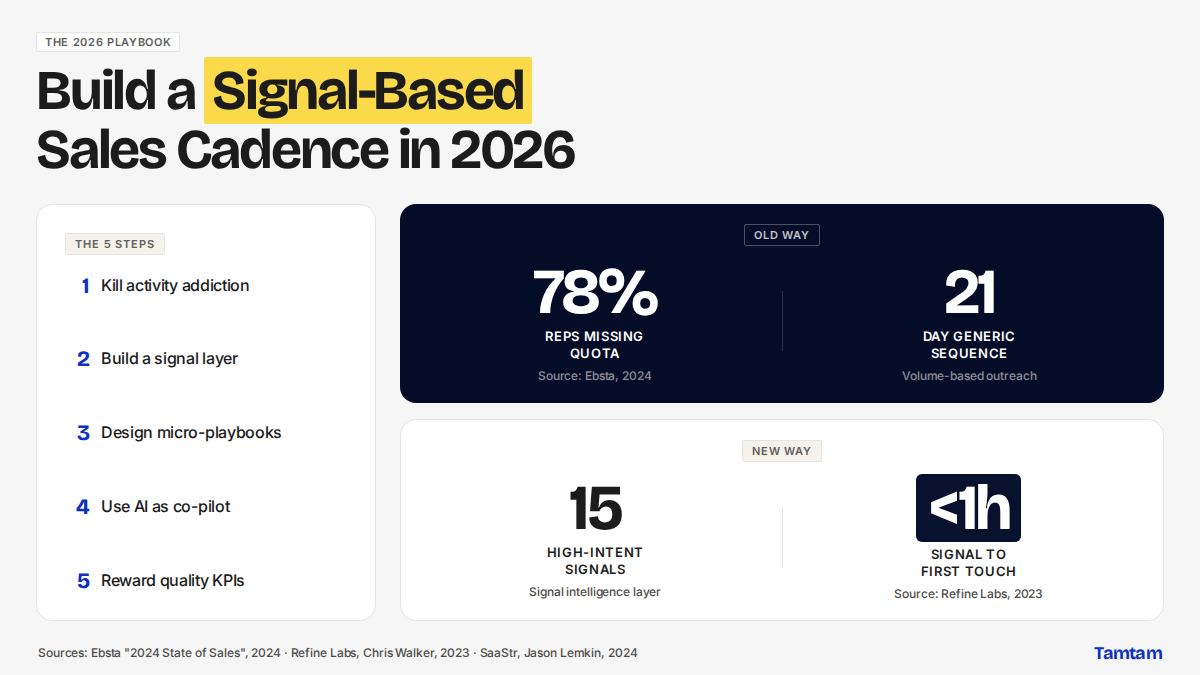
Traditional sales cadences based on a rigid calendar of calls and emails are failing, with nearly 80% of reps missing quota. The future of effective sales outreach isn't about more activity or mythical AI replacements; it's about building a dynamic cadence triggered by real-time buyer signals. This guide provides a five-step playbook for this new approach, from breaking your team's activity addiction to overhauling your KPIs to reward quality over volume.
Let's be honest, your sales cadence is probably garbage.
It’s not your fault. You were taught to worship a 15-step checklist of calls and emails that buyers now actively filter into spam folders and ignore with religious fervor. While you're busy "trusting the process," your peers are missing quota, and B2B win rates are in a freefall.
The game has changed. Your buyers are drowning in low-effort, AI-generated noise. Clinging to the old volume-based playbook isn't just ineffective; it's career suicide. Your cadence is the engine room of pipeline generation, and the old one has stalled.
The good news is there's a better way. It involves less guessing, less brute force, and a hell of a lot more intelligence. It’s time to stop running a checklist and start playing chess. Here’s how.
Before you can build something new, you have to burn the old thing down. And the old thing is your team's addiction to activity metrics.
For decades, sales floors have been managed by a simple, broken equation: more activity equals more results. Low on meetings? Double your dials. Pipeline looks thin? Send 1,000 more emails. This provided a false sense of control. Activity felt like progress. It was measurable, predictable, and easy to manage.
It's also a complete fantasy.
According to research from Ebsta, a staggering 78% of B2B sales reps missed their quota in 2024 [1]. Think about that. Nearly four out of five reps are failing. This isn't a slump. It's a systemic breakdown. The brute-force model is producing historically awful results. Being busy is no longer a proxy for being effective.
The first step is to look your team in the eye and admit it. Call a meeting. Put the numbers on the board. Show them the connect rates, the reply rates, the abysmal conversion from touchpoint to meeting. Make the failure of the old model undeniable.
The manager who sees low conversions and tells reps to "just make more calls." This is like trying to fix a leaky bucket by pouring water into it faster. You just accelerate burnout, destroy your brand's reputation with spam, and scale your failure. The problem isn't the rep's work ethic; it's the strategy.
You need to detox your team from the psychological comfort of activity. It’s scary because it means replacing a familiar process with an unfamiliar one. But the alternative is to keep doing what isn't working and pretend you don't see the iceberg dead ahead.
A modern sales cadence isn't triggered by Day 5 on a calendar. It's triggered by a buyer's actions in the real world. These actions are "buying signals," and they form the foundation of your entire outreach strategy.
Your job is to become an intelligence officer, not a telemarketer. This means building a prioritized list of specific, observable behaviors that indicate a prospect might actually need what you're selling.
Here's how to get started:
Inventory Your Signals: Get your team in a room and brainstorm every possible signal you can think of. Divide them into two buckets:
Ruthlessly Prioritize: You can't chase everything. Treating all signals as equal is a rookie mistake. A demo request is a 10/10 signal that requires immediate, personalized follow-up. A whitepaper download is a 2/10 signal that might just warrant a light, automated touch. Score your signals based on their correlation to closed-won deals. What events actually preceded your biggest wins last year? Focus on those.
Don't try to boil the ocean. Start with just 10 to 15 high-confidence signals. For a company selling cybersecurity software, a great list might include:
Creating a laundry list of 50 signals and chasing them all with equal vigor. This just recreates the chaos of the old model with a new excuse. The goal is focus. A small list of high-intent signals will generate far more quality pipeline than a huge list of low-intent noise. This layer isn't about finding more people to call; it's about finding the right people to call at the right time.
That rigid, 21-day, 15-step sequence you're so proud of? Delete it.
A single, one-size-fits-all cadence is lazy and disrespectful to the buyer. Why would a prospect who just got a new round of funding receive the same message as someone who downloaded an ebook? They wouldn't. The context is completely different.
Instead of a mega-sequence, you need to design "micro-playbooks." Each high-intent signal from Step 2 gets its own short, sharp, and highly contextual sequence. We're talking three to five touches over a few days, not a month-long campaign of attrition.
The goal is to be fast and relevant. Chris Walker of Refine Labs calls this the HIRO Pipeline: High-Intent, Ripe Opportunity [3]. When a high-intent signal fires, it’s an all-hands-on-deck moment. The rep should break from their standard workflow to execute the specific micro-playbook for that signal immediately.
Notice the difference? Every touch is anchored to the original context. It's helpful, not intrusive. It shows you were listening. This is how you build a multichannel sales sequence that doesn't feel like spam. For the mechanics of the follow-up itself, how many touches and when to walk away, see our guide to building a sales follow-up sequence, and how to make the cold call touches actually land.
Over-engineering this. You don't need a different 15-step sequence for each signal. That defeats the purpose. The point is speed, relevance, and precision. Keep your micro-playbooks short, sharp, and focused on starting a conversation, not completing a checklist.
Here comes the AI part. The current hype cycle might tempt you to believe in a "fully autonomous AI SDR" that will cold call, email, and book meetings while you sip piña coladas. This is a fantasy, at least for any sale that involves a considered purchase.
Using AI to scale low-quality, generic outreach is just a faster way to burn your domain reputation and annoy your entire market.
The smart play is to use AI as a co-pilot. The machine does what it's good at: monitoring endless data streams and performing repetitive tasks. The human does what they're good at: exercising judgment, building rapport, and thinking strategically.
The SaaStr story about their "$1 Million AI SDR" is a perfect reality check. Jason Lemkin revealed that while they generated huge revenue with an AI tool, it only worked because senior leaders were spending 15 to 20 hours per week personally managing the AI, curating lists, and refining prompts [2]. The AI was a powerful engine, but it needed an expert human pilot.
Buying an "AI SDR" platform, plugging in a generic prompt like "sell my software," and expecting it to print money. Garbage in, garbage out. An AI co-pilot only amplifies the quality of your strategy and the intelligence of your signals. If your strategy is "spam everyone," AI will just help you become a world-class spammer.
This model is incredibly empowering. It elevates your SDRs from being low-level box-checkers into high-judgment strategic operators. You’re paying them to think, not just to dial.
You can't change the process without changing the measurement. If you implement all these steps but continue to manage your team based on raw activity, they will inevitably revert to the old, comfortable behaviors.
Your compensation plans and leaderboards are a megaphone that tells your team what you really care about. If you celebrate the rep who made 150 dials, you're telling everyone that volume is what matters.
It's time to ditch the vanity metrics and start measuring what actually drives revenue.
| Ditch These (Vanity Metrics) | Adopt These (Quality Metrics) |
|---|---|
| Dials Made | Conversations with ICPs |
| Emails Sent | Positive Reply Rate |
| Raw Meetings Booked | Qualified Meetings Held |
| Talk Time | Pipeline Value Generated |
| Total Touches | Pipeline Quality Score (ICP fit + engagement) |
Introducing metrics like "Pipeline Quality Score" or "Pipeline Value Generated" completely changes the game. It forces SDRs to think like Account Executives. They stop asking, "Who can I get to accept a meeting?" and start asking, "Which of these signals points to a real, closeable business opportunity?"
This shift requires courage from sales leaders. It means telling your CEO or your board that you’re moving away from the comforting, predictable charts of "dials made." It means you might book fewer total meetings, but the meetings you do book will be with higher-intent buyers and have a much higher chance of converting into real pipeline.
Continuing to run SPIFs and leaderboards based on raw activity. This is the fastest way to undermine your new strategy. If you say you want quality but you pay bonuses for quantity, don't be surprised when you get a mountain of low-quality meetings that go nowhere. Your incentives must align with your strategy.
The shift from a static cadence to a sentient, signal-based one is more than a tactical change. It's a philosophical one. It’s about respecting the buyer's time and moving your reps from being robotic checklist-followers to high-judgment strategic operators. The old model asked, "Did you complete your tasks today?" The new model asks, "Did you create real pipeline based on what the market told you today?" Of course, the practical challenge is finding those signals in the first place without drowning your team in research. That's the problem Tamtam is built for. It learns the specific buying triggers from your past wins and then continuously researches your entire market to find new accounts showing those same patterns, delivering a focused list with all the context your reps need to act. It’s the intelligence layer this new playbook requires.
Set up for you before our first call
Book a demo