June 12, 2026
Most multi-touch sales sequences are a psychological crutch, enabling call reluctance rather than driving conversations. The solution isn't a better template but a fundamentally different approach to outreach. This guide shows you how to ditch high-volume spam for focused research, use pattern interrupts to get attention, lead with the phone, and use a powerful breakup question to get a definitive "no" and clean your pipeline.
Let’s be honest. The entire B2B sales industry is obsessed with optimizing the "perfect" follow-up sequence. We debate the ideal number of touches, the best time of day to send an email, and which emoji will magically triple our reply rates. A follow-up sequence is really just one layer of your broader sales cadence, and most are built backwards.
This is a complete and utter waste of time.
Your sequence isn't a productivity tool. It's a psychological safety blanket. It's an elaborate, multi-million-dollar system designed to do one thing: protect you from the raw, visceral, and often terrifying act of selling.
We’ve built an entire tech stack to help salespeople hide from the messy, human work of trying to persuade another human to do something. The sequence runs automatically. The tasks pop up. We click the buttons. We feel busy. We feel productive. And at the end of the day, we can look at our dashboard full of "activity" and tell ourselves we did our job, even if our pipeline is still empty.
This isn't a strategy. It's an addiction to the feeling of work, divorced from the results. Here’s how to stop hiding and start winning.
Before you can fix your sequence, you have to admit why it sucks.
Pull up your current, default sales cadence. The one you dump every new prospect into. Now, look at each step with brutal honesty and ask yourself this one question:
"Is this step designed to get a response, or is it designed to let me check a box and avoid picking up the phone?"
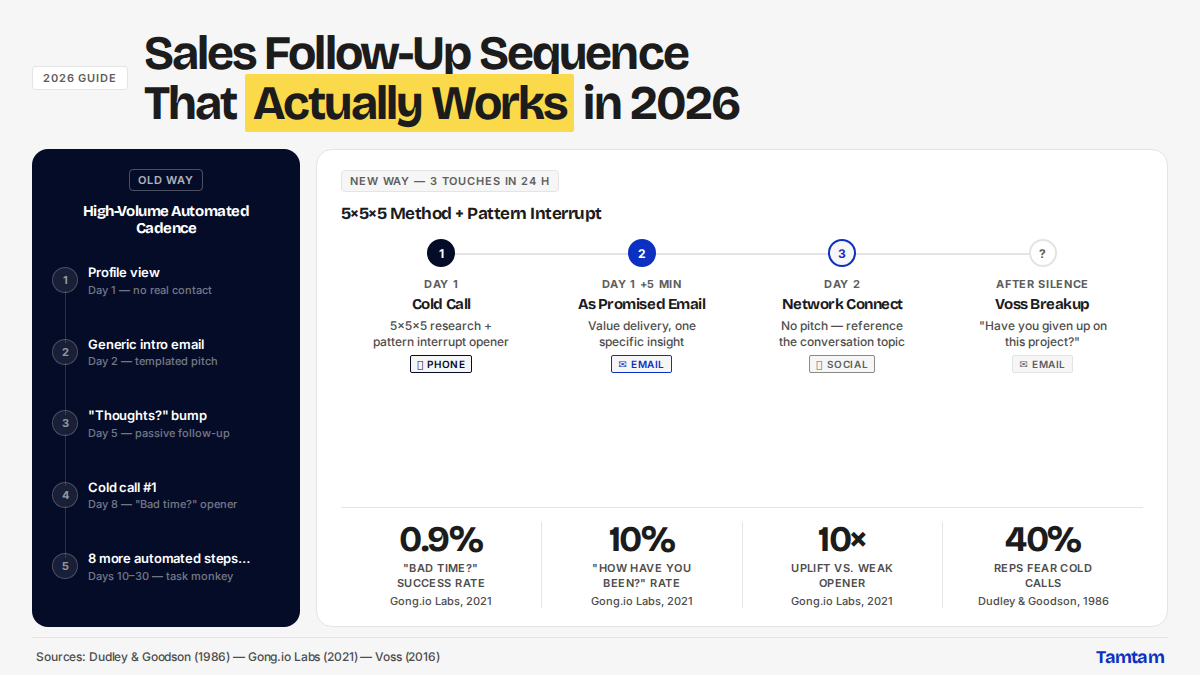
Be ruthless. That "Step 2: Social network profile view" is a joke. That "Step 3: Bump email - 'Thoughts on my last email?'" is pure, uncut cowardice. It simulates activity. It gives you a dopamine hit of "doing something" without risking a direct rejection or having to think critically.
This behavior is rooted in a deep-seated fear that plagues our industry: call reluctance. Research suggests as many as 40% of veteran salespeople experience it (Dudley & Goodson, 1986). They will do anything, literally anything, to avoid a live conversation with a stranger where the outcome is uncertain.
Rigid, automated sequences are the perfect enabler for this fear. They create a state of "learned helplessness," where reps stop thinking and just follow the machine's instructions, even when the machine fails 98% of the time. You become a task-monkey for a system that was broken from the start.
The common mistake here is believing that more activity equals more pipeline. It doesn't. Scaling irrelevant, low-value outreach just burns your market faster and solidifies your reputation as a spammer. The fix isn't a better sequence; it's better B2B lead generation upstream. You’re not building pipeline; you’re just digging your own grave with a very expensive shovel.
The antidote to mindless volume is disciplined, focused research. It’s about respecting the buyer's time, and more importantly, your own. Instead of loading 100 faceless prospects into a generic 12-step cadence, commit to the "5x5x5 Method" for a handful of high-value accounts.
This framework forces you out of the automation crutch. It makes you behave like a strategic consultant, not a call center robot.
Here’s how it works:
For example, instead of this crap:
"Hi Jane, I see you're the VP of Sales at Acme. I wanted to introduce you to our platform..."
You write this:
"Jane, I saw your post about the challenge of scaling your SDR team past 50 reps. The point about diminishing returns on pure activity volume really hit home. We helped ScaleFast solve that exact problem by focusing on A and B, which led to a 4x jump in their pipeline value. Is that a problem you're currently trying to solve?"
See the difference? The first is spam. The second is a consultation.
The common mistake is turning "research" into another form of procrastination. You can lose an hour digging through 10-K reports. The time constraint is the most important part of this framework. It forces you to be decisive and focus only on what truly matters.
Your buyers are professional ignorers of sales outreach. Every day, their inbox and phone are assaulted by a legion of reps with the same generic scripts. Over time, their brain develops an incredibly effective auto-delete filter.
Your first job isn't to sell. It's to short-circuit that filter.
You do this with a pattern interrupt: an unexpected question or statement that jolts the prospect out of their autopilot response. It’s not about being a clown; it's about being different enough to earn three seconds of their conscious attention.
This is grounded in cognitive science. When you break a pattern, the human brain is forced to pause and re-evaluate the situation. In that brief moment, you have an opening.
Gong’s research on millions of sales calls provides a perfect example. They found that the classic, weak opener, "Did I catch you at a bad time?" has a pathetic 0.9% success rate (Gong.io, 2021). The prospect’s brain hears that pattern and immediately knows it's a sales call, triggering the "get rid of this person" script.
But contrast that with a slightly weird, more familiar-sounding opener like, "How have you been?" According to the same data, that question achieves a 10% success rate, a more than 10x improvement. Why? Because it’s unexpected. The prospect’s brain stalls for a millisecond, thinking, "Do I know this person?" That brief confusion is all you need to state your name and your one-sentence value proposition.
The common mistake is using a pattern interrupt that's clever but completely irrelevant to the conversation you want to have. The goal is to open a door to a relevant discussion, not just to get a laugh and then get hung up on. Your interrupt should be a bridge, not an island.
"Multi-channel" has become a buzzword for "annoy people on every available platform." Stop thinking about your channels as a checklist and start thinking about them as specialized tools for specific jobs.
Your sequence should reflect this reality. Stop hiding behind email as your opener. Pick up the damn phone. (Here's how to cold call without a script.)
Here’s a brutally effective 3-touch sequence that works:
This sequence accomplishes more in 24 hours than a generic 12-touch automated cadence does in three weeks. It's human, it's respectful, and it's built around a conversation, not a monologue.
The common mistake is sending the exact same message on every channel. This isn't a multi-channel strategy. It's multi-annoyance. Tailor the message to the medium.
Now we get to the big question: when do you quit?
Most reps are terrified of a definitive "no." They prefer the slow, ambiguous torture of being ghosted. This behavior clogs their pipeline with fantasy deals and wastes countless hours chasing prospects who were never going to buy.
Here's the secret: Elite reps don't fear the "no." They hunt for it. A "no" is a productive outcome. It's a gift. It gives you back your most valuable resource: your time and attention, which you can now reinvest in a prospect who actually might buy.
After you’ve made 3 or 4 valuable attempts (not automated bumps) and you’re still getting silence, it’s time to force a decision. Your best tool for this is the brilliant one-line breakup email inspired by former FBI hostage negotiator Chris Voss (2016).
It’s just one sentence:
"Have you given up on this project?"
This question is a masterpiece of applied psychology. It’s not needy or passive-aggressive. It’s a simple, direct question that frames the situation as them abandoning a previously important goal. This triggers loss aversion, a powerful cognitive bias that makes people more motivated to avoid a loss than to achieve a gain.
It forces them to react. They will either correct you ("No, of course not, I've just been swamped. Let's talk next week.") or they will give you the "yes, we have," which is the clean "no" you were looking for. Either way, you get a definitive answer and can move on.
The common mistake is sending a weak, ego-protecting breakup email like, "Since I haven't heard back, I'm going to assume this isn't a priority for you right now." This is passive-aggressive and accomplishes nothing. It makes you look weak and allows the prospect to continue ignoring you without consequence. Be direct. Ask the hard question.
The debate over the perfect number of touches is a distraction. You can’t automate courage, and you can't template persuasion. The real work of selling is doing the hard, human things: the research, the direct call, the risk of a clean rejection. The obvious problem with the 5x5x5 method is that it doesn't scale if you're the one spending all day digging for those five bullet points. This is where the game is really won or lost: not in the sequence, but in the quality of the list you start with. Getting that part right, with a platform like Tamtam that surfaces why you should call someone right now, is how you stop playing with a handicap and start actually selling.
Set up for you before our first call
Book a demo