June 12, 2026
Cold call scripts act as a psychological crutch against rejection, immediately placing you in a low-status position. This guide provides a 5-step framework to abandon scripts and win more calls in 2026. You'll learn how to reframe your mindset, control the conversation, master your tonality, and use pre-call intelligence to engage prospects as a peer, not a pest. The objective isn't to find the perfect script, but to develop the skills to succeed without one.
Almost all cold calling advice is bullshit.
It’s a steaming pile of recycled tips from 1998, dressed up with a new headline for the current year. The worst offender, by far, is the obsession with finding the "perfect script."
Let me be clear: your script is the reason you're failing. It’s a psychological safety blanket that broadcasts your fear and low status from the first syllable. It’s a trap. When you read a script, you sound like a robot begging for scraps. And people hang up on robots who beg for scraps.
The truth is that success on a cold call has very little to do with the words you say. It has everything to do with the psychological frame you establish in the first seven seconds. It’s about status, tonality, and relevance. It’s about engaging another human as a high-status peer who has something valuable to share, not a telemarketer who is about to be swatted away. Get that frame right and the phone is still one of the sharpest channels in modern B2B lead generation.
This guide will not give you another worthless script to memorize. Instead, it will give you something far more powerful: a five-step framework to become the kind of person who doesn't need one.
Before you even think about picking up the phone, you have to win the battle inside your own head. Most reps are terrified of rejection, and for good reason. Neuroscientists have shown that social rejection lights up the same pain centers in your brain as physical injury. Your brain literally processes a "no" as a physical threat.
Your script is a defense mechanism against that pain. It's a shield. But it also makes you sound stiff, unnatural, and weak.
So, how do you fix it? You perform a mental shift using a technique called Cognitive Reappraisal. It's a fancy term for a simple idea: changing the story you tell yourself about a situation.
Stop thinking of the call as a "high-stakes pitch where I might get rejected." That story puts you in a defensive crouch and guarantees failure.
Instead, reframe it as a "low-stakes peer consultation where I'm delivering valuable market intelligence."
You are not asking for anything. You are offering insight. You are a consultant diagnosing a potential problem based on market signals. The outcome of this one call is irrelevant. Your job is simply to determine if a deeper conversation is warranted. That's it.
This reframing isn't just fluffy self-help crap. It physiologically hacks your brain's fear response. When you tell yourself the stakes are low and you're just sharing information, you prevent your amygdala (the lizard brain) from hijacking the call. This keeps your prefrontal cortex (the smart, strategic part of your brain) in control. Your anxiety drops, your heart rate slows, and your voice calms down.
The reason you get nervous isn't a character flaw; it's a predictable neurobiological reaction. And you have direct control over it by changing the story.
Believing you need to "get hyped" or "feel confident" before calling. Confidence is not a mood you summon. It's the byproduct of having the correct mental frame and then executing the right mechanics. Focus on the frame, not the feeling.
Every cold call starts with an invisible power dynamic. By default, the prospect is in the "One-Up" position (they have the power, their time is valuable) and you are in the "One-Down" position (you are an interruption, you need something from them).
You cannot sell anything from a low-status position. They won't respect you, they won't listen to you, and they will dismiss you as quickly as possible. Your first and most important job is to flip this dynamic instantly.
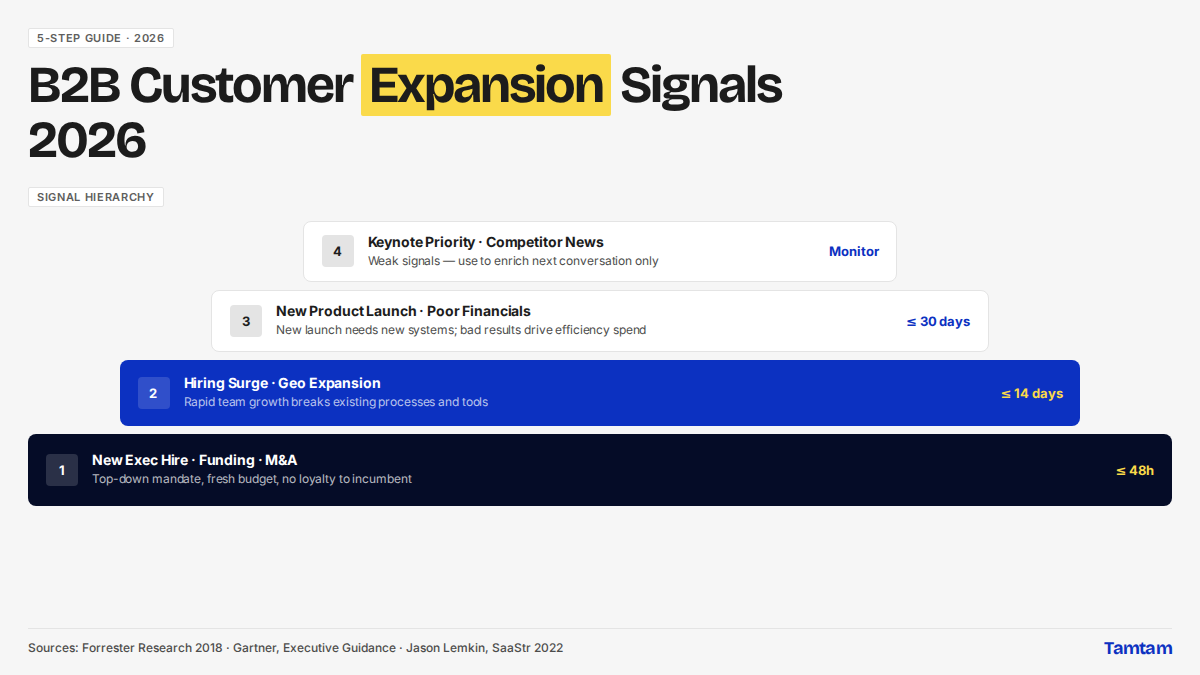
The ultimate hack for seizing high status is to arm yourself with overwhelming relevance. Before you dial, spend 30 to 90 seconds finding a "why you, why now" signal. This isn't about mentioning their favorite sports team. It’s about finding a concrete business trigger.
Look for things like:
When you walk into a call with a sharp, relevant piece of intelligence, you create what sales trainer Oren Klaff calls an "inevitability mindset." You're no longer guessing if they have a problem; you're acting on a clear signal that strongly suggests they do.
This single piece of information shifts the entire frame of the call. It moves it from an interruption to a well-timed intervention. You immediately establish yourself as an informed peer who has done their homework, not some random dialing for dollars.
Think of it this way: a world-class doctor doesn't walk into an appointment and say, "So, got any problems today?" They walk in having already reviewed the patient's chart, lab results, and medical history. They start from a position of authority and intelligence. That's what a signal gives you.
A classic low-status trap is when a prospect says, "I only have 2 minutes." The low-status rep panics, speeds up, and tries to cram their entire pitch into 120 seconds. They lose instantly.
The high-status rep prizes their own time and reframes the situation. They respond with calm authority:
"Two minutes isn't nearly enough time for us to figure out if this is even a fit. We can use these two minutes to decide if a real conversation makes sense next week, or we can just reschedule now. What works better for you?"
This response reasserts control, demonstrates that you aren't desperate, and treats the conversation as a mutual evaluation. You just seized the high-status frame.
Treating pre-call research as "finding a fun fact." Nobody cares that you saw on a social network that they went to the same college as you. Find a business pain signal. Relevance is status.
Once you've set your mental frame and found your signal, the next battle is won or lost in your vocal cords. A buyer's brain trusts the acoustic cues of your voice far more than the content of your words. You can have the most brilliant opener in the world, but if your tonality screams "I'm scared and I don't deserve to be here," you've already lost.
Mastering your tonality is a mechanical skill, not an emotion. You don't have to feel confident to sound confident. You just have to practice the right mechanics. Use the PAVP framework.
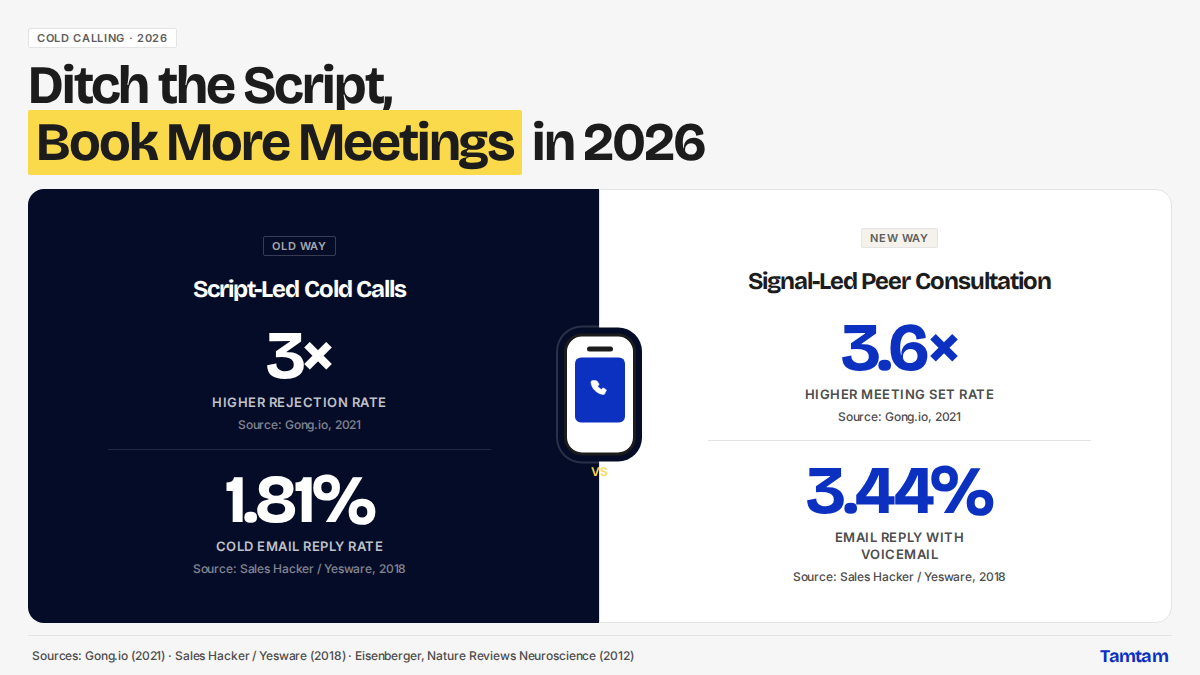
This isn't just theory. Research from Gong.io on over 300 million sales calls proved that reps who consistently use a downward inflection have a 3.6x higher meeting set rate. Your tonality is a weapon. Treat it like one.
The best part about this is that it's completely within your control. You don't need to wait for a feeling of confidence to strike. Spend 10 minutes a day reading an article out loud, focusing on a downward inflection and a slow, deliberate pace. It's a physical drill, like practicing free throws. Do the reps, and the skill will be there when you need it.
Okay, you've got your mindset right, your signal locked in, and your voice warmed up. Now it's time to actually open the call. Instead of a rigid script, you're going to use a flexible, three-part framework designed to bypass the prospect's "salesperson filter" in the first 30 seconds.
This opener is engineered to disarm the prospect. The pattern-interrupt makes them lean in instead of tuning out. The diagnosis label establishes your credibility and relevance instantly. And the confident ask takes control of the next step without being pushy.
Another killer pattern-interrupt is: "Hey [Name], Alex here. Quick question, have you heard our name tossed around recently?" Most of the time, they'll say "No." This is perfect. Your response: "I figured as much. Frankly, that's why I'm calling. Usually when a company [posts jobs for 5 new AEs], they're already talking to us about [how to ramp them faster]. It seemed like it might make sense for us to connect." This is a high-status move. You've subtly reframed their lack of awareness as an anomaly, positioning your company as the standard solution for their exact situation.
What do you do when the prospect doesn't pick up? The average rep leaves a long, rambling, desperate voicemail that's essentially a condensed version of their pitch. This is a massive mistake.
Pitching in a voicemail gives the prospect all the information they need to screen your future calls and delete your emails without ever talking to you. It also reeks of desperation.
Stop trying to get a call back from your voicemails. The goal of a voicemail is not to get a callback. The goal is to amplify your other channels, specifically your email.
Leave a short, flat-toned, professional message that simply points them to another channel. That's it.
"Hey [Name], it's Alex calling from Acme. I'm about to send you an email with the subject line 'New Sales Hire Initiative.' Just wanted to give you a heads-up. Again, Alex from Acme."
End of message. Hang up. No "hope you're having a great day," no pitch, no desperation. Your tone should be flat and professional, like a colleague leaving a quick heads-up.
This is a multi-channel amplifier. Data shows this exact voicemail strategy can nearly double cold email reply rates, from 1.81% to 3.44%. Why? It creates familiarity. When your email lands a few minutes later, the prospect's brain recognizes your name and your company's name. It's no longer a completely cold message. You've signaled that you're a professional who is concise and will be following up methodically. That voicemail only earns its keep as one beat in a deliberate sales follow-up sequence, slotted into a broader multichannel sales cadence.
Leaving a "call me back" voicemail. You're giving away your power. Use the voicemail as a primer for your next move, not a desperate plea for a return call that will never come.
So, the game isn't about the magic words. It's about rewriting the rules of the interaction entirely. You stop acting like a salesperson begging for time and start behaving like a high-value consultant who happens to use the phone. The moment you stop needing their approval is the moment you start earning their respect. But here's the kicker: all the technique in the world is useless if you're calling the wrong people at the wrong time. The real cheat code is starting with a list that isn't just names, but a map of active problems waiting to be solved. That's the entire philosophy behind Tamtam: building lists around real buying triggers, so every call you make already has the "why you, why now" built right in.
Set up for you before our first call
Book a demo