June 2, 2026
Forget blasting cold emails and grinding out dials, buyers are numb to the old volume game. Modern B2B lead generation isn't about channels, it's about timing. The only effective strategy is finding prospects the moment they have a problem you can solve. This guide breaks down the six signal-based strategies that replace outdated tactics with intelligent, high-converting outreach.
Your sales floor is buzzing. The dashboards are lit up green. Reps are hitting their activity KPIs: 100 dials a day, 500 emails a week. Everyone looks busy. Everyone feels productive. There's just one problem.
Your pipeline is empty.
This is the "Illusion of Control" that has infected B2B sales. We’ve become so obsessed with measuring activity that we’ve forgotten to measure what actually matters: outcomes. The Predictable Revenue model, once a brilliant framework, has been automated and scaled into a predictable spam cannon. And buyers are numb to it.
The hard truth is that your prospects don't care about your beautifully crafted 12-step sequence. They don't care that you hit your dial quota. They only care about one thing: solving their problem right now.
The game has changed. Winning in 2024 isn't about out-working your competition. It's about out-timing them. It’s not about finding more channels to blast your message. It’s about recognizing the critical moments, the buying signals, that turn a cold lead into a warm conversation. Lead generation is only the front end of pipeline generation; pack it with the wrong names and the whole engine stalls downstream.
Forget "channels." Let's talk about strategies that actually work.
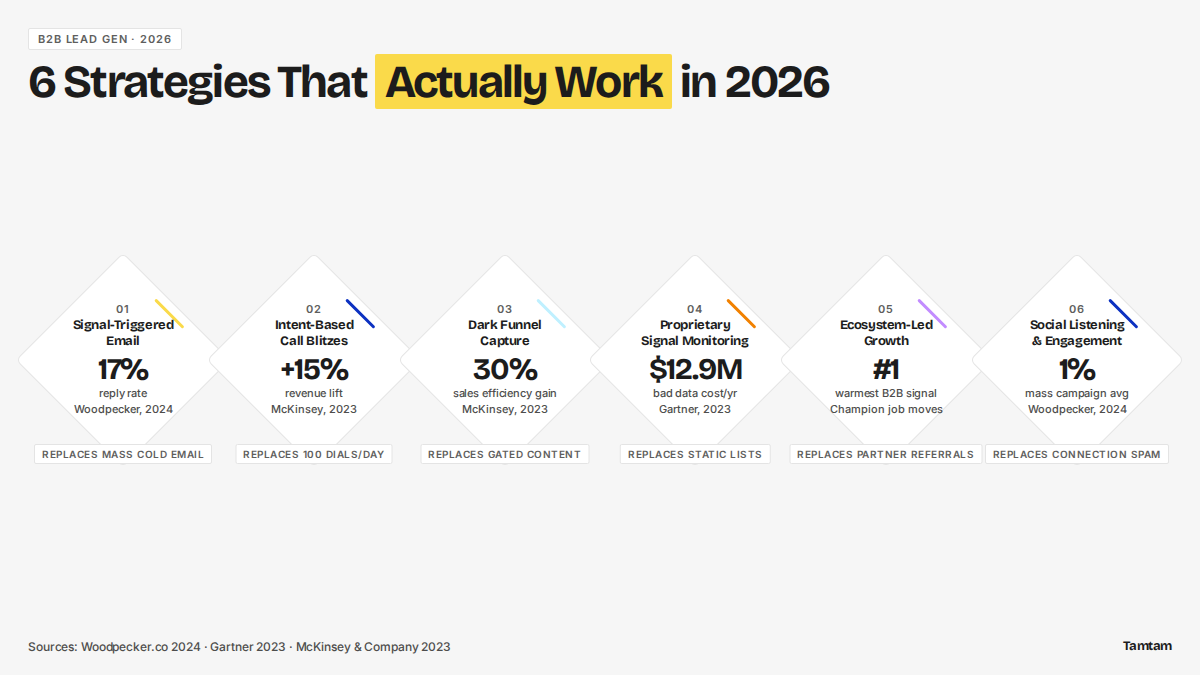
This is the direct replacement for mind-numbing, mass cold email campaigns. Instead of blasting 1,000 generic templates, you send a handful of hyper-relevant emails triggered by a specific event.
This is what replaces the soul-crushing "100 dials a day" grind. A call blitz is a short, focused, high-energy session where the entire team calls a curated list of high-intent prospects for 30 to 60 minutes.
This is the answer to the death of the MQL and gated content. The "dark funnel" refers to all the research and buying activity prospects do anonymously before they ever fill out a form. This strategy is about illuminating that activity.
This strategy replaces the outdated practice of buying static lead lists. Instead of buying a CSV of names that have been sold to ten other companies, you build a system to monitor for the unique buying triggers specific to your business.
This is the evolution of generic partner referrals. Instead of waiting for a partner to remember to send you a lead, you proactively monitor your ecosystem for signals.
This is the intelligent alternative to brain-dead connection request spam on social networks. It’s about being a valuable member of a community, not a digital door-to-door salesman.
| Strategy | Core Principle | Old Method It Replaces | Best For (Company Profile) | Key Metric to Track | The Common Trap (How it's done wrong) |
|---|---|---|---|---|---|
| Signal-Triggered Email | Relevance over volume | Mass Cold Email Campaigns | High ACV, considered purchase | Signal-to-Reply Rate | "Personalizing" a mass email by just adding {{company_name}} to your template. |
| Intent-Based Call Blitzes | Energy and focus | "100 Dials a Day" Grind | High-velocity sales motions | Signal-to-Connect Rate | Calling a random, low-quality list and pretending the "blitz" format makes it strategic. |
| "Dark Funnel" Capture | Behavior over forms | Gated Content & MQLs | Strong content, anonymous buyers | Anonymous Visitor-to-Opp Rate | Over-indexing on weak signals like a single blog post view. |
| Proprietary Signal Monitoring | Timing over brute force | Buying Static Lists | Any B2B company seeking a moat | Signal-to-Opportunity Conversion | Collecting tons of data but having no process to turn it into actionable outreach. |
| Ecosystem-Led Growth (ELG) | Relationships over referrals | Generic Partner Programs | Strong community or tech partners | Champion Job Change-to-Opp Rate | Only tracking partners, not the individual users and champions who hold the real power. |
| Social Listening | Contribution over pitching | Social Network Connection Spam | Reps building a personal brand | Organic Mentions-to-Meetings | Spending hours scrolling a feed instead of monitoring a focused list of target accounts. |
This isn't about picking one strategy and ignoring the rest. The best teams layer two or three of these together. To figure out where to start, ask yourself three honest questions.
1. How mature is your data? Are you working from a clean, centralized CRM, or is your customer data a siloed mess spread across a dozen spreadsheets? If it's a mess, don't try to boil the ocean by implementing a complex Proprietary Signal Monitoring system. Start with one simple, high-impact signal. For example, track your champion job changes (ELG Signals). Prove that model works, show the ROI, and then earn the right to scale up.
2. What’s your Average Contract Value (ACV)? Your deal size dictates how much effort you can invest per lead. If your ACV is $50,000, you can and should invest heavily in the deep research required for Proprietary Signal Monitoring and highly personalized Signal-Triggered Email. If your ACV is $5,000, you need more scale. Your focus should be on creating semi-automated plays around simpler, more frequent signals and using Intent-Based Call Blitzes to create momentum. Regardless of ACV, the financial case is clear. In a recent analysis, McKinsey found that signal-driven personalization doesn't just feel better for the buyer; it directly lifts company revenues by 5 to 15 percent and improves sales and marketing efficiency by up to 30 percent. A focused, signal-driven approach yields higher win rates and shorter sales cycles than any volume-based alternative.
3. Is your leadership courageous enough to change? This is the big one. Moving to a signal-based model means killing your old dashboards. It means telling a VP of Sales that their favorite "dials per day" metric is actively harming the business. It requires trading the psychological comfort of vanity metrics for the real-world accountability of pipeline velocity and signal-to-opportunity conversion rate. Does your leadership have the guts to make that trade? If the answer is no, you’re in for a tough ride.
The bottom line is simple: stop asking which channel is best and start asking which moment is right. The magic isn't in the where, it's in the when. It means trading the psychological comfort of activity metrics for the hard-nosed accountability of outcomes. To win, you need a process for constantly monitoring your market for buying triggers and building fresh lead lists around them, not chasing ghosts in a static database. This is the philosophy behind Tamtam, a platform that builds lists by researching every account against the signals that actually matter. It requires more thought than buying a list, and it’s the only thing that works anymore.
Set up for you before our first call
Book a demo