May 28, 2026
The 2024 Google and Yahoo email updates effectively killed the 'spray and pray' model. With a new mandate to keep spam complaint rates below 0.3%, high-volume outreach has become a direct threat to your domain's survival. The solution isn't a new gimmick but a complete strategic overhaul: fix your technical authentication, hunt for buying signals instead of static titles, and write emails with a real point of view. Success now means ditching volume-based KPIs and focusing on positive reply rates.
Let's be brutally honest. The 2024 deliverability reset isn’t a technical glitch. It’s a public execution of a lazy, cowardly go-to-market philosophy.
For years, sales leaders got addicted to the easy math of "more dials, more dollars." They read half of Predictable Revenue, misinterpreted it as a license to spam, and then forced their sales development reps (SDRs) to blast thousands of generic emails into the void. This created a generation of reps who were measured not on the quality of their conversations, but on the quantity of their clicks.
The result? An entire industry built on a foundation of annoying people at scale.
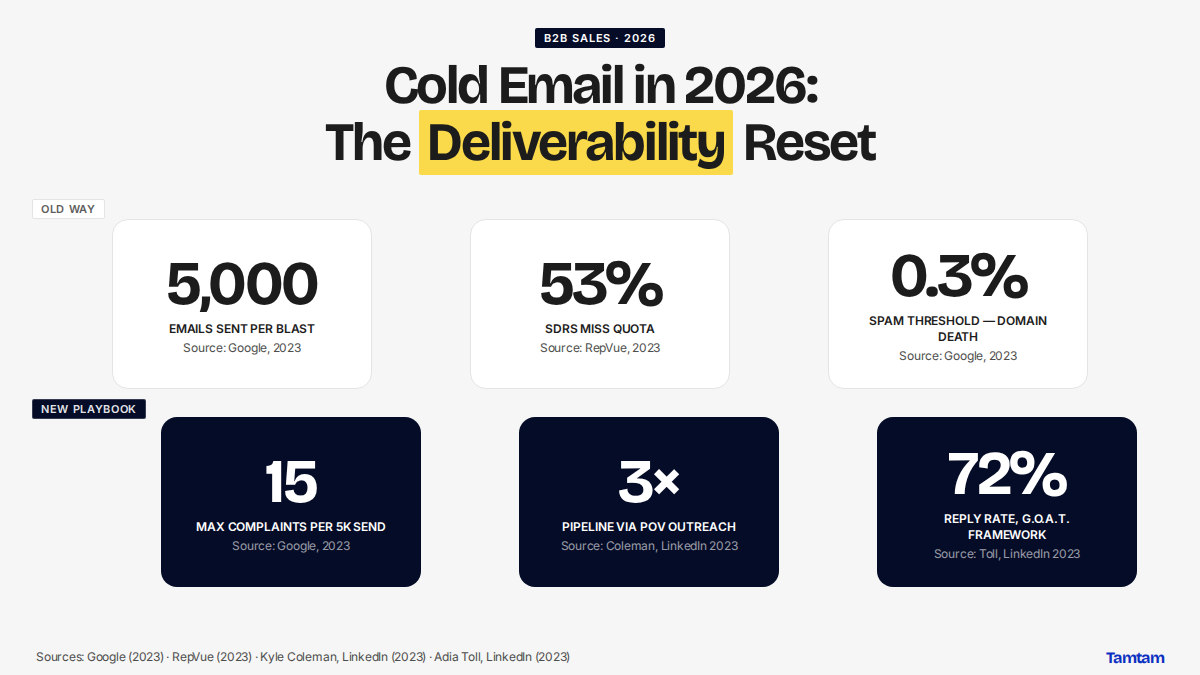
And now, Google and Yahoo have called bullshit. By enforcing a strict 0.3% spam complaint threshold, they've made the high-volume model mathematically impossible. If you send 5,000 emails, you can only afford 15 spam complaints before your domain reputation starts to tank. Your generic template just became a weapon of mass destruction aimed directly at your own pipeline.
This isn’t a small problem. It's the logical conclusion of a broken system where, according to RepVue, a staggering 53% of SDRs consistently miss quota. They were set up to fail.
Getting your domain blacklisted isn't an SDR problem or a RevOps issue. It's a leadership crisis. It’s the consequence of prioritizing activity over intelligence. The good news is, there's a way out. It requires throwing out the old playbook and building something that respects your buyer, your reps, and your own brand. Cold email is one channel inside modern B2B lead generation, and it's the one the 2024 reset hit hardest.
Here’s how to stop setting your pipeline on fire and build an outreach engine that actually works in 2026.
The first step is to stop the bleeding. And the source of the bleeding is your dashboard.
Immediately, as in right now, stop measuring and rewarding reps based on "emails sent" or "activities logged." These metrics directly incentivize the exact behavior that gets your domain blacklisted. Every time a sales leader praises a rep for hitting "200% of their activity goal," they are celebrating the guy who is actively destroying the company's ability to reach customers.
These activity dashboards are a security blanket for VPs who can’t stomach telling the board the truth: the old engine is broken. It’s easier to show a chart that goes up and to the right, even if that chart is measuring how fast you’re driving off a cliff.
Think of the "Dashboard Addict" VP. He proudly projects a board slide showing "SDR Activity: 115% of Goal!" He beams, taking credit for his team's work ethic. Meanwhile, in the real world:
The Dashboard Addict isn’t a bad person. He’s just a coward. He’s afraid to admit that the strategy he built his career on is now obsolete.
What to do instead: Shift your primary outbound metric from "activities" to "positive reply rate." A positive reply is anything that isn’t a "no," an "unsubscribe," or a spam complaint. It could be "interesting, but not right now," or "talk to my colleague Jane." This metric measures resonance, not volume. It forces your team to ask, "Is this message good enough to earn a thoughtful human response?" instead of "Did I click send enough times today?"
Common mistake to avoid: Firing SDRs for low activity numbers or blaming the RevOps team for deliverability issues. The problem isn’t the individual reps or the tech stack. The problem is the executive-level strategy and the KPIs they enforce. Don’t punish the players for a game that was rigged from the start. Change the rules of the game.
Okay, let's get the boring but essential part out of the way. You can’t win the game if the referees don't even let you on the field. Email authentication is your ticket to entry. It used to be a "nice to have" for the nerds in IT. Now, it's non-negotiable.
This isn't about gaming the system. It's about proving to mailbox providers like Google and Yahoo that you are who you say you are. Think of it like a passport. Without it, you’re not getting into the country (the inbox).
Here’s the holy trinity of email authentication you need to have in place:
SPF (Sender Policy Framework): This is a list of all the servers authorized to send email on behalf of your domain. It’s like telling the bouncer, "These people are with me." Without it, anyone can spoof your domain and send spam that looks like it came from you.
DKIM (DomainKeys Identified Mail): This adds a digital signature to every email you send. The receiving server can check this signature to verify that the email hasn’t been tampered with in transit. It’s the digital equivalent of a wax seal on a letter.
DMARC (Domain-based Message Authentication, Reporting, and Conformance): This is the boss. DMARC tells receiving servers what to do with emails that fail the SPF or DKIM checks. You can set it to p=quarantine (send to spam) or p=reject (block it completely). Implementing a DMARC policy is the single biggest signal you can send that you take email security seriously.
On top of this, you need a one-click unsubscribe link in every email and you should be using dedicated sending domains (e.g., getcompany.com instead of company.com) to isolate your cold outreach from your corporate email. Always warm these new domains up properly over several weeks before sending any real volume. And none of it matters if you're mailing a dirty list, so start by learning how to get verified emails.
This step might feel technical and annoying. Good. Do it anyway. It’s a clear, finite checklist. Completing it provides a tangible foundation for everything that follows. Skipping this step is like trying to run a marathon barefoot over broken glass. You might be tough, but you’re not going to get very far.
For too long, we’ve defined our targets with static, lifeless criteria. Your Ideal Customer Profile (ICP) is probably something like "VPs of Marketing at 500-plus-person SaaS companies in North America."
This is a graveyard of outdated information.
A job title tells you what someone does. It doesn't tell you what they need, what they’re struggling with, or whether they are even remotely open to a conversation right now. Targeting based on job titles alone is the primary cause of low-quality, low-relevance outreach.
The new playbook requires a fundamental shift: you must hunt for signals, not job titles.
A signal is an event. It’s a change in the prospect's world that indicates a high propensity to buy. A signal gives you the "why you, why now?" that turns a cold email into a timely, relevant conversation. It’s the difference between interrupting someone's day and showing up with a life raft when they’re already drowning.
Examples of powerful buying signals:
Stop building static lists of people who fit a demographic profile. Start building dynamic lists of accounts experiencing a critical event. One lead with a strong, timely signal is worth more than a hundred leads with the right job title. Your job isn’t to find everyone who could buy, but to find the few who need to buy right now.
Let’s assume you’ve fixed your tech and found a prospect with a real buying signal. You’re already ahead of 90% of your competitors. Now comes the moment of truth: the email itself.
And this is where most reps still fall flat on their face. They write emails that start with, "I saw your company was mentioned in TechCrunch, congrats!" and end with, "Do you have 15 minutes to learn how we can help you drive more revenue?"
This is garbage.
The buyer doesn't care that you can use Google. They don’t want 15 minutes to see your demo. They want insight. They want to learn something. Your email is competing with a hundred others in their inbox, and "Can I have your time?" is a losing proposition.
You need to stop asking for their time and start proving you’re worthy of it. The way you do that is by leading with a strong Point of View (POV).
A POV isn't a pitch. It’s a provocative insight about their world. It’s a diagnosis of a problem they might not even know they have. It demonstrates that you understand their industry, their challenges, and their goals better than they do.
As Kyle Coleman, former SVP of Marketing at Clari, demonstrated, shifting from generic personalization to a POV-led framework can triple your pipeline without increasing send volume. A POV email might sound like this:
See the difference? The first one is a self-serving request. The second is a valuable, challenging insight that repositions you from a vendor to a strategic advisor.
Common mistake to avoid: Confusing personalization with relevance. Personalization is "I saw on your network profile that you like the Golden State Warriors." It's often creepy and always irrelevant to their business problems. Relevance is a well-researched Point of View that connects their specific business context (the signal you found in Step 3) to a larger, strategic challenge. One is fluff. The other is value.
At this point, the objection is always the same: "This sounds great, but it doesn't scale. My reps can't spend an hour researching every single prospect."
This objection is a red herring. It’s a defense mechanism from people who are comfortable with the old volume-based model. The goal isn’t to do everything manually. The goal is to build a system that allows you to deliver high-quality, signal-based outreach efficiently.
You don’t automate the thinking. You automate the assembly.
As sales expert Adia Toll proved with her G.O.A.T. framework, you can achieve insane results (like a 72% reply rate) by first proving a conversation works manually, and then using technology to scale the proven playbook. You systematize what works; you don't use automation to find out what works.
Here’s a simple framework for scaling quality:
Identify and Cluster Your Signals: Look at your past 20 closed-won deals. What were the common triggers that kicked off the sales cycle? (New exec? Funding round? Bad earnings call?) Group these into 5 to 10 core "plays."
Build Your POV Templates: For each signal cluster, write a hyper-relevant email template based on a strong Point of View (from Step 4). This isn't a generic, fill-in-the-blank template. It's a 90% complete message tailored to a specific business scenario.
Use AI for Leverage, Not Creation: This is the key. Don't ask an AI to "write a cold email to a VP of Sales." That gives you generic garbage. Instead, use it for the non-selling work that precedes the writing. Use it to surface the signals, enrich account data with relevant news and reports, and summarize key information. The rep's job is to take that raw intelligence, select the right POV template, and add the final 10% of human insight and customization.
This approach flips the model. Instead of spending 80% of their time on mindless research and list building and 20% on writing, your reps can spend 80% of their time on high-value activities: thinking critically about the prospect’s problem, refining their POV, and engaging in meaningful conversations. The same logic powers a signal-based sales cadence across every channel, not just email.
The old way of thinking was about making the sales process faster. The new way is about making every step of it smarter. The friction isn't the manual writing anymore; it's the crushing, time-consuming effort of finding the right accounts and the right signals in the first place. Solving that research problem is the new frontier, and the teams that use technology to find the highest-quality triggers, like the platform we're building at Tamtam, are the ones who will own the next decade of sales.
Set up for you before our first call
Book a demo