May 27, 2026
The debate over what RevOps owns is a distraction from its true purpose: replacing the analog go-to-market engine with an AI-powered system of truth. This shift renders traditional gut-feel sales leadership obsolete as data-driven models consistently outperform human guesswork. The primary barrier isn't technology but the psychological resistance of leaders who distrust algorithms. As AI automates analytics and admin, the only defensible human role becomes the Human Exception—high-empathy, complex trust-building that machines can't replicate.
Let's be honest about the weekly sales forecast meeting. It's theater.
You’ve got the VP of Sales, a seasoned warrior with a Rolodex from the Clinton administration, staring at a spreadsheet. They're "interrogating" the reps, trying to sniff out the sandbaggers from the happy-ears optimists. The reps, in turn, are playing a game of poker, hedging their bets, massaging their commit numbers to keep the boss off their back for another week.
The whole ritual is based on feelings, intuition, and political maneuvering. It’s a complete waste of time. Worse, it’s a liability.
Jason Lemkin, a guy who knows a thing or two about building SaaS companies, once wrote about founders running their business on "fumes and a hockey stick projection." For decades, this was acceptable because there was no alternative. The "art" of sales was celebrated because the "science" was just too damn messy. Your experience, your gut, your ability to "read the room" were your assets.
In 2026, those assets are rounding errors.
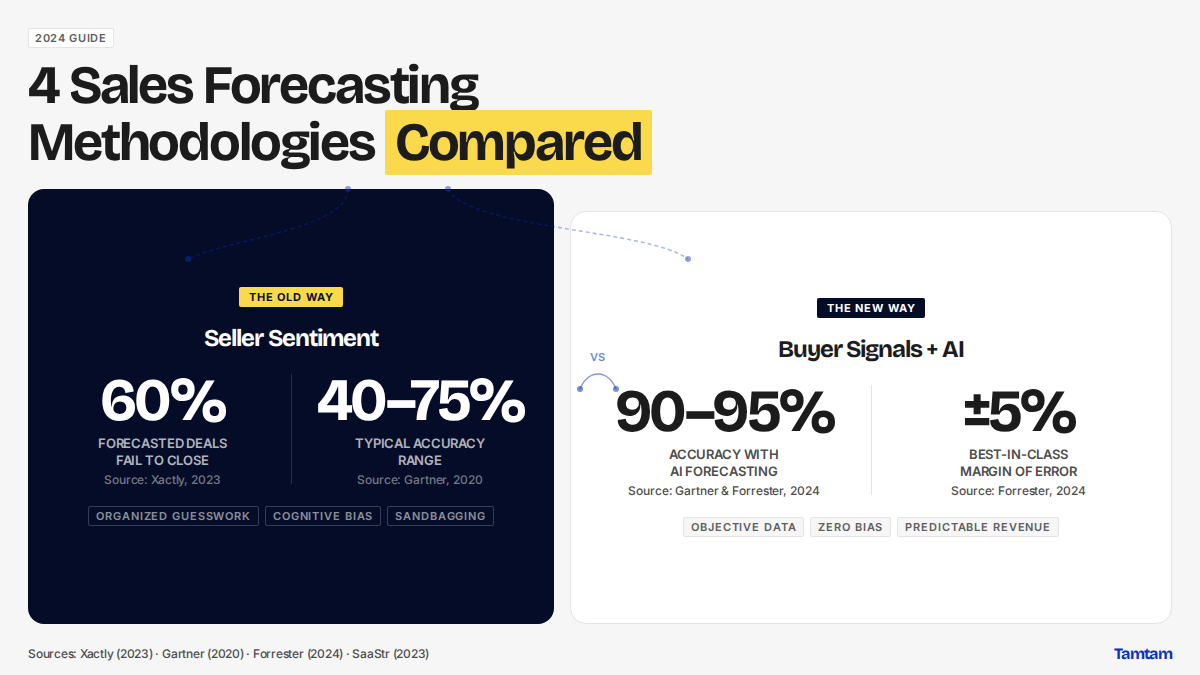
The sales forecast is no longer a human opinion problem. It's a math problem. And AI is devastatingly good at math. A well-trained model can analyze thousands of data points: deal velocity, engagement signals, buyer personas, historical close rates, the time of day an email was opened. It can then project a 12-month revenue trajectory with unnerving accuracy in about 60 seconds.
It doesn’t care if your top rep is having a bad day. It doesn’t care about the VP’s happy gut. It just sees the patterns. And the patterns are almost always more reliable than the people.
This isn’t a subtle shift. It’s an extinction event for a certain type of leader. The leader whose value is derived from their "feel for the market" is being replaced by a leader whose value is derived from their ability to architect, manage, and trust the system that provides the truth.
And the architect of that system is RevOps.
For years, we've debated what RevOps "owns." Is it the CRM? The tech stack? Sales enablement? Compensation plans?
This entire debate misses the point. It’s like arguing over who owns the bricks while someone else is designing the skyscraper.
In 2026, the primary responsibility of RevOps is to architect your company's go-to-market (GTM) brain. They are not a support function or a service desk that cleans up messy data. They are the systems engineers building the central operating system for your entire revenue engine.
Their job is to connect sales, marketing, and customer success not with weekly meetings and shared dashboards, but with a single, automated, intelligent system. This system ingests data, identifies opportunities, routes them to the right person with the right context, and predicts the outcome. It's the connective tissue that makes the entire GTM motion feel less like a clunky assembly line and more like a single, autonomous organism.
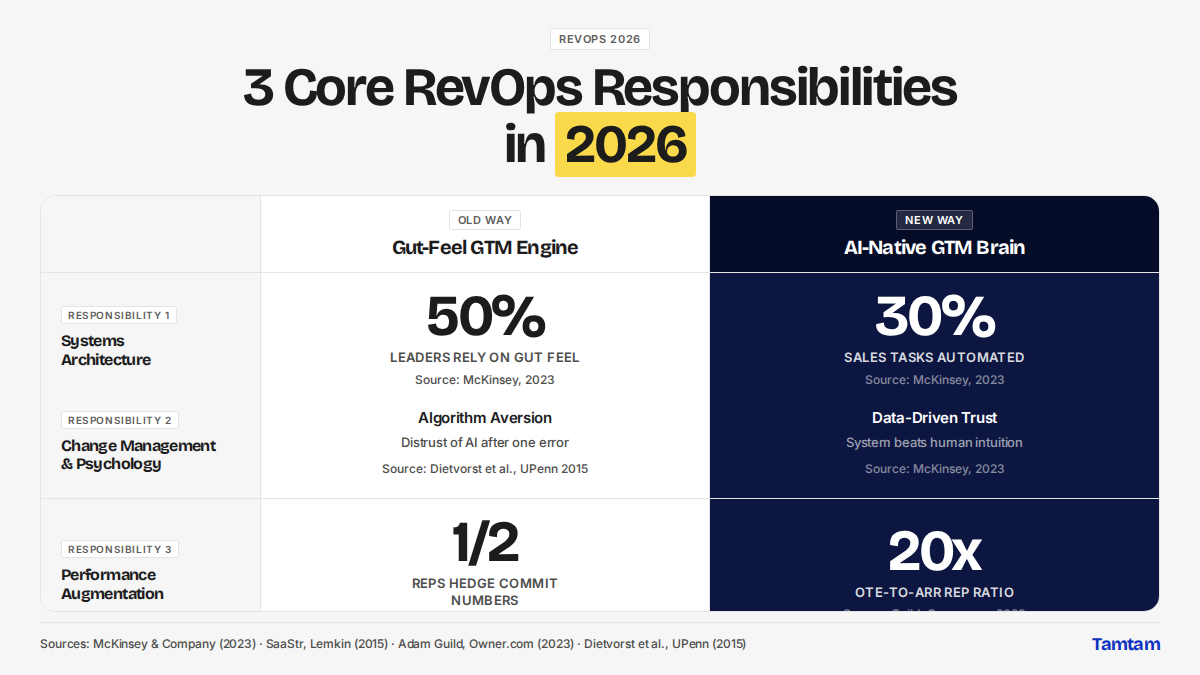
This sounds like some far-off sci-fi concept, but the economic proof is already here. A 2023 analysis by McKinsey found that generative AI has the potential to automate up to 30 percent of sales-related work tasks. Think about that. A third of the stuff that clogs up a sales team's calendar: pre-call research, summarizing notes, drafting follow-up emails, updating the CRM. It's all on the chopping block.
This isn't about firing 30% of your team. It's about reallocating 30% of their time from low-value administrative crap to high-value selling. Companies achieve this by automating the bullshit.
The manual data entry, the second-guessing, the forecast theater, the turf wars between departments. All of it gets systematically replaced by intelligent workflows. In these leaner, more efficient GTM models, you see a higher concentration of RevOps talent. The company is investing not in more bodies to turn the crank, but in more engineers to build a better crank.
This is the first core responsibility of future-state RevOps: Systems Architecture. They are no longer just administrators of the tech stack. They are the designers of the automated revenue factory. Their deliverable isn't a report; it's a more efficient, predictable, and intelligent GTM machine.
If this transition is so obvious and economically superior, why isn't everyone doing it? Why are so many sales floors still run like it's 2006?
The answer has nothing to do with technology and everything to do with psychology. Your brain is actively working against you.
Two cognitive biases are at war with every RevOps leader trying to build a modern GTM engine: Algorithm Aversion and the Illusion of Control.
Algorithm Aversion is our completely irrational tendency to distrust algorithms more than humans. Research from the University of Pennsylvania shows it clearly: we forgive humans for making mistakes, but we lose all faith in an algorithm if it screws up even once.
Think about it. A sales rep can whiff on their forecast for three straight quarters, and the response is, "Well, that's sales for you. Keep swinging." But if the AI forecasting model is off by 5%, the VP slams their laptop shut and declares, "See! I told you this thing doesn't work. My gut is better."
This is insane. Your gut is not better. Your gut is a soup of biases, emotions, and the burrito you had for lunch. But we trust it because it's our soup.
This leads to the second, more comical bias: the Illusion of Control. This is the VP who spends hours tweaking numbers in a spreadsheet, changing a deal's probability from 60% to 65% based on a "good call." They feel like they are steering the ship, but they're just rearranging deck chairs. They're a medieval alchemist, mixing potions and chanting incantations, convinced their subjective meddling is adding value. In reality, they are just introducing noise into the system.
The second core responsibility of RevOps is therefore Change Management & Psychology. It's not enough to build the system. You have to be a corporate therapist, patiently explaining to legacy leaders that their desire for control is actually the biggest risk to the business. You have to prove, with data, that the system is more reliable than their intuition. This is less about technical skill and more about managing human fear and ego.
So if the AI is running the forecast, analyzing the data, and automating the workflows, what the hell is left for humans to do?
This is where it gets good.
By automating all the logical, analytical, and administrative work, you free up your best people to focus on the one thing the machines can't replicate: high-stakes, trust-based, emotionally intelligent human interaction.
This is the Human Exception.
Look at a company like Owner.com. Their CEO, Adam Guild, has spoken about building a GTM motion where reps can have a 20x ratio of on-target earnings to annual recurring revenue. That number is almost unbelievable. They did it by ruthlessly stripping away every non-selling activity from their reps. The reps don't prospect. They don't do admin. They don't update the CRM. They just talk to qualified buyers who are ready to have a conversation.
Their job isn't to manage a pipeline. Their job is to build trust.
The skill set required for this is not pipeline management; it's what former FBI hostage negotiator Chris Voss calls "Tactical Empathy." It's the ability to listen, to understand the underlying emotional drivers of a decision, to build rapport, and to guide a complex conversation to a mutually beneficial outcome.
This becomes the third core responsibility for RevOps in 2026: Performance Augmentation. Their role shifts from enforcing process compliance to designing systems that make humans better at being human. This means serving up the right piece of context right before a call. It means identifying the conversational patterns of top performers and turning them into prompts for the rest of the team. It means using AI not to replace the rep, but to give them superpowers.
The goal is to get every rep to operate like your absolute best one. Not by forcing them to follow a rigid script, but by augmenting their natural skills with machine intelligence. The system does the math so the human can create the magic.
So the system does the math, and the human creates the magic. But what if the math could also point you to where the magic is most likely to happen? The ultimate job of this GTM brain isn't just to optimize the machine, but to aim it. It's about engineering a system that doesn't just process leads faster but identifies the right ones to begin with, based on the specific buying signals that mirror your best customers. When RevOps builds this kind of intelligence at the source, your reps aren't just augmented with superpowers; they're teleported directly to the final boss battle. It's that focus on starting with the right list that drove us to build Tamtam.
Set up for you before our first call
Book a demo