June 10, 2026
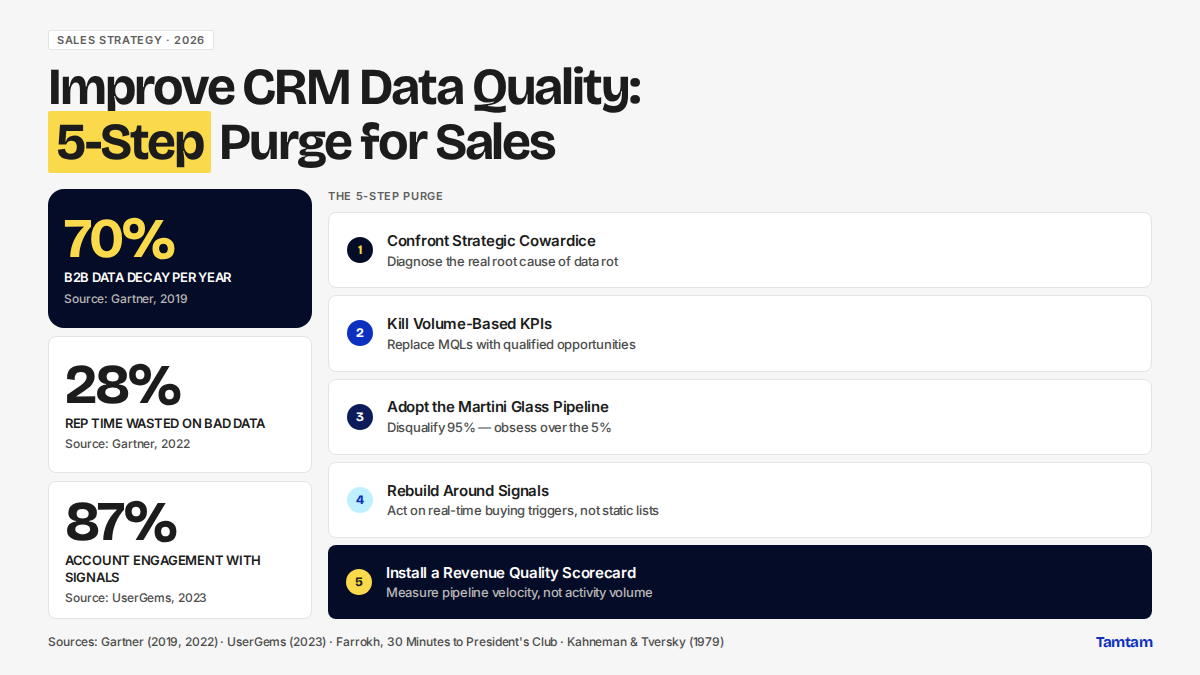
Your CRM is a data landfill because your sales strategy is based on fear, not facts. With B2B contact data decaying up to 70% annually, sales reps waste over a quarter of their time chasing ghosts in a bloated database. Forget buying more cleanup tools; the only real fix is a strategic purge. This guide explains how to kill volume-based KPIs, adopt a ruthless "Martini Glass" pipeline, and rebuild your GTM around real-time buying signals to close more deals.
Let's get one thing straight. Your CRM data doesn't just "go bad." It rots. People change jobs, companies get acquired, priorities shift. According to Gartner, B2B data decays at a staggering rate of up to 70.3% per year. Think about that. By this time next year, 7 out of 10 contacts in your CRM could be completely useless.
This isn't just a messy database problem. It's a multi-million dollar catastrophe. Another Gartner study found that sales reps waste 28% of their time on random, non-value-added tasks, much of it driven by bad data. That's more than a full day every week, per rep, spent chasing ghosts.
So what does everyone do? They buy more data hygiene tools. They schedule quarterly "CRM cleanup" sprints. They hire more ops people to be digital janitors.
They're treating a terminal illness with band-aids.
A rotting CRM is a symptom of a much deeper disease: strategic cowardice. You're hoarding contacts like a doomsday prepper hoards canned beans because you're terrified of making a real choice. You're afraid to commit to a niche, afraid to disqualify a lead, afraid to tell a prospect "no."
Your CRM isn't a technology problem. It's a psychological one. And the only cure is a strategic purge. Here's how to do it.
Before you delete a single contact, you have to look in the mirror and diagnose the root cause of the mess. Your bloated CRM is a psychological safety blanket, and everyone from the C-suite to the SDRs is clinging to it for dear life.
The problem starts at the top. Leadership is terrified of committing to a narrow Ideal Customer Profile (ICP). They suffer from what psychologists Daniel Kahneman and Amos Tversky called "loss aversion". Their research found that the pain of losing something is twice as powerful as the pleasure of gaining something equivalent.
For your CEO, the pain of "losing" a potential market segment feels far worse than the potential pleasure of absolutely dominating a smaller, more focused niche. So they demand a massive Total Addressable Market (TAM). They want to "keep options open." The result: your sales team gets a list of 50,000 "potential" customers that is functionally useless, turning your CRM into a graveyard of good intentions.
This fear trickles down to the reps. They hang onto dead-end deals for months, terrified of marking them "Closed Lost." This is the "sunk cost fallacy" in action. They've already invested time and effort, so admitting defeat feels like a personal failure. It’s easier to let the opportunity fester in the pipeline, a zombie clogging up the system, than to kill it and face the emptiness of a smaller pipeline.
What to do: Hold a leadership meeting and put the psychology on the table. Ask the hard questions:
The common mistake: Blaming your reps for being "lazy" about CRM hygiene. They aren't lazy. They are rational actors responding to the incentives you've created. The fear, and therefore the problem, starts at the top. The moment you blame the reps, you've lost. You're treating the symptom, not the disease.
For the last two decades, a single book has defined modern B2B sales: Predictable Revenue. It was revolutionary for its time, but it has created a monster we now live with every day: the MQL hamster wheel.
Your SDRs are paid to look busy. Their compensation is tied to vanity metrics like dials, emails sent, and Marketing Qualified Leads (MQLs) generated. This system forces them to hoard thousands of unqualified contacts in the CRM. How else can they hit their 100-dials-a-day target? They need a massive, low-quality list to burn through.
They are incentivized to create noise, not revenue.
As Jon Miller, co-founder of Marketo and Engagio, wrote, the problem with the MQL model is that "the 1% of the people who are actually ready to buy are buried in the 99% of the people who aren’t".
Imagine celebrating a record month with 10,000 new MQLs. Your marketing team gets a bonus. The board is thrilled. But your sales team’s win rate plummets. Why? Because your reps are so busy sifting through the 9,900 pieces of junk that they miss the 100 golden tickets. They're drowning in "opportunity" and dying of thirst for actual revenue.
What to do: Kill your volume-based KPIs. All of them.
The common mistake: Trying to "fix" the MQL problem by tiering them. Creating MQL-A, MQL-B, and MQL-C categories is just organizing the garbage into different piles. It doesn't solve the fundamental problem: you're still measuring your team on their ability to generate noise. You have to kill the concept entirely.
Look at your pipeline report. Is it a big, fat cylinder, with tons of deals stuck in every stage for months on end? If so, you're doing it wrong.
A healthy pipeline is not a cylinder. It’s a Martini Glass.
This model, popularized by sales leaders like Armand Farrokh, visualizes the ideal flow of opportunities.
The key to the Martini Glass is the speed and ruthlessness with which you move from the bowl to the stem. You must disqualify 95% of your "opportunities" as fast as humanly possible to give the top 5% the intense focus they need to close.
Top enterprise reps don't juggle 50 active deals. They obsess over the 5 that will get them to President's Club. They wake up every morning and ask one question: "How am I breaking into one of my top five target accounts today?" This is the exact opposite of data hoarding. It's strategic, focused execution.
What to do: Implement a "kill criteria" for your pipeline. Any deal that doesn't meet this strict, non-negotiable set of qualifications gets disqualified. Immediately. No exceptions.
If the answer to any of these is "no," kill the deal. Push it back into a nurture sequence and get it out of your active pipeline. Free up your rep's time and attention to focus on the deals that have momentum.
The common mistake: Measuring pipeline purely by its total dollar value. A $10 million pipeline full of zombie deals that haven't moved in 90 days is worth less than a $1 million pipeline of deals with real, tangible momentum. Stop celebrating pipeline size and start celebrating pipeline velocity.
The old way of selling was based on static data. You bought a list of companies that fit your ICP based on firmographics: industry, employee count, revenue. Then you hammered that list for a year. This is why your CRM is rotting. The list is dead the moment you buy it.
The new way of selling is dynamic. It's built around signals. You stop asking, "Who is in our CRM?" and start asking a much more powerful question: "Who is showing they have a problem we can solve right now?"
This is the shift to signal-based selling.
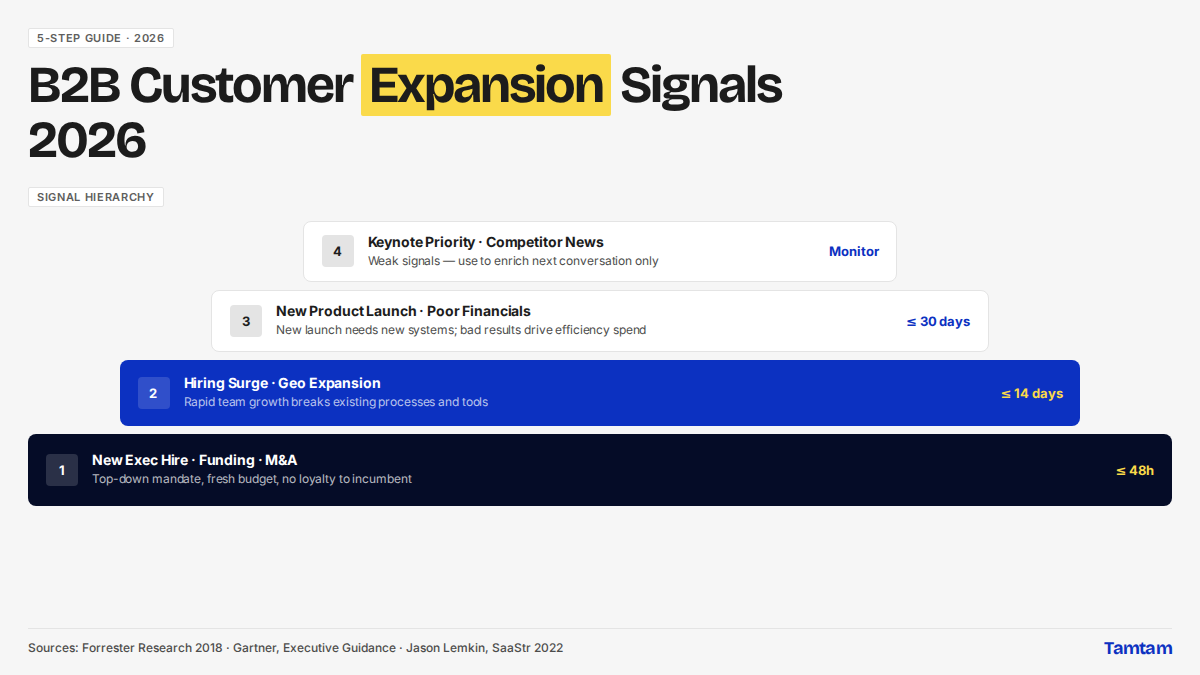
A contact's email address might decay over the course of a year. But a high-intent buying signal, like a key executive visiting your pricing page or their company posting a job for a "Director of a problem-you-solve," decays in hours. Your entire go-to-market motion needs to be rebuilt for speed and precision, not volume and storage.
This isn't some futuristic fantasy. It's how the best companies operate today.
They aren't just working harder. They're working smarter, using timing as their primary weapon.
What to do: Brainstorm the top 5 to 10 buying signals that indicate an account is ready to talk. Go beyond the obvious "visited our website." Think about the real-world triggers:
Then, build a process to find and act on these signals within 24 hours.
The common mistake: Thinking "intent data" is just another list to upload to your CRM. Buying a list of companies "in-market" for your category is still static thinking. True signal-based selling requires an automated, real-time workflow to act on a specific event within its short window of relevance. If you're not acting on the signal the day it happens, you've already lost.
You can't manage what you don't measure. Now that you've killed the old, toxic KPIs, you need to replace them with a new scorecard that reflects this smarter, more focused strategy. Your dashboard shouldn't just show activity; it should show progress and expose the hidden costs of your old, cowardly ways.
First, make the pain of bad data impossible to ignore. Calculate your "Cowardice Tax." It's a simple but horrifying formula:
(28% of a rep's time is wasted) x (2,080 annual work hours) = 582.4 wasted hours/year/rep
582 Wasted Hours x (Number of Reps) x (Fully Loaded Hourly Cost/Rep) = Your Annual Cowardice Tax
When you put a seven-figure number on the problem, people suddenly start paying attention. This isn't a "data hygiene" issue anymore. It's a massive financial drain that is strangling your growth.
What to do: Build a new dashboard with metrics that track efficiency and quality, not just volume.
The common mistake: Not having a process to monitor data decay itself. Your CRM shouldn't just be cleaned once a quarter. It should be getting progressively fresher every single month because your entire strategy is now focused on timely, relevant engagement. If your "90-day engagement" metric is flat or declining, your new strategy isn't working.
Stop being a data janitor and start being a revenue sniper. A clean CRM isn't the goal; it's the byproduct of a focused, high-conviction sales strategy. The problem is, you can't execute this strategy with last year's contact database. Winning requires a system that constantly researches your market for those fleeting buying triggers, turning a dead list into a live one. It's about replacing data hoarding with perfect timing. That’s the entire philosophy behind what we’re building at Tamtam.
Set up for you before our first call
Book a demo