May 22, 2026
Your lead list is the root of your sales problem. That massive, static database you bought is a graveyard of contacts who are out of market, have changed jobs, or simply don't want to hear from you. The predictable revenue model built on list volume is obsolete, driven by an addiction to vanity metrics. To succeed in 2026, you must abandon this approach and build dynamic lists based on real-time buying signals, shifting from buying contacts to hunting for context.
You’ve seen the dashboard. It’s glowing. Dials are up. Emails sent are through the roof. The activity chart for that massive new list you bought, sourced from the usual B2B data providers, looks like a rocket launch. Everything, according to the numbers you obsess over, is going according to plan.
So why does your pipeline feel so anemic? Why are your reps burning out chasing ghosts? And why does every deal feel like a minor miracle instead of the result of a well-oiled machine?
Because the foundation is rotten. The entire philosophy your sales machine was built on, the belief that a bigger list is a better list, is a relic from a bygone era. And the metrics you worship are lying to you.
Welcome to the new reality of B2B list building. It’s messy, it’s unpredictable, and it will punish anyone who refuses to adapt. Here are the brutal truths you need to accept if you want to survive, let alone thrive, in 2026.
For the last twenty years, B2B sales has been dominated by a simple, seductive equation: More Contacts = More Revenue.
This was the gospel of the "predictable revenue" era. Buy the biggest database you can afford, slice it up by title and industry, and have SDRs hammer it until something gives. It was beautifully simple. It was beautifully controllable.
And now, it’s beautifully obsolete.
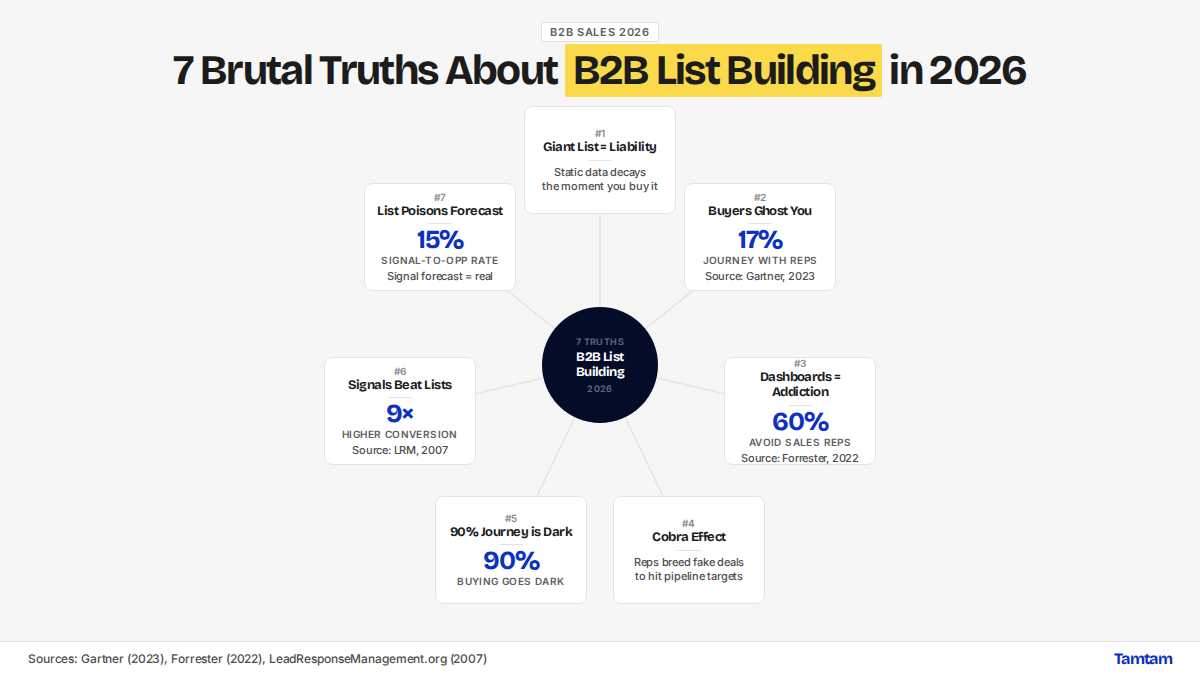
That model assumed the list was a stable asset. It's not. It's a rapidly depreciating liability. B2B data decays at a horrifying rate. People change jobs, companies get acquired, priorities shift. A significant chunk of your expensive list is irrelevant the moment you buy it. Continuing to hammer that static list with brute-force outreach isn't just inefficient. It's brand suicide. Every irrelevant email you send teaches a potential future customer that you don't do your homework and should be ignored.
Your giant list isn't an asset that fuels growth. It's a boat anchor that encourages bad habits and actively damages your reputation in the market you're trying to win.
The reason your volume-based outreach is failing is simple: the buyer seized control.
According to Gartner's latest analysis, B2B buyers still spend only 17% of their total purchase journey meeting with potential suppliers. When considering multiple suppliers, that means any single sales rep gets a measly 5% of the customer’s time. The rest of the journey, a whopping 83% of it, happens without you. They’re reading reviews, talking to peers, and forming opinions long before your SDR's email about "circling back" hits their inbox.
Worse, Forrester research shows that 60% of buyers prefer not to interact with a sales rep at all. Let that sink in. The majority of the people on your master lead list actively want to avoid the very people you’re paying to harass them.
So what does this mean for your list-building strategy? It means every name on it represents a person who is actively building an immunity to your outreach. Your list isn't just a collection of potential buyers; it's a roster of people who are getting better and better at ignoring you. The more you blast, the stronger their defenses become.
If we all know, deep down, that blasting 500 emails a day to a cold, static list is a fool's errand, why do we keep doing it? Why do sales leaders, people who are otherwise incredibly smart and driven, cling to this broken model?
One simple reason: we are psychologically addicted to the illusion of control.
When you start with a low-quality list, the only thing you can measure is activity. You can't measure quality because there is none. So you fall back on the metrics that are easy to track: dials, emails, meetings booked. They are the perfect drug for an anxious manager. They make a dashboard look productive and give you a comforting, tangible thing to point at when your boss asks, "What's the team doing?"
"They're working the list! 500 dials a day, each!"
It feels good. It feels like you're in command. But you’re not steering the ship; you're just furiously polishing the brass while it sails toward an iceberg. The bad list creates the need for vanity metrics, and the vanity metrics justify the existence of the bad list. It's a vicious cycle.
This addiction to vanity metrics, fueled by a poor-quality list, creates a toxic system of perverse incentives. It’s a classic case of the Cobra Effect. During British rule in India, the government, concerned about the number of venomous cobras in Delhi, offered a bounty for every dead cobra. It worked, for a while. Then, enterprising locals started breeding cobras just to kill them and collect the bounty. When the government scrapped the program, the breeders released their now-worthless snakes. The wild cobra population exploded.
The policy designed to solve the problem made it infinitely worse. Sound familiar?
Think about the ubiquitous "4x pipeline coverage" rule in SaaS. An AE has a $200k quarterly quota, so they are told they must have $800k in their pipeline at all times. What does a rational AE with a list of unresponsive leads do? They stop focusing on finding real deals and start manufacturing fake ones, just to hit the magic 4x number. They pull names from the static database, have a flimsy discovery call, and slap an optimistic deal size on it.
They start breeding cobras. The raw material for these junk opportunities is your low-quality list, and the incentive is your flawed metric. The system you designed to ensure revenue ends up destroying forecast accuracy and wasting everyone's time on deals that were never going to close.
So where did the buyers go? If they’re not on your list and answering your calls, did they just vanish? No. They just went dark.
The most critical conversations, the ones that actually lead to a purchase, are now happening in places your contact database can't see. They’re happening in private professional communities, on social network DMs, and through peer recommendations. Sales thought leader Chris Walker calls this "Dark Social." It's the invisible universe of influence that shapes buying decisions.
Your static list knows a name, a title, and a company. It's a snapshot of a person's professional identity from six months ago. But it's completely blind to the fact that this person just asked for vendor recommendations in a private group. It has no idea their new CEO just announced a company-wide initiative on an earnings call that aligns perfectly with your product. Your list is ignorant of every single important event that happens in the present.
Relying on a static list for outreach is like trying to navigate a city using a map from 1985. The streets have changed, the destinations are different, and you're going to end up lost.
If you can't force a buyer into a sales cycle, and your list can't see the real buying journey, you have two choices. You can either double down on the old playbook, buy more stale data, and scream louder into the void. Or you can do something radical.
You can let go.
You can accept that you can only be there, ready and relevant, when a buyer decides to enter a cycle. This requires a fundamental shift: from building static lists to monitoring for dynamic signals.
A list is a collection of names based on who someone was. A signal is a behavioral trigger that indicates who someone is becoming.
Signals can be anything: a target account hires a new VP of Engineering, a company posts five new sales jobs that mention a competitor's CRM, or an annual report highlights "cost optimization" as a key initiative. This changes the entire game. Instead of asking "Who should we sell to?" you start asking "Who is ready to buy now, and why?"
This philosophy must extend to how you distribute opportunities. The "Round-Robin Fallacy" of giving a hot, signal-driven lead to whichever rep is next in line is madness. A hot lead is a five-alarm fire. It gets routed instantly to your best reps. This isn't some new discovery. A landmark study by LeadResponseManagement.org found that reps who follow up on a web lead within five minutes are nine times more likely to convert them. It's a simple, brutal law of physics for sales: momentum dies fast. A signal-based list is built on timing, and wasting that timing is unforgivable.
At this point, every CFO and CRO reading this is getting hives. "This is chaos! How do we forecast a business based on random signals? I need a predictable, scalable model!"
This is fear talking. A signal-based approach isn't about passivity; it's about precision. Your forecast is currently poisoned because it’s based on the wrong variable: your team's activity against a bad list. It’s a classic garbage-in, garbage-out scenario.
You can absolutely forecast with signals. You just have to change what you measure. Stop forecasting based on inputs (dials against the static list) and start forecasting based on the historical conversion rates of your outputs (signal-to-meeting, meeting-to-opportunity, opportunity-to-close). Your forecast becomes: "We typically generate 200 high-intent signals per month. Historically, our reps convert these to a qualified opportunity at a rate of 15%. Our average deal size is X. Therefore, our forecast is Z."
This is more accurate because it's based on real buyer behavior, not your team's busywork. To keep the system honest, every KPI needs a "guardian counter-metric."
This forces your team to optimize for revenue, not just for looking busy. It redefines the SDR role from a list-worker to a detective who hunts for signals and engages with the context that earns a conversation. The quality of your list becomes the number one driver of forecast accuracy.
The brutal truth is that building a genuinely high-quality lead list, one where every name has a clear reason and precise timing for outreach, is the hardest part of modern sales. It requires trading the comforting lie of a massive, static database for the messy reality of monitoring your entire market for faint whispers of intent. This is the real work. It’s the shift from managing activity to orchestrating opportunity. It’s not about finding a bigger hammer; it’s about knowing exactly when and where to tap. Frankly, it's the entire reason a platform like Tamtam has to exist in the first place.
Set up for you before our first call
Book a demo