Discovery call
A discovery call is the initial conversation between a sales representative and a qualified prospect, focused on understanding their needs and business challenges.
A discovery call is the first significant, two-way conversation between a sales representative and a potential customer. Its primary purpose is to diagnose a prospect’s situation, challenges, and goals, not to pitch a product. The insights gathered during this call determine whether the prospect is a good fit for the company's solution and inform the entire subsequent sales cycle, laying the foundation for a relevant demo or proposal.
Key Objectives
The main goal of a discovery call is lead qualification, where a representative assesses the prospect’s fit against the company's Ideal Customer Profile (ICP). This involves confirming that a real business problem exists that the solution can solve and exploring its quantifiable impact. A second objective is to understand the buyer's internal world by identifying members of the buying committee, their roles, and the company's typical purchasing process and timeline. Throughout the conversation, the representative works to establish trust and position themself as a credible advisor.
Structure and Next Steps
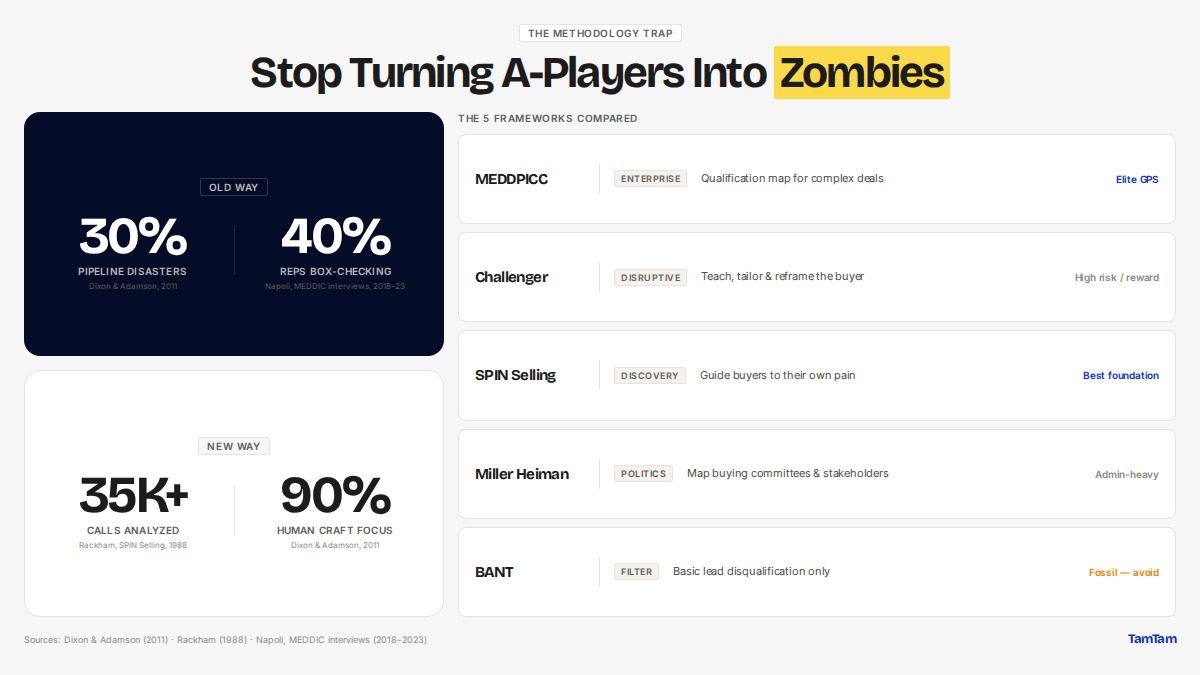
An effective discovery call follows a structured agenda. It typically begins with building rapport and aligning on the call’s purpose. The majority of the conversation is dedicated to open-ended questioning, often guided by a methodology like SPIN Selling to explore the prospect’s situation and uncover their underlying needs. Before concluding, the representative summarizes the key challenges discussed to confirm understanding. The call ends by establishing clear, mutually agreed-upon next steps, such as scheduling a tailored product demo. A successful discovery call converts a prospect into a Sales Qualified Lead (SQL), officially entering them into the sales pipeline.
Also known as: disco call, qualification call
See how Tamtam handles outbound & pipeline generation in practice.
Learn more →