May 26, 2026
Chasing database size is a trap that kills European outbound sales. High bounce rates from cheap, US-centric lists will get your domain blacklisted, and the real cost is the 27% of SDR time wasted on bad data. For EU prospecting, prioritizing GDPR-native tools like Cognism, Dropcontact, and Kaspr with high, verified match rates is critical to protect your domain and pipeline. Budget options like Apollo.io require a separate, robust verification tool to be effective in Europe.
We live and breathe B2B sales in Europe every single day. We’ve managed the teams, paid for the tools, and cleaned up the CRMs after a cheap data provider torched a sales pipeline. We’ve seen firsthand how the wrong choice here doesn’t just waste money on a software license: it burns your reps, kills your domain reputation, and makes hitting quota nearly impossible. This guide is the advice we wish we’d had. Finding emails is one piece of a broader data enrichment strategy; here we zoom in on the tools that actually work in Europe.
Apollo.io is the all-in-one sales platform that offers a massive database, sequencing, and analytics for a price that makes you do a double-take. It's often the first tool teams buy when they decide to get serious about outbound.
Best for: Teams on a tight budget who need an all-in-one platform and are willing to accept the hidden cost: investing in a separate, robust verification tool for every EU list they pull.
Strengths: The price-to-volume ratio is, frankly, unbeatable. For less than $100 a month, you get access to a database of a claimed "275 million contacts" and a built-in sequencer. For a US-based team running a high-volume, low-touch sales motion, it’s an incredibly compelling package. The user interface is clean, and the workflow tools get the job done.
Weaknesses: That massive database is Apollo’s biggest strength and its greatest weakness, especially in Europe. The data is overwhelmingly US-centric. When you pull lists for France, Germany, or the Nordics, the accuracy plummets. Bounce rates can easily climb above 10-15%, which is high enough to get your domain flagged by Google and Microsoft. Using Apollo for European outbound without a secondary, high-quality email verifier is like driving without insurance. You're also on your own for GDPR compliance, putting the legal burden squarely on your shoulders.
Verdict: Apollo is a powerful tool for the price, but treating it as a reliable source of European contact data out of the box is an act of self-sabotage.
Cognism is the premium, enterprise-grade sales intelligence platform that focuses on data quality, global coverage (with a strong EU focus), and strict compliance. It’s the tool you buy when the cost of bad data becomes more painful than the cost of a premium software license.
Best for: Enterprise and mid-market teams with a significant budget who need the highest quality, human-verified European data and mobile numbers, and for whom compliance is non-negotiable.
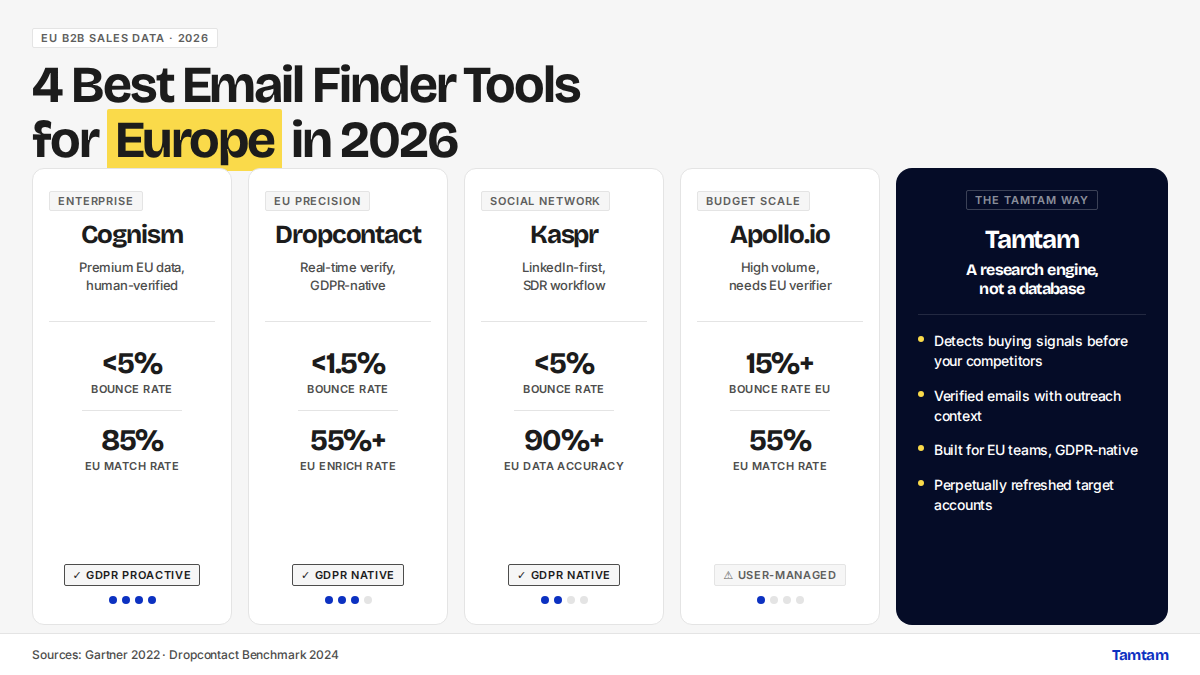
Strengths: Cognism’s European dataset is one of the best on the market. They invest heavily in compliance, proactively notifying European contacts to adhere to Article 14 of GDPR, a step most others skip. Their real differentiator is "Diamond Data," a service where their research team manually verifies mobile numbers, giving your reps a direct line to decision-makers. The result is consistently low bounce rates (under 5%) and data you can actually trust to build a pipeline on.
Weaknesses: This level of quality and compliance comes at a steep price. Contracts typically start in the five-figure range annually ($15,000+), putting it out of reach for most startups and small businesses. For teams that don't need hyper-accurate mobile numbers or whose primary market isn't Europe, the premium price tag can feel like overkill.
Verdict: Cognism is an expensive but powerful investment in data quality that pays for itself by eliminating the massive hidden costs of bad data.
Dropcontact is a French-built, GDPR-native tool that flips the traditional data model on its head. Instead of maintaining a massive, static database that slowly decays, it finds and verifies emails in real-time using a proprietary waterfall of algorithms.
Best for: Modern GTM teams focused on the French and broader EU markets who prioritize deliverability and data accuracy above all else.
Strengths: Because it doesn't rely on a stored database, Dropcontact's data is fresh. It boasts an impressively low bounce rate of less than 1.5%. A (clearly biased, but still interesting) benchmark study by Dropcontact themselves showed an effective enrichment rate of nearly 55% across various European datasets, climbing much higher for French contacts specifically. It’s built from the ground up to be GDPR compliant, which isn't just a legal checkbox. It’s a technical architecture that results in higher-quality data for the European market. It also cleans and enriches your existing CRM data, which is a massive bonus.
Weaknesses: The flip side of its real-time, verification-first approach is that its raw "find" rate can be lower than scrapers like Apollo. If a valid, deliverable email can't be found algorithmically, it won't return one. This is a good thing for your domain, but it can frustrate reps accustomed to getting a result, any result, for every contact. Its North American data isn't as robust as its EU coverage.
Verdict: For teams who understand that a smaller list of verified contacts is infinitely more valuable than a giant list of bad ones, Dropcontact is the smartest choice for EU prospecting.
Kaspr is a one-trick pony, but it’s a hell of a trick. It’s a French-built tool designed to do one thing perfectly: pull verified contact info directly from the professional social network where your reps are already living.
Best for: SDR teams whose primary prospecting workflow is built around searching and building lists on specific professional social networks.
Strengths: Kaspr’s genius is its simplicity. Its Chrome extension lives inside the most popular professional network, and it just works. The integration is clean, fast, and removes every ounce of friction from the prospecting workflow. They claim over 90% accuracy on European data, and unlike most marketing fluff, this claim actually holds up in the trenches. And because it’s a French company, GDPR compliance isn't some checkbox they ticked; it's fundamental to how the tool operates. For reps building lists on that network, it feels like magic.
Weaknesses: The flip side of being a one-trick pony is that it only knows one trick. If your prospecting workflow doesn't start and end on that one social network, Kaspr is basically useless. It doesn't have the broad database of a Cognism or the CRM enrichment power of a Dropcontact. And its North American data is an afterthought.
Verdict: Kaspr is the definition of a specialist tool. If your team lives on that one social network, buy it yesterday. If they don't, don't even book a demo.
| Tool | Best For | EU/France Match Rate (Effective) | Typical Bounce Rate | GDPR Compliance Approach | Price Point | Key Weakness |
|---|---|---|---|---|---|---|
| Apollo.io | Budget-conscious, all-in-one platform seekers | Lower (40-55%), requires verification | High (5-15%+) | User-managed | $ | Very poor EU data quality out of the box |
| Cognism | Enterprise teams needing premium, compliant data | High (70-85%) | Very Low (<5%) | Proactive (Article 14) | $$$$ | Prohibitively expensive for smaller teams |
| Dropcontact | EU-focused teams prioritizing accuracy | High (55-94%) | Extremely Low (<1.5%) | GDPR-native (no database) | $$$ | Lower "find rate" due to strict verification |
| Kaspr | Social network-centric SDRs | High (75-90%) | Low (<5%) | GDPR-native | $$ | Limited effectiveness outside of its core network |
Forget the vanity metric of "275 million contacts." It's a cognitive bias designed to make you feel like you're getting a great deal. The number is irrelevant if 60% of the European contacts are wrong and bounce.
Instead, ask these three questions:
1. What is my real cost tolerance? Are you willing to pay with your software budget, or with your SDRs' time and your domain's reputation? A cheap tool isn't cheap when you factor in the cost of bad data. Gartner research suggests sales reps waste 27% of their time on bad data. For a 10-person SDR team with an average loaded cost of €85,000 per rep, that’s €229,500 per year pissed away on cleaning lists, dealing with bounces, and chasing ghosts. Suddenly, a €15,000 Cognism license doesn't seem so expensive, does it?
2. Where is my primary market? This should be obvious, but people get it wrong all the time. If 80% or more of your target market is in France and the EU, buying a US-centric data tool is madness. A GDPR-native tool like Dropcontact or Kaspr isn't just a compliance feature. Their entire architecture is designed for the nuances of the European market, which leads to better data. If you're 80% US-focused, Apollo might work, but you absolutely must bolt on a separate verification process for your European lists.
3. What is my team's workflow? Tools work best when they fit into an existing process. Do your reps live on a social network all day building lists? Kaspr is a no-brainer. Do they need an all-in-one system to manage data, sequencing, and calls? Apollo offers that (with the data quality caveats). Are they running high-touch, account-based plays that require perfect, human-verified mobile numbers? That's Cognism’s sweet spot. Are you a modern team that wants to enrich your CRM with fresh, verified data in real-time? Dropcontact is built for that.
This entire comparison operates on a critical assumption: that you already know exactly who you should be contacting. The tools above are specialists in finding an email for a name on a list. But what if the list itself is the entire source of your problems? What if the real bottleneck isn't the contact info, but the timing and relevance of your outreach?
Tamtam is built for European B2B sales teams who are tired of this disconnect. It’s for teams who understand that the most valuable asset isn't a bigger database, but knowing the precise moment to reach out with a message that actually lands. It starts by analyzing your past successes to identify the unique combination of buying triggers your best customers share. Then, it continuously scours your total addressable market for those same signals. When a company posts a specific job, an executive mentions a key initiative in a podcast, or a 10-K reveals a new strategic direction, the platform flags the opportunity. It then surfaces the right people to contact, complete with verified emails and the specific context for your outreach.
This obsession with timing isn't for everyone. If your GTM strategy is pure volume, designed to carpet-bomb an entire industry and pray for a response, stick with Apollo and budget for a new domain every six months. The focused research would just slow you down. If you’re a massive enterprise where procurement demands one global vendor to rule them all, Cognism’s all-encompassing contract is your path of least resistance.
Tamtam’s angle is different. It’s not a database you search; it's a research engine that delivers a perpetually refreshed list of accounts that have a reason to talk to you now. The verified email is just the final step, not the starting point. More on the approach at Tamtam.
The uncomfortable truth is that there's no "cheap" way to get good European data. You either pay for a premium tool upfront, or you pay for it later with burned-out SDRs, a blacklisted domain, and a phantom pipeline that never converts. The modern sales playbook is about relevance and reputation, not just volume. The question you should be asking isn't just "how do I find their email," but "why should I be emailing them in the first place?"
Set up for you before our first call
Book a demo