June 17, 2026
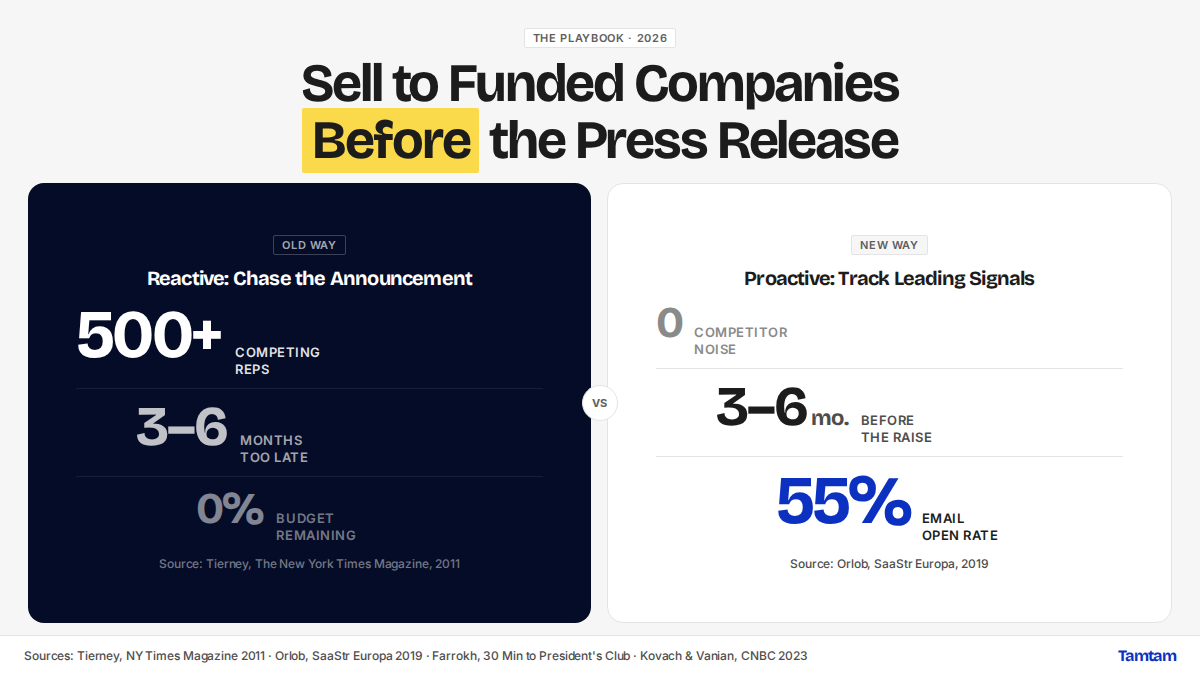
Treating a funding announcement as a buy signal is a strategic trap, as it's a lagging indicator of decisions made months earlier. Newly funded executives are exhausted and facing a flood of vendors, while the new capital is already pre-allocated based on their pitch deck's 'Use of Funds' plan. The winning playbook involves front-running the money by tracking leading indicators, like the hiring of a fractional CFO, to engage prospects when urgency is high and competition is non-existent.
The B2B sales world has a collective delusion.
Everyone thinks a funding announcement is a starting gun. A signal flare that a company is suddenly flush with cash and desperate to buy your software. You see the news pop up on your feed and you think, "This is it. They're my perfect customer now."
So you fire off your template: "Hey {first_name}, saw the big news, congrats on the round! Companies like yours use our platform to scale. Got 15 minutes?"
Then you wait. And you get nothing. Crickets.
You’re showing up to the party after the music has stopped, the bar is closed, and the cleaners are mopping the floor. You're wondering why nobody wants to talk to you. Here's the brutal truth: the funding announcement isn't the starting line. It's the finish line. A funding round is a real buying signal, but only if you catch the leading indicators, not the press release. And you just lost the race before you even knew it started.
It's time to stop reacting to old news and start anticipating the future. Here’s how.
Let's get one thing straight. You have to accept that the "Congrats on the round!" email is dead on arrival. A public funding announcement is a historical artifact, not a live sales trigger. By the time it hits the press, you are catastrophically late.
This reactive approach is killing your pipeline for three core reasons. Internalize them, and you can start to fix your broken process.
You think that new pile of cash is a free-for-all budget. It's not. Venture capitalists don't hand over a duffel bag of money and say, "Have fun, call us next year."
Before a single dollar was wired, the company's founders spent months building a detailed financial model. That model includes a "Use of Funds" plan. It’s a spreadsheet that dictates exactly where every dollar of that new capital is going: X% for new hires, Y% for marketing spend, and Z% for the exact software and tools they need to hit their growth targets.
Your competitor was likely evaluated, demoed, and baked into that financial model three to six months ago. That budget was allocated and locked in to secure the funding. If you weren't in the model, you're not in the budget. It's that simple.
Picture the executive you're trying to reach. Do you think they’re feeling energized and adventurous after closing a round? Hell no.
They just survived months of grueling due diligence. They've been picked apart by investors, worked 100-hour weeks, and lived in a state of high-stakes stress. They are cognitively and emotionally drained. Psychologists call this "decision fatigue," a state where the quality of your decisions deteriorates after a long session of decision-making.
Now, in this depleted state, their inbox is hit by a tsunami of 500 other reps sending the exact same "congrats" email. Their brain, desperate for the path of least resistance, defaults to the easiest options:
Your brilliant, disruptive solution is just more noise to an overstimulated brain. More work. More risk. They're not looking for new ideas; they're looking for a nap.
The biggest mistake is believing more money automatically equals an open-minded buyer. The reality is the opposite. More money means more pressure from the board, more scrutiny on every dollar spent, and far less tolerance for unproven vendors who showed up late with a generic pitch.
You need to feel the dawning horror of this. Realize that a core tenet of your prospecting strategy is fundamentally, strategically flawed. Good. Now you're ready for a better way.
Elite sellers don't react to news. They anticipate needs.
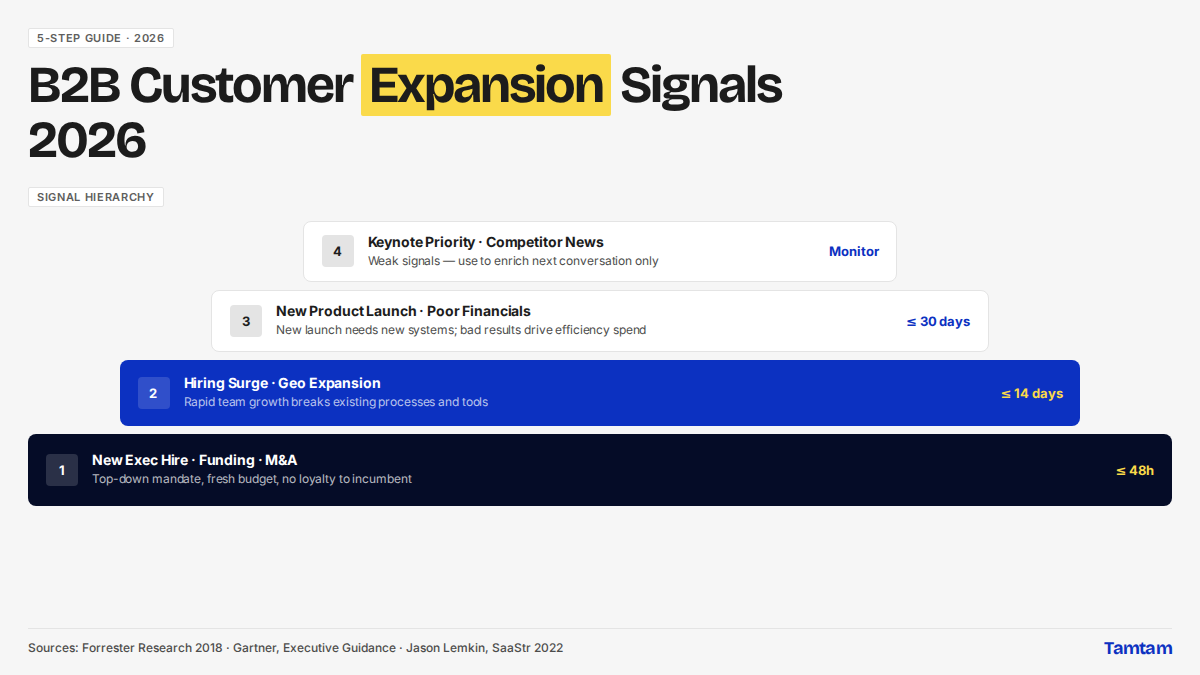
This requires a fundamental shift in your thinking. You need to move from lagging indicators (the funding announcement) to leading ones. Leading indicators are the organizational moves a company makes when it’s preparing to grow and raise capital. These are your real buying signals, and they appear months before any money changes hands.
Here are two of the most powerful leading indicators you can track right now.
A company approaching a Series A or Series B financing round almost always brings in outside help to get its books in order. They often hire a fractional CFO three to six months before they start seriously pitching VCs.
Why is this your golden ticket? Because the fractional CFO's explicit job is to professionalize the company's finances for investor scrutiny. They audit existing systems, identify gaps, and build the financial model that becomes the "Use of Funds" plan.
Their mandate is literally to find and recommend the tools needed to look like a well-oiled machine. If you sell finance software, compliance tools, or HR platforms, this person is your champion. Get to them when they're building the plan, and you become part of the plan. You’re not fighting for a budget; you’re helping create it.
A company hiring its first-ever VP of Sales is a massive buying signal. (That overlaps two signals: a fresh hire, often a champion who just moved.) It’s a declaration of intent: "We are about to pour fuel on the fire and scale our revenue engine."
This single hire creates a cascade of immediate needs. The new VP needs a solid CRM, sales enablement tools, forecasting software, conversation intelligence, and reliable data platforms. They have a 90-day window to show results, and they can’t do it with a messy tech stack.
Gong famously built a massive pipeline by targeting this one specific trigger. Their former Chief Strategy Officer, Chris Orlob, reported that emails targeting this signal saw a 55% open rate. Why? Because they engaged at the precise moment of maximum pain and urgency. The message wasn't "buy our stuff," it was "we know the hell you're about to walk into, and we can help."
The mistake is finding these gold-plated triggers and then treating them like cheap aluminum. You identify the new VP of Sales, the perfect signal, and then you dump them into the same generic outreach sequence as everyone else. The trigger isn't just a reason to reach out; it's the entire context for the conversation. Using a powerful trigger to send a low-effort message is like having the keys to a Ferrari and using it to haul garbage. It completely misses the point and wastes the opportunity.
So, you’ve identified a real trigger. You’re months ahead of the competition. Now what?
Your outreach has to evolve. The trigger isn't an excuse to celebrate. It's the context for their pain. Your message must connect the dot between the event you observed and the specific operational chaos it’s creating inside their business.
Sales leader Armand Farrokh has a brilliant framework for this. It’s about leading with their problem, which you’ve intelligently inferred from the trigger.
Let's use the "new VP of Sales" trigger as an example.
Bad Outreach (What Everyone Else Does):
Subject: Congrats!
Hey Sarah,
Saw you just joined Acme Corp as the new VP of Sales, congratulations on the new role!
Companies use our platform to improve sales performance. Want to see a demo next week?
This is awful. It's generic, self-centered, and adds zero value. It forces the recipient to do all the work to figure out why they should care. They won’t. Delete.
Good Outreach (What You Will Do):
Subject: First 90 days at Acme Corp
Hi Sarah,
Noticed you recently came on board to lead the sales team.
Typically, when a new leader steps in, the first 90 days are a scramble to fix territory planning, standardize sales onboarding, and build a forecast you can actually trust, all with a messy CRM.
We help new VPs get a quick win on the board by automating pipeline analytics, which usually frees up enough time to focus on coaching and strategy in the first quarter.
See the difference? This message demonstrates that you understand their world. You’ve identified the trigger (new role) and connected it directly to the probable pains (territory planning, onboarding, forecasting). You aren’t selling a product; you're offering a solution to a problem they are almost certainly facing right now.
The most common mistake is leading with your product. Nobody cares about your product. They care about their problems. The trigger gives you an educated guess about their most urgent problem. Lead with that. Your product is just the proof that you can solve it.
Sometimes, even if you identify the right trigger and send the perfect message, the game is rigged from the start. You need to develop a healthy paranoia and learn to spot deals that are unwinnable, so you can disqualify them early and focus your energy elsewhere.
Many VCs don't just provide capital. They provide an ecosystem. This often includes a list of preferred vendors or portfolio-wide deals for essential software. All their portfolio companies might get a huge discount on AWS, a specific HR platform, or a particular CRM.
In some cases, the funding is even unofficially contingent on using certain tech from the VC's "approved" list. They do this to standardize reporting, leverage their network, and sometimes because they're investors in those vendor companies, too.
If you’re selling against a vendor that has an inside track with the company's lead investor, your odds of winning are slim to none.
For a macro example of this, look at OpenAI's massive "funding rounds." Much of that capital wasn't cash; it was pre-committed vendor credits from strategic investors like Microsoft for Azure cloud computing.
While that's an extreme case, the same dynamic plays out at a smaller scale in every Series A and B round. The question you have to ask is: "Is their lead investor also an investor in my main competitor?"
This is not a reason to give up. It's a reason to be smart. When you see a funding announcement (even if you're already in the deal), do this 2-minute check:
If you see a clear conflict, your deal just got 10x harder. It doesn't mean it's impossible, but you need to be realistic. Wasting six months chasing a deal that was lost because of back-channel politics is the ultimate pipeline killer. Qualify out ruthlessly and move on to an account where the game isn't rigged against you.
Stop being a sales archeologist, digging up old news and wondering why you're not finding treasure. Become a sales futurist. The best reps don't chase headlines; they see the patterns that create them. But let's be honest: manually tracking these leading indicators across your entire market is a full-time job you don't have. It's an operational nightmare. The modern playbook isn't about more brute force; it's about starting with a better list built on this exact philosophy. A platform like Tamtam learns the unique triggers from your past wins and continuously finds prospects showing the same early signals, letting you win deals before your competition even knows a game is being played.
Set up for you before our first call
Book a demo