June 17, 2026
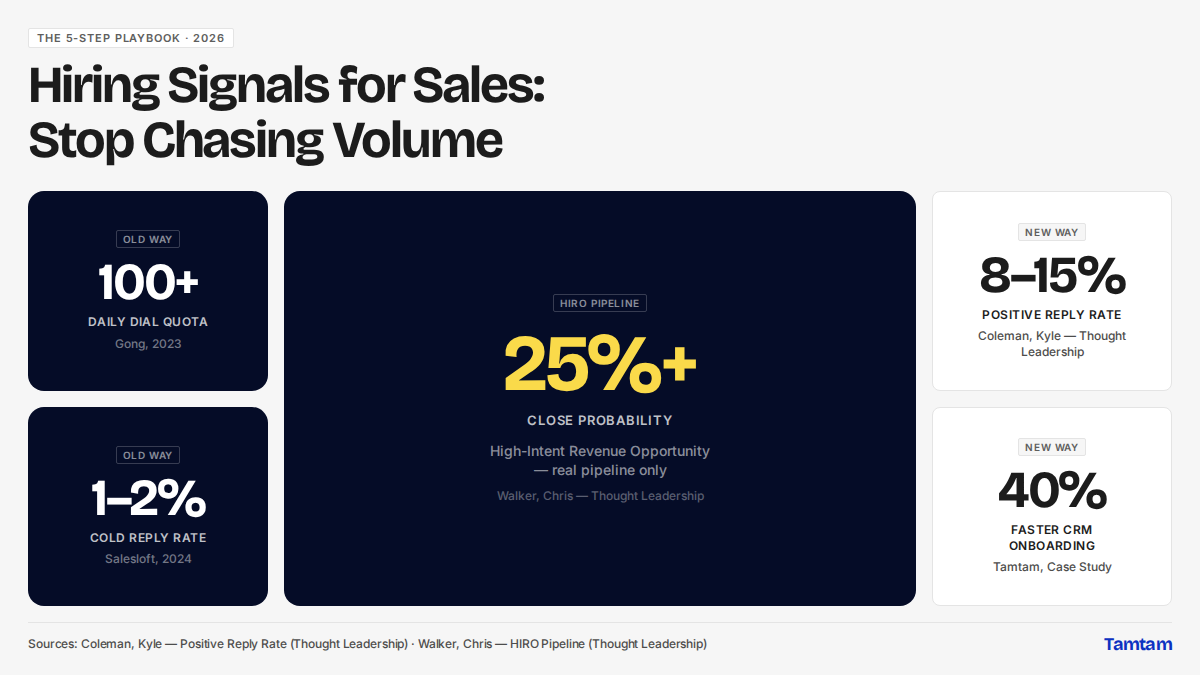
Hiring signals from job postings are a powerful source of buyer intent, but most sales teams can't leverage them because their culture rewards high activity over thoughtful outreach. This playbook shows how to fix the problem by replacing vanity metrics with measures of engagement, like positive reply rates. You'll learn how to identify high-intent job posts, decode the specific business pain behind them, and craft outreach that earns a response.
Everyone’s talking about “signal-based selling.” It’s the hot new thing at every sales conference, the subject of a million network posts, the magic bullet that’s supposed to fix your broken pipeline.
And yet, almost no one is doing it right.
Why? Because the very metrics your sales managers use to measure “productivity” actively punish the research and thoughtfulness required to act on a real buying signal. We tell our reps to "be relevant" and "add value," then we stick them in front of a dashboard that only celebrates one thing: volume.
Dials made. Emails sent. Talk time logged.
It's a system designed to reward looking busy over being effective. It forces reps into a terrible choice: either spend an hour researching one perfect account and look like a slacker, or hammer out 100 generic emails and get a gold star on the leaderboard.
You want to use hiring signals to find buyers with their wallets already open? Great. But first, you have to fix the broken system that’s stopping you. Hiring is just one of many buying signals; the discipline to act on it is what's rare.
Before you look for a single signal, you have to destroy the culture that rewards mindless volume. I’m talking about the public leaderboards, the daily dial quotas, the talk-time trophies. These are vanity metrics, pure and simple. They create a culture of pseudo-productivity where reps optimize for activity, not outcomes.
You cannot run a signal-based motion on a volume-based sales floor. The two are fundamentally at odds. One requires patience, research, and precision. The other demands speed, repetition, and a complete disregard for context.
Imagine this. It's Day 1 for a new VP of Sales. She walks into the sales pit, looks at the giant TV screen displaying the daily call leaderboard, unplugs it, and walks away. Panic ensues. The CRO starts sweating. "How will we know if they're working?"
The VP replaces the old dashboard with two new metrics: "Signal Coverage" (what percentage of our priority accounts have we researched for buying signals this month?) and "Positive Reply Rate" (what percentage of our outreach is generating genuine interest?). For a week, the activity numbers plummet. It looks like the team is doing nothing. But then, something happens. The number of qualified meetings booked starts to climb. Then it doubles. Pipeline value skyrockets.
The team wasn't being lazy. They were finally being effective. They were given the space to stop looking busy and start closing deals.
Common Mistake to Avoid: Trying to have it both ways. You can't tell your team to “be thoughtful and hyper-relevant” while also demanding they hit a 100-dial-a-day quota. That’s like telling a chef to prepare a Michelin-star meal using only a microwave. Pick one. You’re either a factory that values widgets produced, or you’re a special forces unit that values targets neutralized.
Once you've cleared the cultural debris, you can start the real work. It's time to stop thinking like a list-scraper and start thinking like a detective.
Not all job postings are created equal. Your goal isn't to find any company that's hiring. It's to find companies hiring for roles that directly precede a purchase of your product. This requires you to understand the sequence of events that leads to a sale.
If you sell sales software, a "VP of Sales" or "First SDR Hire" posting is a massive flare in the night. The new leader will have a budget and a mandate to build or fix a tech stack. (When that leader is an existing champion who just moved, it's even warmer.)
If you sell cybersecurity, a "Chief Information Security Officer" posting at a company that's never had one before is a five-alarm fire of intent. It means they just got a wake-up call, maybe from a breach, a new compliance requirement, or a board-level directive. They are actively looking to solve a huge, expensive problem.
Here’s how to do it:
Common Mistake to Avoid: Treating all job postings as equal. Don't just download a list of every company hiring a "Sales Manager." The context is everything. A 10,000-person company hiring another sales manager is incremental. A 50-person startup hiring its very first sales manager is transformational. Focus on the transformation.
A job description is not a piece of HR fluff. It's a public confession. It's a detailed, multi-page document outlining a specific business problem, signed by the hiring manager, and approved by the finance department.
The "Responsibilities" and "Requirements" sections are a treasure map pointing directly to the pain the hiring manager is feeling right now. Your job is to read between the lines and diagnose the underlying disease, not just the symptom.
Let's take a real-world example. A company posts a job for a "Director of Revenue Operations." Don't just see the title. Read the bullet points.
This isn't a simple request for a new employee. It's a cry for help.
Decoding the pain:
Now you know exactly what problems to talk about. You're no longer selling a "CRM implementation service." You're selling a way to fix their chaotic tech stack, give their leadership clear visibility, and make their reps more productive. (A job post that names a tool is also a tech-stack signal.)
Common Mistake to Avoid: Just mentioning the job post. "Saw you're hiring a Director of RevOps..." is lazy and instantly marks you as a generic spammer. Anyone can do that. Your job is to connect the specific responsibilities in that job posting to a specific problem you solve. That's the difference between noise and relevance.
You have your target. You've decoded their pain. Now it's time to pull the trigger. But this isn't a machine gun. It's a sniper rifle. One shot, one kill.
Your outreach needs to prove, in the first two sentences, that you have done your homework. The best way to do this is by referencing the specific language they used in their own job description. It shows you're not just another bot scraping titles; you're a peer who understands their world.
Let's illustrate with two reps: Chad, the volume jockey, and Sarah, the sniper.
Chad's goal is to hit 250 emails today. He pulls a list of "Director of RevOps" contacts and blasts a template that goes something like: "Hi {first_name}, as a leader in RevOps, you're probably focused on optimizing your sales process. Our tool helps with that. Got 15 mins?" Delete.
Sarah's goal is to book one great meeting. She spends 25 minutes on that single RevOps job post. Her email to the VP of Sales looks like this:
Subject: a thought on your new RevOps Director role
Hi [VP of Sales Name],
Saw the job posting for your new Director of RevOps. The focus on migrating from legacy systems to a unified CRM really stood out.
Teams we've worked with during a similar transition often struggle with getting reps to adopt the new platform while keeping sales velocity high. We helped [Similar Company] cut their new CRM onboarding time by 40% and actually increase deal velocity during the migration.
If managing that transition is a priority, happy to share the framework they used.
Best, Sarah
See the difference? Chad's email is about him. Sarah's is about the VP's stated problem. It's specific, relevant, and helpful. It doesn't ask for time; it offers value. Which one do you think gets the reply?
In the old, volume-based world, Sarah gets punished. Her manager sees she only sent one email and puts her on a performance plan. Chad gets praised for his "hustle." This is insanity. This is why you had to burn the dashboard first.
Common Mistake to Avoid: Automating the un-automatable. Using technology to find hiring signals is smart. Using a generic AI writer to then craft an email that says, "I saw your job post for X..." is just scaling bad behavior faster. The research part is human. The empathy is human. Don't automate the very thing that makes you valuable.
You burned the old dashboard. Now you have to build the new one. This is how you prove to your boss, your board, and yourself that this new way of working is superior. You need to track the metrics that prove your signal-based strategy is working.
Stop obsessing over leading indicators that don't indicate anything useful. Dials, emails, talk time... these are metrics of effort, not progress. Instead, build your new dashboard around metrics of engagement and real pipeline.
Here's what to track:
When you measure these things, the conversation with leadership changes. You're no longer defending a dip in call volume. You're pointing to a spike in positive replies and a healthier, higher-converting pipeline. You're talking about revenue, not just activity.
Common Mistake to Avoid: Panicking and reverting to the old metrics during a slow week. There will be dips. Trust the process. The lagging indicators (closed-won revenue) will eventually prove that your new leading indicators (positive replies, quality meetings) were the right things to focus on all along.
Shifting to a signal-based approach isn't just about learning a new tactic. It's a fundamental change in how you view sales. Your job is no longer to hit an activity quota. Your job is to find companies with problems you can solve and start intelligent conversations with them. Job postings are simply one of the most honest, public, and high-intent places to find those problems. The challenge isn't finding the signals, but building a system that allows your reps to act on them with the care they deserve.
This is the problem Tamtam was built to solve. It automates the painful market research, scanning job posts, news, and dozens of other sources for the specific triggers you care about, to build a continuously refreshed list of high-intent accounts. It means your reps can stop hunting for clues and start having the conversations that actually lead to revenue.
Set up for you before our first call
Book a demo