June 17, 2026
When a champion changes jobs, most reps send a lazy congratulations and wait. This is a fatal mistake. New executives are under immense pressure and spend up to 70% of their new budget in the first 100 days. This playbook shows you how to act as a strategic ally, track champions proactively, and craft a 'Day 1 Lifeline' that turns job changes into your most predictable source of new revenue.
Your champion changing jobs isn't a networking event. It’s a coup.
They're not strolling into a new office looking for a "solution." They are marching in to win a political war in a new company. They have to prove their value, fast. They need to establish credibility, navigate new alliances, and avoid the landmines left by their predecessor.
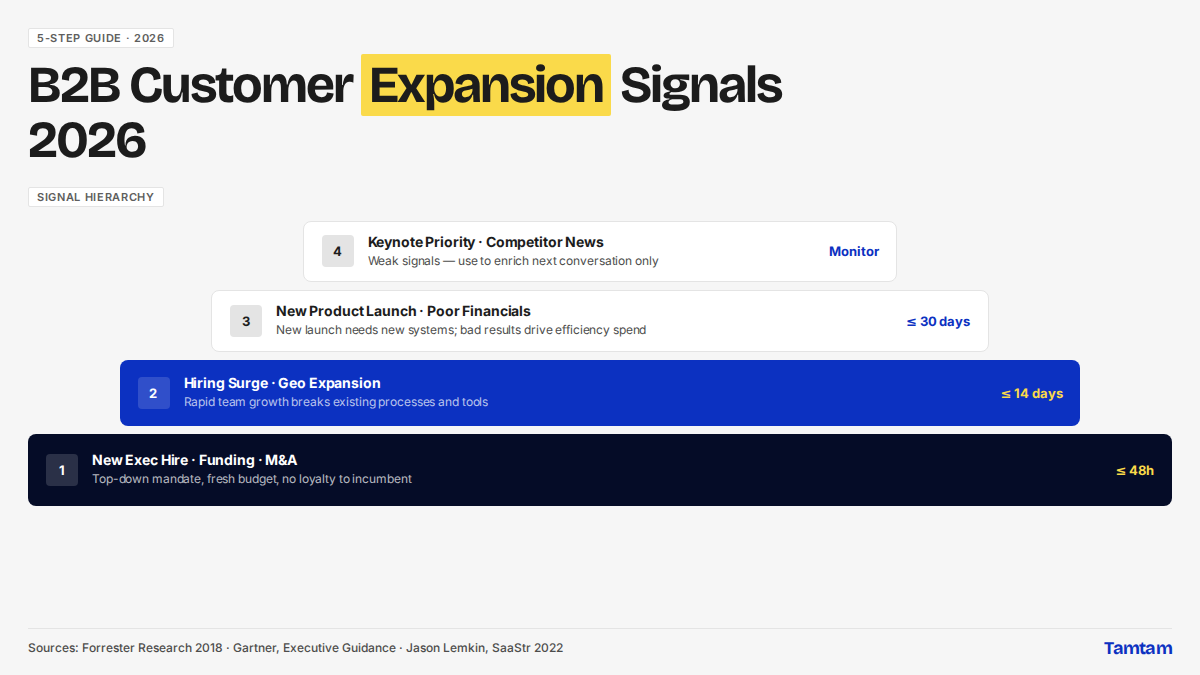
And what’s their first move? They import their personal army and their preferred weapons. (Building that team out shows up as hiring signals too.)
This is the core misunderstanding. We treat a job change like a simple sales trigger. We see a lead. They experience a high-stakes bid for survival. And in this moment of vulnerability, they don’t want a vendor. They want an ally. A job change is one of the highest-intent buying signals in B2B.
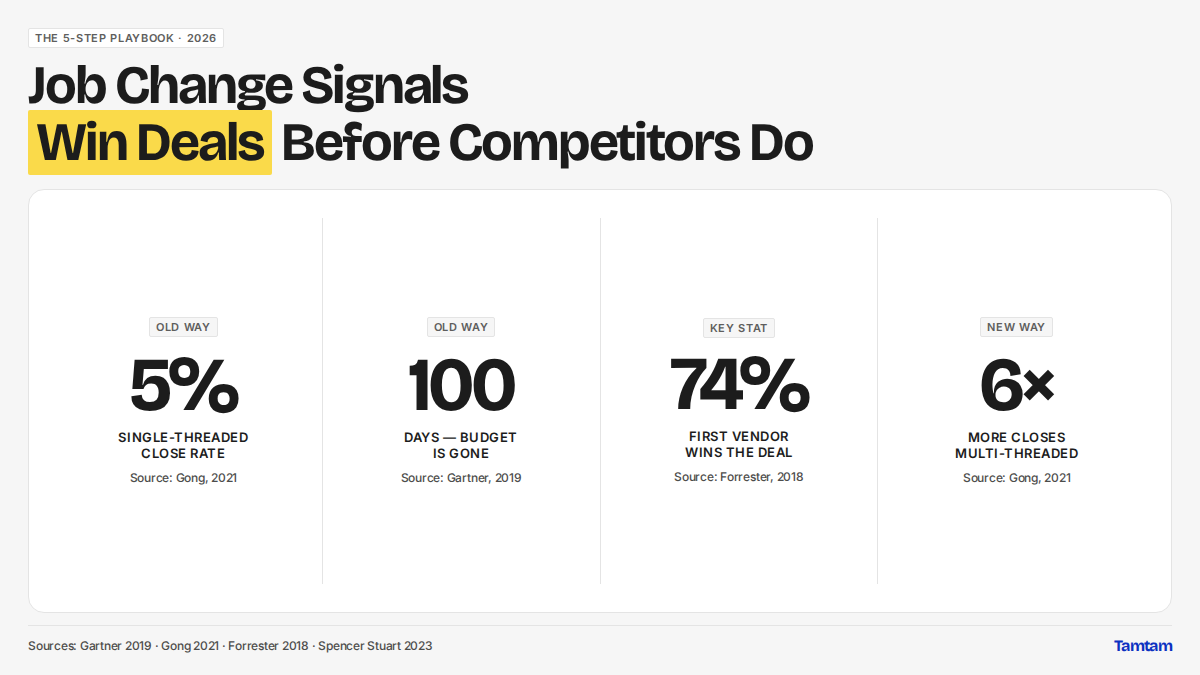
The data on this is brutal. According to Gartner, new executives spend up to 70% of their budget in the first 100 days. (Same urgency when a company lands a funding round: fresh budget, new priorities.) They are under immense pressure to deliver early wins. Waiting for them to "get settled" is a mathematical guarantee that you will lose. By the time they have a minute to breathe, their budget is gone, and their key decisions are made.
Great champions don’t buy features. They bring their "personal tech stack" with them. These are the trusted vendors who function less like suppliers and more like a shadow cabinet: a team of external experts who can help them mitigate risk, look smart, and secure a quick, visible victory.
Your goal is simple: be part of their cabinet. Acting like a polite, patient vendor isn't just slow. It's an act of political abandonment that costs you the deal and the relationship.
Why this matters: Single-threading your deals is lazy, and it will kill you. When your one and only contact walks out the door, your deal doesn't just stall. It dies. All that work, all those demos, gone. Your watchlist is your insurance policy.
What to do: Get proactive. For every single deal in your pipeline, active or closed, identify and tag not just your primary champion, but every advocate, influencer, and decision-maker involved.
Tag them in your CRM. Create a list. This isn't just about protecting the current deal. It's about building a portfolio of high-value relationships that you can take with you. This watchlist becomes your future prospect list.
The hard truth: Data from Gong shows that single-threaded deals have a measly 5% close rate. Multi-threaded deals? They close at a rate of 30%. That's a 6x difference. Your watchlist is the foundation of multi-threading, protecting your current revenue at the old account and creating your future revenue at the new one.
Common Mistake: Believing your amazing personal relationship with one person is enough to protect a six-figure deal. It’s not. People get re-orged, they quit, they get fired. Your relationship is an asset, but relying on it alone is just gambling with your quota.
Why this matters: The game is won or lost in the first 48 hours. If you find out about your champion’s move by casually scrolling your professional network's feed a week later, you are already catastrophically late.
What to do: Stop doing manual recon. This is a job for technology. Use modern tools that are built to give you real-time alerts when someone on your watchlist updates their job title or company. This isn't a "nice to have" anymore. It's table stakes for professionals.
The goal is to know about the move the moment it becomes public, and often even before your competitors' sales reps have finished their first coffee of the day.
The hard truth: According to Forrester, the first vendor to reach out and provide value wins the business an astounding 74% of the time. The first vendor. Not the best. Not the cheapest. The first.
Think about the difference. You can be the person who gets a private, automated alert the moment your champion’s profile changes. Or you can be one of the 200 other reps liking the "Congrats on the new role!" post three days later, desperately trying to get noticed in a sea of noise. One is a strategic move. The other is a public plea for scraps.
Common Mistake: Relying on your daily or weekly network scroll. It’s inconsistent, it’s slow, and it guarantees you’ll always be behind the curve. You're treating a high-value signal like random noise.
Why this matters: A new executive is drowning. They are buried in internal meetings, inherited problems, and pressure from the board. The absolute last thing they want is another vendor asking for "15 minutes to sync on their new priorities." It’s selfish, and it shows you don’t understand their reality.
What to do: Your first outreach must be generous. It should be a lifeline, not a sales pitch. It needs to offer a solution to their most immediate political problem: the need for an early, visible win.
The formula is simple: Context + Value - Ask.
You are not asking for their time. You are giving them a turnkey solution that makes them look good with minimal effort on their part.
The Tale of Two Reps:
Rep A (The Taker): "Hey Sarah, congrats on the new VP role! Awesome news. Would love to grab 15 minutes next week to learn about your new priorities and see if we can help."
Rep B (The Giver): "Hey Sarah, huge congrats on the move to Acme Corp! At your last company, we cut your team's onboarding time by 40%. I’ve already mapped out a 3-step playbook to replicate that quick win for your new team at Acme. Happy to send it over, no strings attached. Let me know if it's helpful."
Which one do you think gets a reply?
Common Mistake: Leading with a request for a meeting. It’s a dead giveaway that you care more about your pipeline than their success.
Why this matters: The moment your champion leaves, a power vacuum is created at their old company. And your competitors are genetically engineered to exploit that vacuum. If you aren't properly multi-threaded, they will use this event as the perfect excuse to rip and replace you.
What to do: The same day you reach out to your champion about their new role, you need to engage your other contacts at the old account. Your mission is two-fold:
A cautionary tale: Jason Lemkin of SaaStr often tells the story of how he lost a major logo. He had a great relationship with his champion. When that champion left for a new company, Lemkin played the polite friend, sending congrats and waiting. Meanwhile, his competitor immediately engaged the champion about their new role, became part of their "shadow cabinet," and simultaneously used the champion's departure from the old company to swoop in and replace Lemkin’s product. He got hit from both sides because he was slow and single-threaded.
Don't be that person. Defend your turf with the same urgency you use to chase the new opportunity.
Common Mistake: Focusing exclusively on the new opportunity and letting the existing account go dark. It's a rookie move that can cost you a renewal and give your competitor a powerful case study to use against you.
Why this matters: Sometimes, your champion will land at a company that is a terrible fit for your product. It might be too small, in the wrong industry, or in a country you don't serve. Pitching them anyway is the fastest way to burn a great relationship. It’s shortsighted and makes you look desperate.
What to do: Pivot from "sales rep" to "career ally." Do not pitch them. Instead, invest in the relationship with zero expectation of immediate return.
The hard truth: Executive tenure isn't what it used to be. The average CMO tenure, for example, is around 3.5 years according to Spencer Stuart. It's highly likely your champion will be back in your Ideal Customer Profile (ICP) within 24 months. By playing the long game, you ensure you are the very first person they call when they land their next role. You've proven you care about them as a person, not just a commission check.
Common Mistake: Jamming your square-peg enterprise solution into the round hole of their new 10-person startup. You look foolish, you damage the relationship, and you get a "no" that you absolutely deserved.
Ultimately, the difference between top performers and everyone else isn't a better script. It's a better diagnosis of the situation. They see job changes not as simple triggers, but as moments of acute vulnerability for a leader who desperately needs a trusted ally. Being that ally and delivering an early win is how you own an account before a formal buying process is ever announced. Of course, this entire playbook hinges on your ability to build those watchlists and detect those moves the second they happen. The manual work is the bottleneck. It’s why platforms like Tamtam were built: to automate the deep research on every person and account in your market, freeing your team to stop digging for signals and start acting on them with the speed and context that actually wins deals.
Set up for you before our first call
Book a demo